

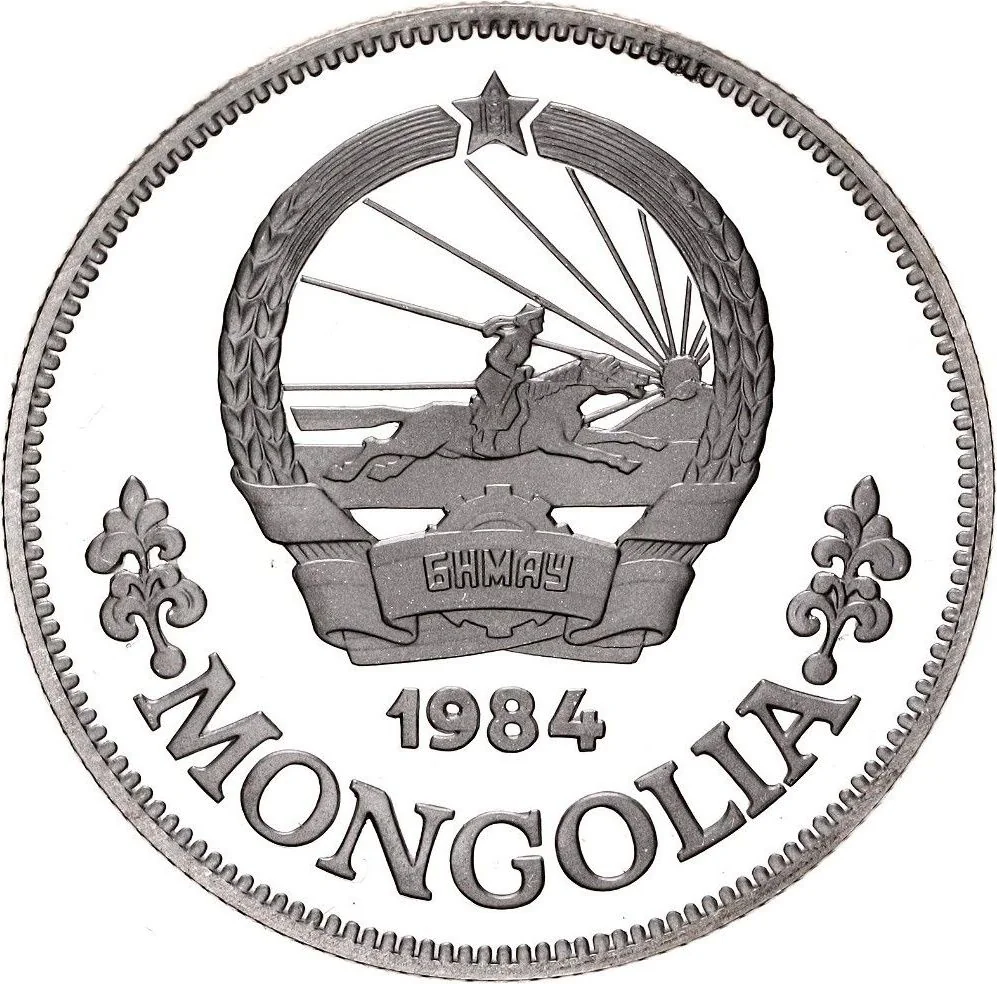
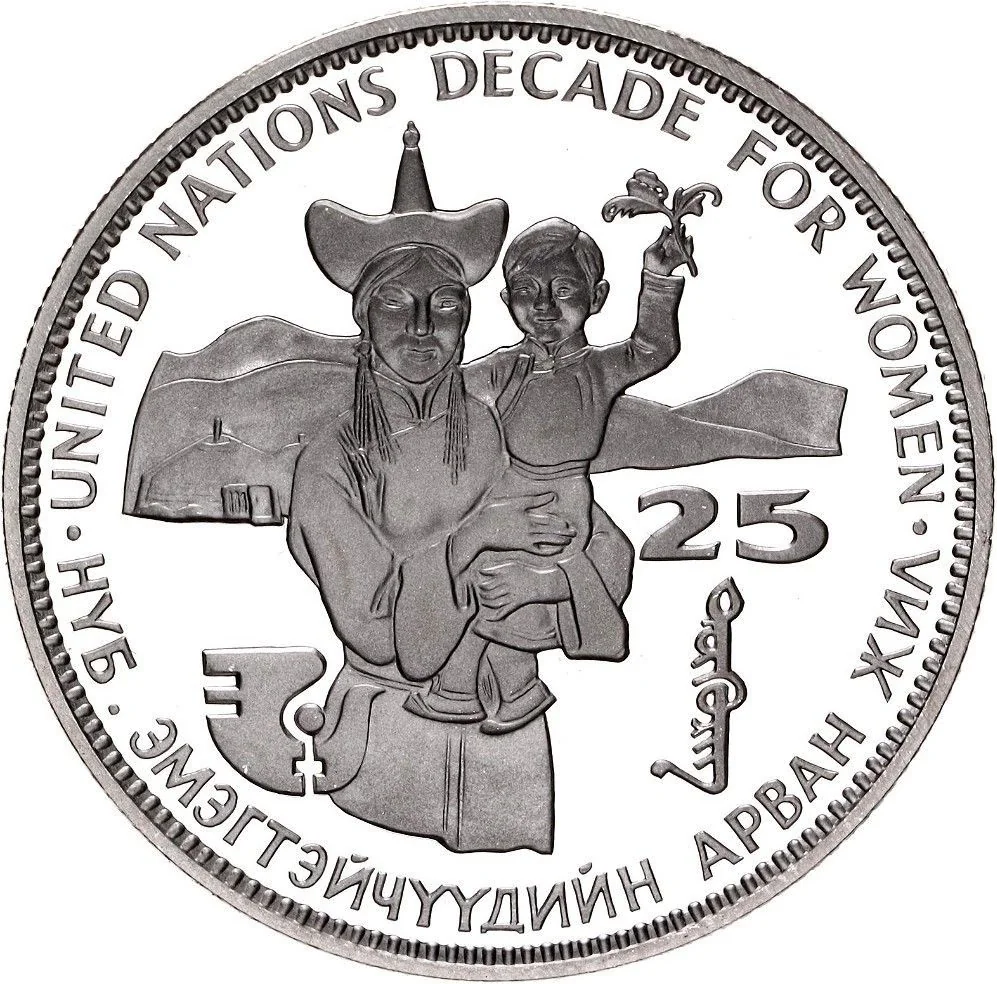
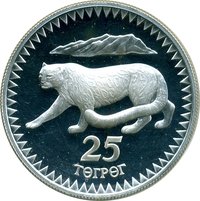
25 Tögrög – Mongolia
Non-circulating coins
Commemoration: Decade for Women
Mongolia
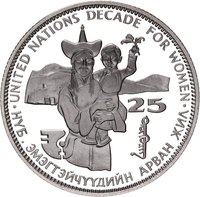
Obverse
Reverse
Edge
Reeded
Categories
| History> Feminism |
| Organization> United Nations |
Mints
| Name | Mark |
|---|---|
| Royal Mint | — |
Mintings
| Year | Mint Mark | Mintage | Quality | Collection |
|---|---|---|---|---|
| 1984 | — | 1,249 | Proof |
Historical background
In 1984, Mongolia's currency situation was entirely defined by its status as a satellite state of the Soviet Union and a member of the Council for Mutual Economic Assistance (COMECON). The national currency, the Möngö (MNT), operated within a rigid, centrally planned economy and was a non-convertible "soft currency." Its value was administratively set by the State Bank of Mongolia and had no meaningful link to market forces or major world currencies. Internally, it functioned as an accounting unit for the state plan, but its purchasing power and utility were heavily constrained by chronic shortages of consumer goods and a pervasive rationing system.
Externally, Mongolia's trade and currency relations were almost exclusively oriented toward the Soviet bloc. The vast majority of its trade—primarily exports of raw materials like copper, cashmere, and livestock products in exchange for Soviet petroleum, machinery, and consumer goods—was conducted through bilateral clearing agreements using the Transferable Ruble, an artificial accounting currency for COMECON. This system insulated Mongolia from the global financial system but created deep dependency, as the MNT's stability was wholly underpinned by Soviet subsidies and concessional loans, which by the 1980s accounted for a significant portion of the state budget.
Consequently, there was no active foreign exchange market, and the official exchange rate (approximately 3.5 MNT to 1 USD) was a symbolic figure with little practical use for ordinary citizens or businesses. Access to hard currencies like US dollars or Deutsche marks was severely restricted to a small state elite for diplomatic travel or specific import plans. This closed system masked growing economic inefficiencies and a mounting foreign debt, problems that would contribute to the profound currency and economic crises following the withdrawal of Soviet support at the decade's end.
Externally, Mongolia's trade and currency relations were almost exclusively oriented toward the Soviet bloc. The vast majority of its trade—primarily exports of raw materials like copper, cashmere, and livestock products in exchange for Soviet petroleum, machinery, and consumer goods—was conducted through bilateral clearing agreements using the Transferable Ruble, an artificial accounting currency for COMECON. This system insulated Mongolia from the global financial system but created deep dependency, as the MNT's stability was wholly underpinned by Soviet subsidies and concessional loans, which by the 1980s accounted for a significant portion of the state budget.
Consequently, there was no active foreign exchange market, and the official exchange rate (approximately 3.5 MNT to 1 USD) was a symbolic figure with little practical use for ordinary citizens or businesses. Access to hard currencies like US dollars or Deutsche marks was severely restricted to a small state elite for diplomatic travel or specific import plans. This closed system masked growing economic inefficiencies and a mounting foreign debt, problems that would contribute to the profound currency and economic crises following the withdrawal of Soviet support at the decade's end.
✨ Legendary