

5 fils – Iraq
Add to wishlist
Circulating commemorative coins
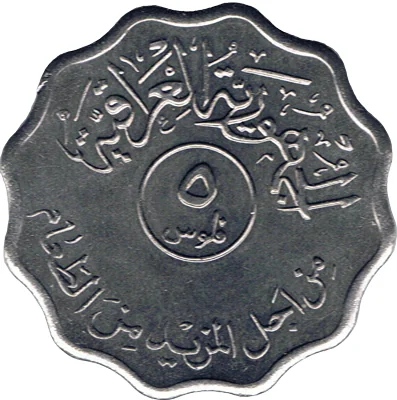
Commemoration: F.A.O.
Iraq
Context
Year: 1975
Islamic (Hijri) Year:: 1395
Issuer: Iraq
Period:
(since 1958)
Currency:
(since 1931)
Demonetized: Yes
Total mintage: 2,000,000
Material
Diameter: 21.96 mm
Weight: 4.03 g
Thickness: 1.62 mm
Shape: Scalloped
Composition: Stainless steel
Technique: Milled
Alignment: Medal alignment
flip
References
KM: #
Numista: #7977
Value
Exchange value: 0.005 IQD
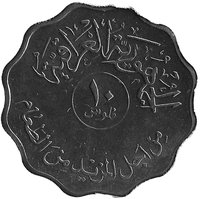
Obverse
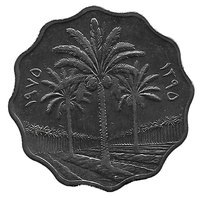
Reverse
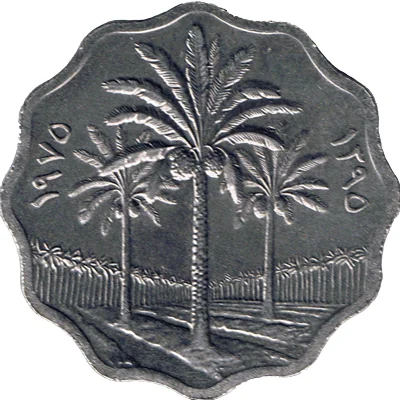
Description:
Three palms
Inscription:
١٣٩٥ ١٩٧٥
Translation:
1395 1975
Script: Arabic
Engraver: Geoffrey Colley
Edge
Plain
Categories
| Organization> FAO |
Mints
| Name | Mark |
|---|---|
| Royal Canadian Mint of Winnipeg | — |
Mintings
| Year | Mint Mark | Mintage | Quality | Collection |
|---|---|---|---|---|
| 1975 | — | 2,000,000 |
Historical background
In 1975, Iraq's currency, the Iraqi dinar (IQD), was in a period of relative strength and stability, underpinned by the nation's booming oil economy. Following the nationalization of the Iraq Petroleum Company in 1972, state revenues from oil exports surged dramatically. This influx of petrodollars provided the government of the Ba'ath Party, led by President Ahmed Hassan al-Bakr (with Saddam Hussein as his deputy), with substantial foreign exchange reserves. Consequently, the dinar was pegged to a strong basket of currencies, effectively tied to the British pound and the US dollar, and was considered one of the most valuable currencies in the region.
This economic strength allowed for ambitious state-led development and industrialization projects, as outlined in the 1975-1979 National Development Plan. The government invested heavily in infrastructure, agriculture, and social services, funded without the need for significant foreign borrowing. The currency's stability facilitated these imports of technology and goods, contributing to a period of notable economic growth and urbanization. Internally, there was little pressure on the dinar, as confidence in the currency was high and inflation was controlled by state subsidies and price controls on essential goods.
However, this apparent stability was fragile and politically managed. The economy was overwhelmingly dependent on a single commodity—oil—making it vulnerable to global price shocks. Furthermore, the prosperity was not evenly distributed, and the state's authoritarian control masked underlying tensions. The situation would change drastically before the decade's end, as the combination of massive military spending during the Iran-Iraq War (beginning in 1980) and a subsequent drop in oil prices would deplete reserves, lead to heavy borrowing, and ultimately trigger a severe devaluation of the dinar, erasing the stability witnessed in 1975.
This economic strength allowed for ambitious state-led development and industrialization projects, as outlined in the 1975-1979 National Development Plan. The government invested heavily in infrastructure, agriculture, and social services, funded without the need for significant foreign borrowing. The currency's stability facilitated these imports of technology and goods, contributing to a period of notable economic growth and urbanization. Internally, there was little pressure on the dinar, as confidence in the currency was high and inflation was controlled by state subsidies and price controls on essential goods.
However, this apparent stability was fragile and politically managed. The economy was overwhelmingly dependent on a single commodity—oil—making it vulnerable to global price shocks. Furthermore, the prosperity was not evenly distributed, and the state's authoritarian control masked underlying tensions. The situation would change drastically before the decade's end, as the combination of massive military spending during the Iran-Iraq War (beginning in 1980) and a subsequent drop in oil prices would deplete reserves, lead to heavy borrowing, and ultimately trigger a severe devaluation of the dinar, erasing the stability witnessed in 1975.
🌱 Common