

250 Dirhams – Morocco
Non-circulating coins
Commemoration: Marriage of King Mohammed VI
Morocco
Context
Material
References
Y: #Click to copy to clipboard113
Numista: #79411
Value
Exchange value: 250 MAD
Bullion value: $67.02
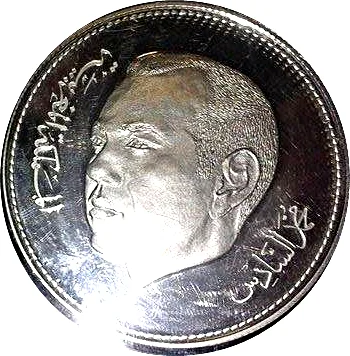
Obverse
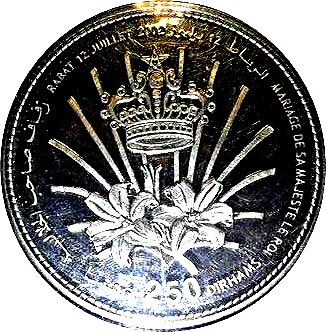
Reverse
Description:
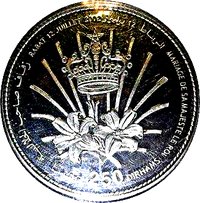
The royal wedding lily, featuring two open flowers and a bud in a radiant glow beneath a crown, is encircled by these words.
Inscription:
زفاف صاحب الجلالة RABAT12JUILLET 2002الرباط 12يوليوز MARIAGE DE SA MAJESTE LE ROI
250 DIRHAMS
250 DIRHAMS
Translation:
Wedding of His Majesty RABAT12JULY 2002 Rabat 12 July Wedding of His Majesty The King
250 Dirhams
250 Dirhams
Edge
Reeded
Categories
| Marriage |
Mintings
| Year | Mint Mark | Mintage | Quality | Collection |
|---|---|---|---|---|
| 2002 | — | — | Proof |
Historical background
In 2002, Morocco's currency situation was defined by a tightly managed exchange rate regime. The Moroccan dirham (MAD) was pegged to a basket of currencies, heavily weighted toward the euro (then the European Currency Unit) and the US dollar. This policy, established in the 1980s, aimed to provide stability for trade and investment, particularly with the European Union, which was Morocco's dominant trading partner. The peg was actively managed by Bank Al-Maghrib (the central bank), which intervened in the foreign exchange market to maintain the dirham within an official, albeit unpublished, fluctuation band.
The year fell within a period of relative macroeconomic stability for Morocco, with low inflation and modest growth. However, the fixed exchange rate regime presented growing challenges. It limited the central bank's ability to use monetary policy independently to address domestic economic conditions, as interest rates were largely geared toward maintaining the peg. Furthermore, the system required significant foreign exchange reserves to defend the currency's value, which constrained economic policy options. Critics argued that the overvalued dirham hampered the competitiveness of Moroccan exports, a concern for a country seeking to integrate further into the global economy.
Consequently, 2002 was a point of ongoing debate about currency reform, setting the stage for future changes. While the peg provided short-term predictability, pressure was building from both international financial institutions and domestic reformers for a more flexible exchange rate to better absorb external shocks and enhance economic resilience. This dialogue ultimately led to a gradual shift; in 2018, Morocco transitioned to a more flexible exchange rate system, but in 2002, the long-standing, managed peg remained firmly in place as the cornerstone of monetary policy.
The year fell within a period of relative macroeconomic stability for Morocco, with low inflation and modest growth. However, the fixed exchange rate regime presented growing challenges. It limited the central bank's ability to use monetary policy independently to address domestic economic conditions, as interest rates were largely geared toward maintaining the peg. Furthermore, the system required significant foreign exchange reserves to defend the currency's value, which constrained economic policy options. Critics argued that the overvalued dirham hampered the competitiveness of Moroccan exports, a concern for a country seeking to integrate further into the global economy.
Consequently, 2002 was a point of ongoing debate about currency reform, setting the stage for future changes. While the peg provided short-term predictability, pressure was building from both international financial institutions and domestic reformers for a more flexible exchange rate to better absorb external shocks and enhance economic resilience. This dialogue ultimately led to a gradual shift; in 2018, Morocco transitioned to a more flexible exchange rate system, but in 2002, the long-standing, managed peg remained firmly in place as the cornerstone of monetary policy.

✨ Legendary