

1 Rupee – Bengal Presidency
India
Context
Years: 1802–1806
Country: India 
Issuer: Bengal Presidency
Ruler: George III
Currency:
(1765—1835)
Demonetized: Yes
Material
References
Numista: #79299
Value
Bullion value: $32.81
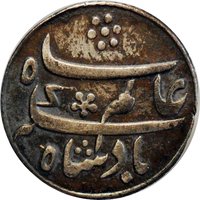
Obverse
Description:
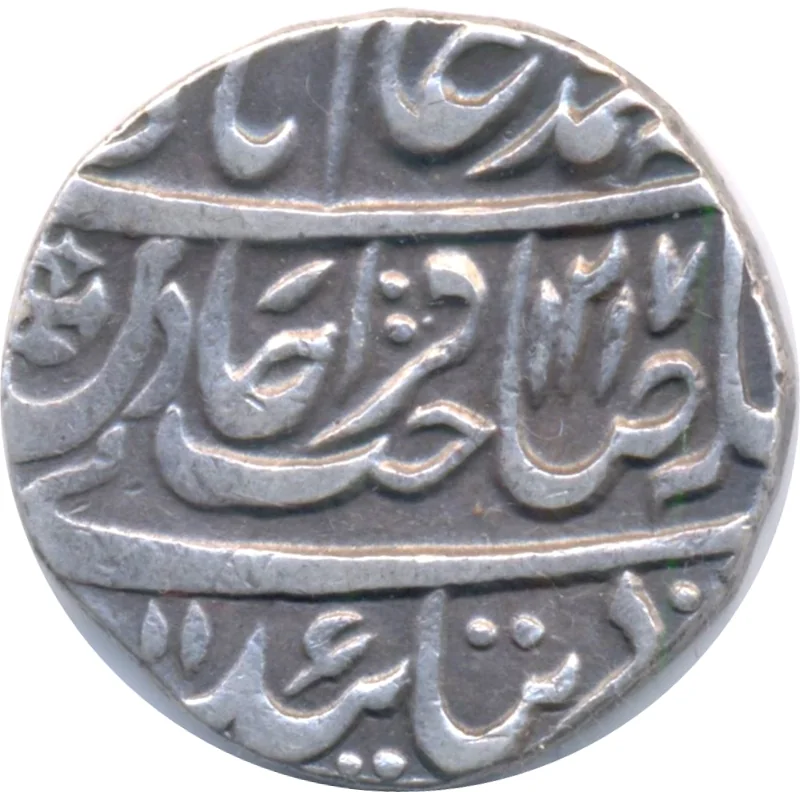
Sikka zad bar haft kishwar: "Fazl Ilah, Hami ud-din Muhammad Shah Alam Badshah" (AH 1217).
Inscription:
١٢١٧
Translation:
1217
Language: Arabic
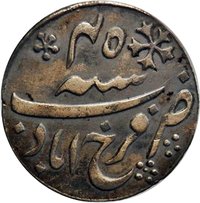
Reverse
Edge
Plain
Mints
| Name | Mark |
|---|---|
| Bareli | — |
Mintings
| Year | Mint Mark | Mintage | Quality | Collection |
|---|---|---|---|---|
| 1802 | — | — | ||
| 1803 | — | — | ||
| 1804 | — | — | ||
| 1805 | — | — | ||
| 1806 | — | — |
Historical background
In 1802, the Bengal Presidency's currency situation was characterised by a complex and often chaotic system of multiple, competing currencies. The official currency was the silver rupee, primarily the "Sicca" rupee minted in Calcutta, but its value and purity were under constant pressure from older, debased rupees still in circulation, such as the "Sonat" rupee. Furthermore, a severe shortage of small change plagued the economy, leading to the widespread use and cutting of damaged "pice" (copper coins) and even cowrie shells in rural markets, creating a disjointed system where daily transactions for the majority were separate from high-value Company and mercantile finance.
This monetary disorder was a direct concern for the East India Company's government, as it hampered revenue collection, trade, and administrative efficiency. The Company had attempted reform with the "Coinage Act of 1793," which aimed to standardise the rupee and introduce new copper coinage. However, by 1802, these efforts had met with limited success. Public distrust of new coins, the logistical difficulty of recalling old money, and the entrenched practices of shroffs (money-changers) who profited from the variability, all acted as significant barriers to creating a uniform currency.
Consequently, 1802 represents a point of ongoing struggle rather than resolution. The Presidency operated with a dual economy: a top layer of Company accounts and large-scale trade conducted in reckoned silver rupees, and a vast substratum of local bazaars and rural transactions reliant on a fragmented system of cut copper and primitive money. This instability would eventually lead to more decisive action, culminating in the major reforms of Lord William Bentinck in the 1830s, but in 1802, the monetary landscape remained fragmented and in need of effective centralised control.
This monetary disorder was a direct concern for the East India Company's government, as it hampered revenue collection, trade, and administrative efficiency. The Company had attempted reform with the "Coinage Act of 1793," which aimed to standardise the rupee and introduce new copper coinage. However, by 1802, these efforts had met with limited success. Public distrust of new coins, the logistical difficulty of recalling old money, and the entrenched practices of shroffs (money-changers) who profited from the variability, all acted as significant barriers to creating a uniform currency.
Consequently, 1802 represents a point of ongoing struggle rather than resolution. The Presidency operated with a dual economy: a top layer of Company accounts and large-scale trade conducted in reckoned silver rupees, and a vast substratum of local bazaars and rural transactions reliant on a fragmented system of cut copper and primitive money. This instability would eventually lead to more decisive action, culminating in the major reforms of Lord William Bentinck in the 1830s, but in 1802, the monetary landscape remained fragmented and in need of effective centralised control.
💎 Extremely Rare