

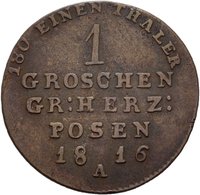
3 Groschens – Grand Duchy of Posen
Poland
Context
Years: 1816–1817
Country: Poland 
Issuer: Grand Duchy of Posen
Ruler: Frederick William III
Currency:
Demonetized: Yes
Material
References
KM: #Click to copy to clipboard31
Numista: #79072
Obverse
Description:
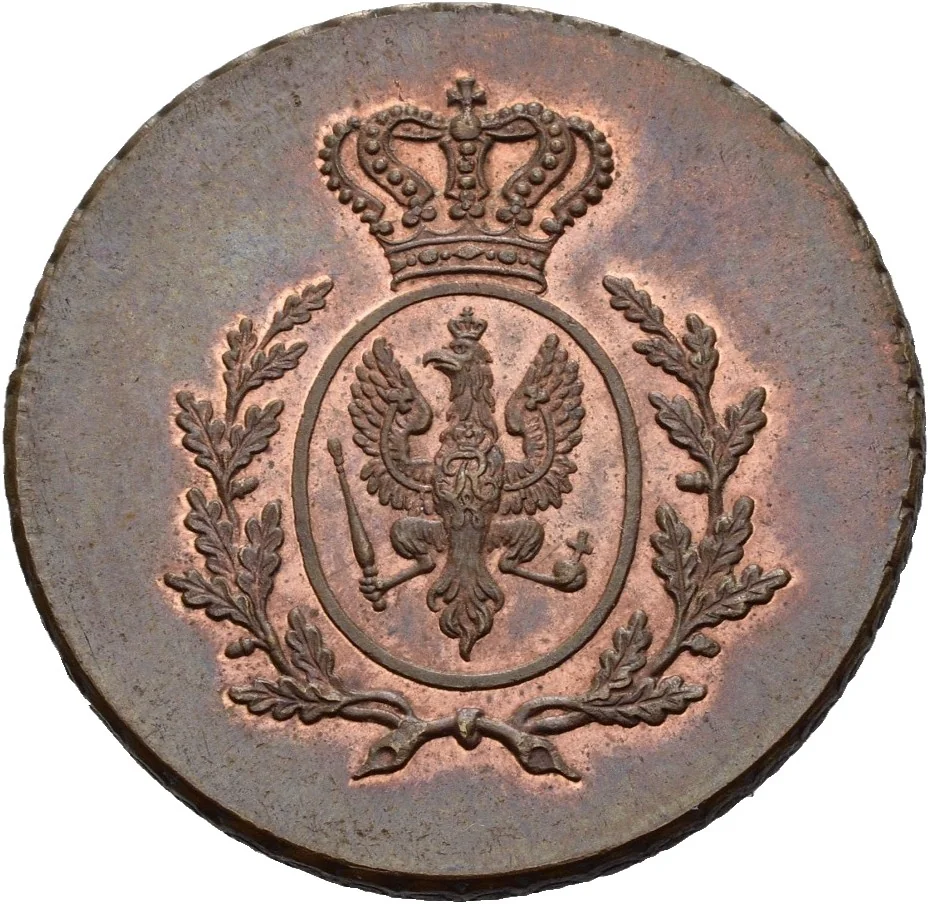
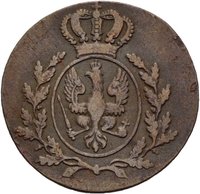
Prussian eagle with central FW monogram in an oval, crowned and wreathed with oak leaves.
Reverse
Edge
Ornament
Historical background
Following its creation at the Congress of Vienna in 1815, the Grand Duchy of Posen found itself in a complex monetary transition in 1816. This autonomous Polish polity within the Kingdom of Prussia inherited a chaotic currency landscape from the Napoleonic era, which saw a mix of obsolete Polish coins, Prussian thalers, and various foreign currencies, including Russian rubles and Austrian gulden, all circulating simultaneously. This multiplicity of coins, with fluctuating values and widespread counterfeiting, created significant confusion for daily commerce and hindered economic integration with Prussia.
The Prussian government, seeking to stabilize and control the economy of its new territory, initiated a formal currency unification in 1816. The key legislation was the Münzvereinigung (Coin Unification), which legally established the Prussian monetary system as the sole standard. The Prussian Thaler was declared the official unit of account, subdivided into 30 Silbergroschen, each of 12 Pfennige. This move was a clear step toward administrative and economic integration, aiming to simplify trade and tax collection by replacing the patchwork of old currencies.
However, the process in 1816 was one of proclamation rather than immediate realization. While the law was enacted, the physical replacement of the myriad old coins in public hands was a slow and logistical challenge. For several years, older coins remained in practical use, especially in rural areas, alongside the new Prussian issues. Thus, the currency situation in 1816 was defined by a new legal framework imposing order from above, while on the ground, a period of gradual and sometimes cumbersome transition from the old monetary fragmentation to the new Prussian standard was just beginning.
The Prussian government, seeking to stabilize and control the economy of its new territory, initiated a formal currency unification in 1816. The key legislation was the Münzvereinigung (Coin Unification), which legally established the Prussian monetary system as the sole standard. The Prussian Thaler was declared the official unit of account, subdivided into 30 Silbergroschen, each of 12 Pfennige. This move was a clear step toward administrative and economic integration, aiming to simplify trade and tax collection by replacing the patchwork of old currencies.
However, the process in 1816 was one of proclamation rather than immediate realization. While the law was enacted, the physical replacement of the myriad old coins in public hands was a slow and logistical challenge. For several years, older coins remained in practical use, especially in rural areas, alongside the new Prussian issues. Thus, the currency situation in 1816 was defined by a new legal framework imposing order from above, while on the ground, a period of gradual and sometimes cumbersome transition from the old monetary fragmentation to the new Prussian standard was just beginning.
💎 Extremely Rare