

50 rubles (Bashkiria joining Russia) – Russian Federation
Add to wishlist
Non-circulating coins
Commemoration: The 450th Anniversary of Voluntary Entering of Bashkiria into Russia
Russia
Context
Year: 2007
Country: Russia
Issuer: Russian Federation
Period:
(since 1991)
Currency:
(since 1998)
Total mintage: 1,500
Material
Diameter: 22.6 mm
Weight: 7.89 g
Gold Weight:: 7.88 g
Thickness: 1.3 mm
Shape: Round
Composition: 99.9% Gold
Standard: Silver quarter ounce
Magnetic: No
Technique: Milled
Alignment: Medal alignment
flip
References
Value
Exchange value: 50 RUB
Bullion value: $1210.92
Inflation-adjusted value: 235.86 RUB
Obverse
Description:
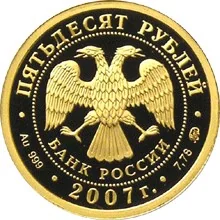
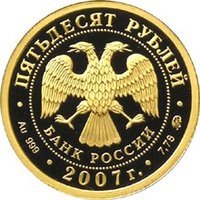
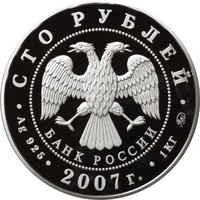
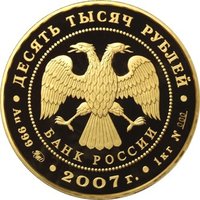
Central: Bank of Russia emblem (two-headed eagle, "БАНК РОССИИ") within a dotted circle.
Rim: Top – "ПЯТЬДЕСЯТ РУБЛЕЙ". Bottom left – metal and fineness, centre – "2007 г.", right – fine weight and mint mark.
Rim: Top – "ПЯТЬДЕСЯТ РУБЛЕЙ". Bottom left – metal and fineness, centre – "2007 г.", right – fine weight and mint mark.
Inscription:
ПЯТЬДЕСЯТ РУБЛЕЙ
БАНК РОССИИ
• Au 999 • 2007 г. • 7,78 ММД •
БАНК РОССИИ
• Au 999 • 2007 г. • 7,78 ММД •
Translation:
FIFTY RUBLES
BANK OF RUSSIA
• Au 999 • 2007 • 7.78 SPMD •
BANK OF RUSSIA
• Au 999 • 2007 • 7.78 SPMD •
Language: Russian
Designer and engraver: Alexander Vasilyevich Baklanov
Reverse
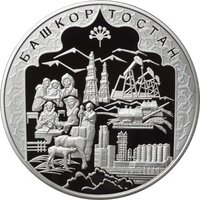
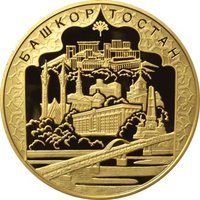
Description:
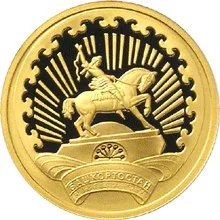
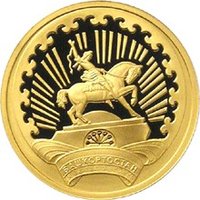
The coat of arms of the Republic of Bashkortostan.
Inscription:
БАШКОРТОСТАН
Translation:
Bashkortostan
Script: Cyrillic
Engraver: Alexey Igorevich Parfenov
Edge
134 corrugations
Mints
| Name | Mark |
|---|---|
| Moscow Mint | (ММД) |
Mintings
| Year | Mint Mark | Mintage | Quality | Collection |
|---|---|---|---|---|
| 2007 | ММД | 1,500 | Proof |
Historical background
In 2007, the Russian Federation's currency situation was characterized by robust strength and significant accumulation of reserves, marking the peak of a multi-year boom driven by high global commodity prices. The Russian ruble (RUB) experienced a sustained appreciation against a bi-currency basket of the US dollar and the euro, as the Central Bank of Russia (CBR) pursued a managed float policy. This policy involved regular interventions to curb excessive ruble strength, which threatened export competitiveness, leading to a steady increase in foreign exchange and gold reserves, which soared to a record $478.8 billion by year's end, making Russia the world's third-largest holder.
This financial strength was fundamentally underpinned by record-high prices for oil and natural gas, Russia's key exports. Urals crude oil averaged approximately $69 per barrel in 2007, flooding the state coffers with revenue and creating a large balance of payments surplus. The government's fiscal discipline, exemplified by the creation of the Stabilization Fund in 2004 (split into the Reserve Fund and National Welfare Fund in 2008), helped sterilize part of this petrodollar inflow, mitigating inflationary pressures. However, inflation remained a persistent concern, ending the year at 11.9%, driven by strong domestic demand, wage growth, and capital inflows.
Looking ahead, the prevailing sentiment in 2007 was one of optimism and stability, with the ruble increasingly seen as a symbol of Russia's economic resurgence. The focus was on continued liberalization of the currency regime, with discussions about making Moscow an international financial center and potentially easing capital controls. However, this apparent stability was built on a vulnerable mono-structural foundation. The global financial crisis, which began in 2008, would soon expose these vulnerabilities, triggering a sharp devaluation of the ruble, a dramatic fall in reserves, and a stark reversal of the trends that defined the seemingly prosperous currency situation of 2007.
This financial strength was fundamentally underpinned by record-high prices for oil and natural gas, Russia's key exports. Urals crude oil averaged approximately $69 per barrel in 2007, flooding the state coffers with revenue and creating a large balance of payments surplus. The government's fiscal discipline, exemplified by the creation of the Stabilization Fund in 2004 (split into the Reserve Fund and National Welfare Fund in 2008), helped sterilize part of this petrodollar inflow, mitigating inflationary pressures. However, inflation remained a persistent concern, ending the year at 11.9%, driven by strong domestic demand, wage growth, and capital inflows.
Looking ahead, the prevailing sentiment in 2007 was one of optimism and stability, with the ruble increasingly seen as a symbol of Russia's economic resurgence. The focus was on continued liberalization of the currency regime, with discussions about making Moscow an international financial center and potentially easing capital controls. However, this apparent stability was built on a vulnerable mono-structural foundation. The global financial crisis, which began in 2008, would soon expose these vulnerabilities, triggering a sharp devaluation of the ruble, a dramatic fall in reserves, and a stark reversal of the trends that defined the seemingly prosperous currency situation of 2007.
✨ Legendary