

50 Xu – South Vietnam
Vietnam
Context
Year: 1963
Country: Vietnam 
Issuer: South Vietnam
Ruler: Ngô Đình Diệm
Currency:
(1953—1975)
Demonetized: Yes
Total mintage: 20,000,000
Material
Diameter: 30 mm
Weight: 3.1 g
Thickness: 1.62 mm
Shape: Round
Composition: Aluminium
Standard: Gold tenth ounce
Magnetic: No
Technique: Milled
Alignment: Coin alignment
flip
References
KM: #Click to copy to clipboard6
Numista: #7866
Obverse
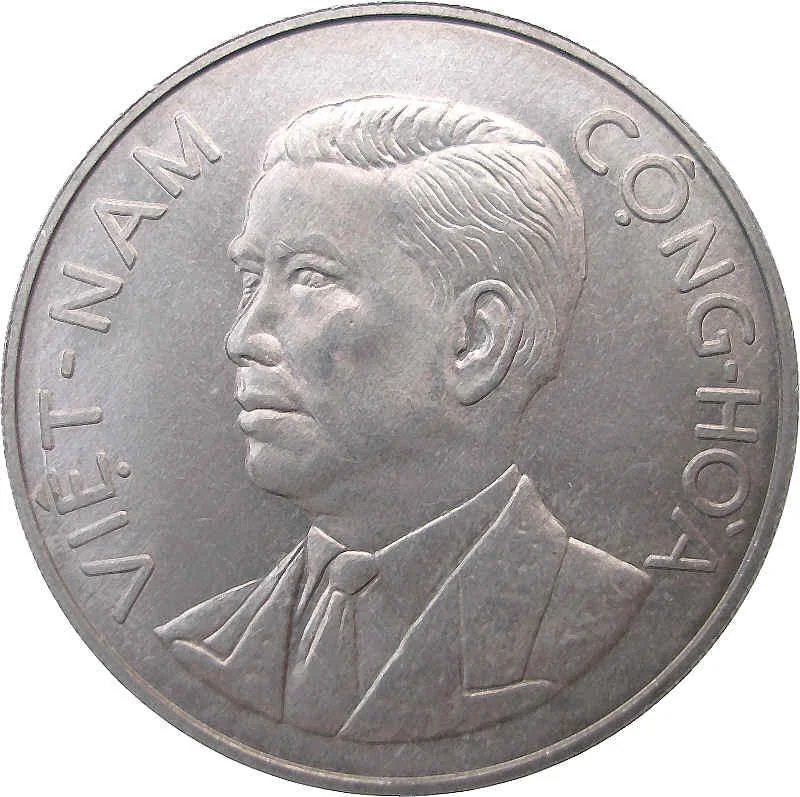
Description:
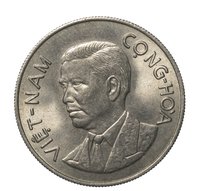
Ngo Dinh Diem (left), President of South Vietnam (1955-1963).
Inscription:
VIỆT-NAM CỘNG-HÒA
Translation:
SOCIALIST REPUBLIC OF VIETNAM
Script: Latin
Language: Vietnamese
Engraver: Norman Sillman
Reverse
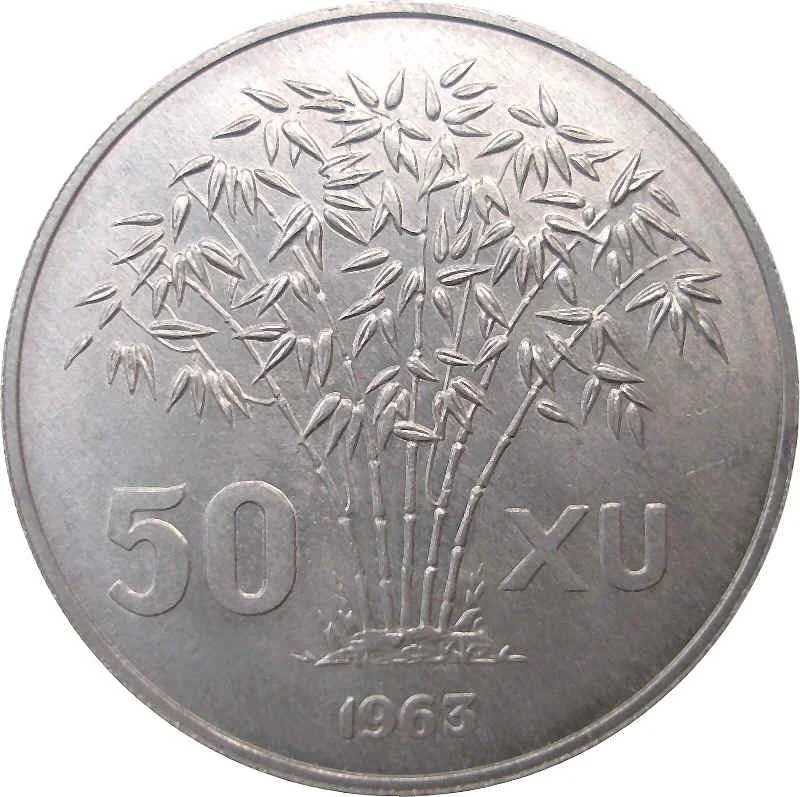
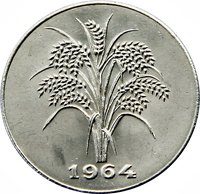
Description:
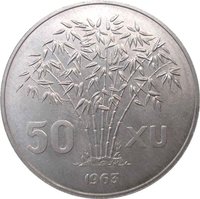
Bamboo dividing the coin's face value.
Inscription:
50 XU
1963
1963
Script: Latin
Engraver: Norman Sillman
Edge
Reeded
Categories
| Person> Politician |
Mintings
| Year | Mint Mark | Mintage | Quality | Collection |
|---|---|---|---|---|
| 1963 | — | 20,000,000 |
Historical background
In 1963, South Vietnam's currency, the piastre, was in a precarious state, deeply entangled with the nation's political instability and economic mismanagement. The currency was artificially pegged at a high official rate of 73 piastres to one U.S. dollar, a policy heavily supported by American aid to prop up the government of President Ngo Dinh Diem. This overvaluation, however, created a distorted economy, fueling a rampant black market where the piastre traded for as low as 130 to the dollar. This gaping disparity encouraged widespread corruption and smuggling, as individuals with access to dollars at the official rate could make immense profits by converting and selling them on the illegal market.
The situation was a direct reflection of the Diem regime's failing policies and the growing U.S. involvement. American economic and military aid, which constituted a massive portion of South Vietnam's budget, was essentially subsidizing the currency peg. However, this aid was often misappropriated, doing little to build a productive domestic economy. Furthermore, strategic programs like the "Commercial Import Program," which injected dollars to finance imports, inadvertently exacerbated the black market and inflation, as goods were scarce and the financial system was weak.
The currency crisis reached a peak in mid-1963, becoming a focal point of tension between the Diem government and its American patrons. U.S. officials, frustrated with Diem's nepotism and economic failures, saw the manipulation of the exchange rate as a symbol of systemic corruption. Attempts to pressure Diem to devalue the piastre and implement reforms were met with resistance, contributing to the breakdown in relations. Ultimately, the unstable piastre was both a cause and a symptom of the broader collapse; the economic disillusionment it fostered among the populace and American officials alike was a significant factor in the lead-up to the coup that overthrew and assassinated Diem in November 1963.
The situation was a direct reflection of the Diem regime's failing policies and the growing U.S. involvement. American economic and military aid, which constituted a massive portion of South Vietnam's budget, was essentially subsidizing the currency peg. However, this aid was often misappropriated, doing little to build a productive domestic economy. Furthermore, strategic programs like the "Commercial Import Program," which injected dollars to finance imports, inadvertently exacerbated the black market and inflation, as goods were scarce and the financial system was weak.
The currency crisis reached a peak in mid-1963, becoming a focal point of tension between the Diem government and its American patrons. U.S. officials, frustrated with Diem's nepotism and economic failures, saw the manipulation of the exchange rate as a symbol of systemic corruption. Attempts to pressure Diem to devalue the piastre and implement reforms were met with resistance, contributing to the breakdown in relations. Ultimately, the unstable piastre was both a cause and a symptom of the broader collapse; the economic disillusionment it fostered among the populace and American officials alike was a significant factor in the lead-up to the coup that overthrew and assassinated Diem in November 1963.
🌱 Common