

250 euro – France
Add to wishlist
Non-circulating coins
Commemoration: The Sower (La Semeuse)
France

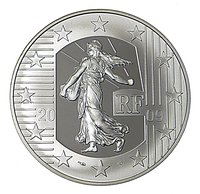
Obverse
Description:
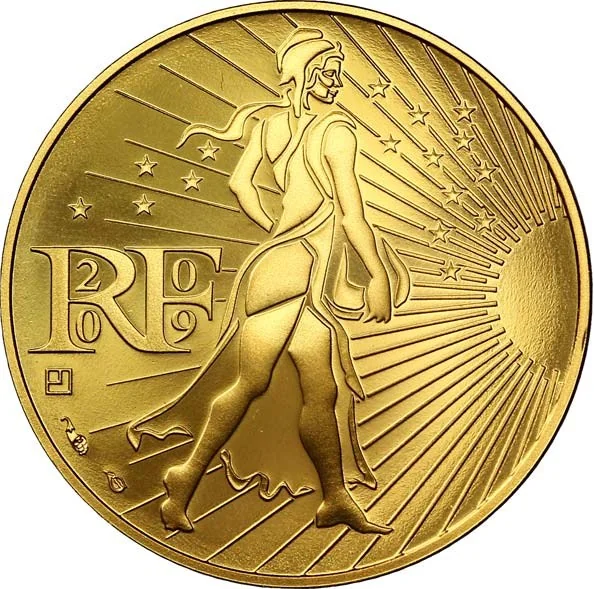
Sower strides right, sunlit from below.
Inscription:
RF
2 0 0 9
2 0 0 9
Script: Latin
Engraver: Joaquin Jimenez
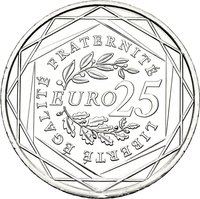
Reverse
Description:
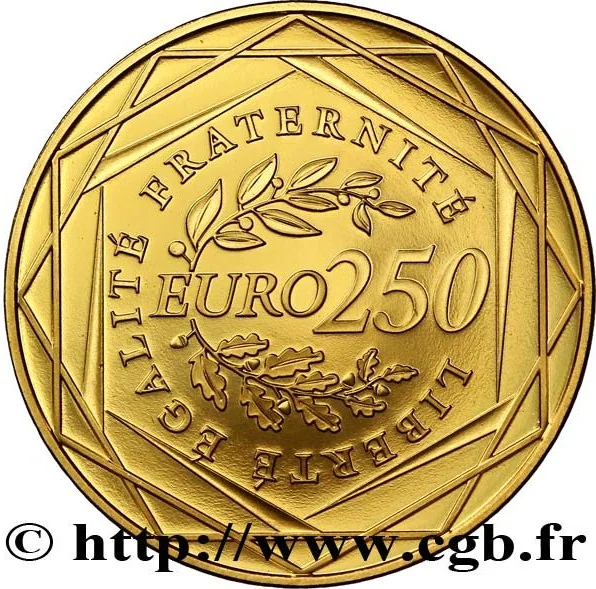
Centered within a horizontal wreath.
Inscription:
LIBERTÉ ÉGALITÉ FRATERNITÉ
EURO 250
EURO 250
Translation:
LIBERTY EQUALITY FRATERNITY
EURO 250
EURO 250
Script: Latin
Language: French
Engraver: Joaquin Jimenez
Edge
Plain
Categories
| Symbol> Phrygian cap |
| Symbol> Wreath |
Mints
| Name | Mark |
|---|---|
| Monnaie de Paris | — |
Mintings
| Year | Mint Mark | Mintage | Quality | Collection |
|---|---|---|---|---|
| 2009 | — | 25,000 |
Historical background
In 2009, France, as a member of the Eurozone, was navigating the global financial crisis under the umbrella of the euro. The common currency provided a crucial shield against the speculative currency attacks that had plagued European nations in past crises, ensuring monetary stability. However, this also meant France had ceded control of its monetary policy to the European Central Bank (ECB), limiting its ability to independently devalue its currency to boost exports—a traditional tool for economic recovery. The focus was therefore on coordinated Eurozone responses and domestic fiscal policy, rather than national currency management.
The year was dominated by the severe economic recession triggered by the 2008 global meltdown. France's GDP contracted by 2.9%, leading to rising unemployment and significant strain on public finances. In this context, the stability of the euro was a double-edged sword: while it prevented a national liquidity crisis, the ECB's initial focus on inflation control over growth was seen by some as too restrictive for the dire economic circumstances. Domestically, debates intensified about the euro's strength potentially hampering the competitiveness of French exports outside the Eurozone.
President Nicolas Sarkozy's government responded with substantial fiscal stimulus, including a €26 billion "Grand Emprunt" (national loan) for strategic investments, while also pushing for a more assertive European response. The French discourse centered on strengthening Eurozone economic governance and advocating for a "strong euro" policy that also considered growth and employment. Thus, France's 2009 currency situation was defined by operating within the constraints and protections of the euro, while grappling with a deep recession and leading calls for greater European coordination to weather the storm.
The year was dominated by the severe economic recession triggered by the 2008 global meltdown. France's GDP contracted by 2.9%, leading to rising unemployment and significant strain on public finances. In this context, the stability of the euro was a double-edged sword: while it prevented a national liquidity crisis, the ECB's initial focus on inflation control over growth was seen by some as too restrictive for the dire economic circumstances. Domestically, debates intensified about the euro's strength potentially hampering the competitiveness of French exports outside the Eurozone.
President Nicolas Sarkozy's government responded with substantial fiscal stimulus, including a €26 billion "Grand Emprunt" (national loan) for strategic investments, while also pushing for a more assertive European response. The French discourse centered on strengthening Eurozone economic governance and advocating for a "strong euro" policy that also considered growth and employment. Thus, France's 2009 currency situation was defined by operating within the constraints and protections of the euro, while grappling with a deep recession and leading calls for greater European coordination to weather the storm.
⭐ Somewhat Rare