

5 Francs – Burundi
Circulating commemorative coins
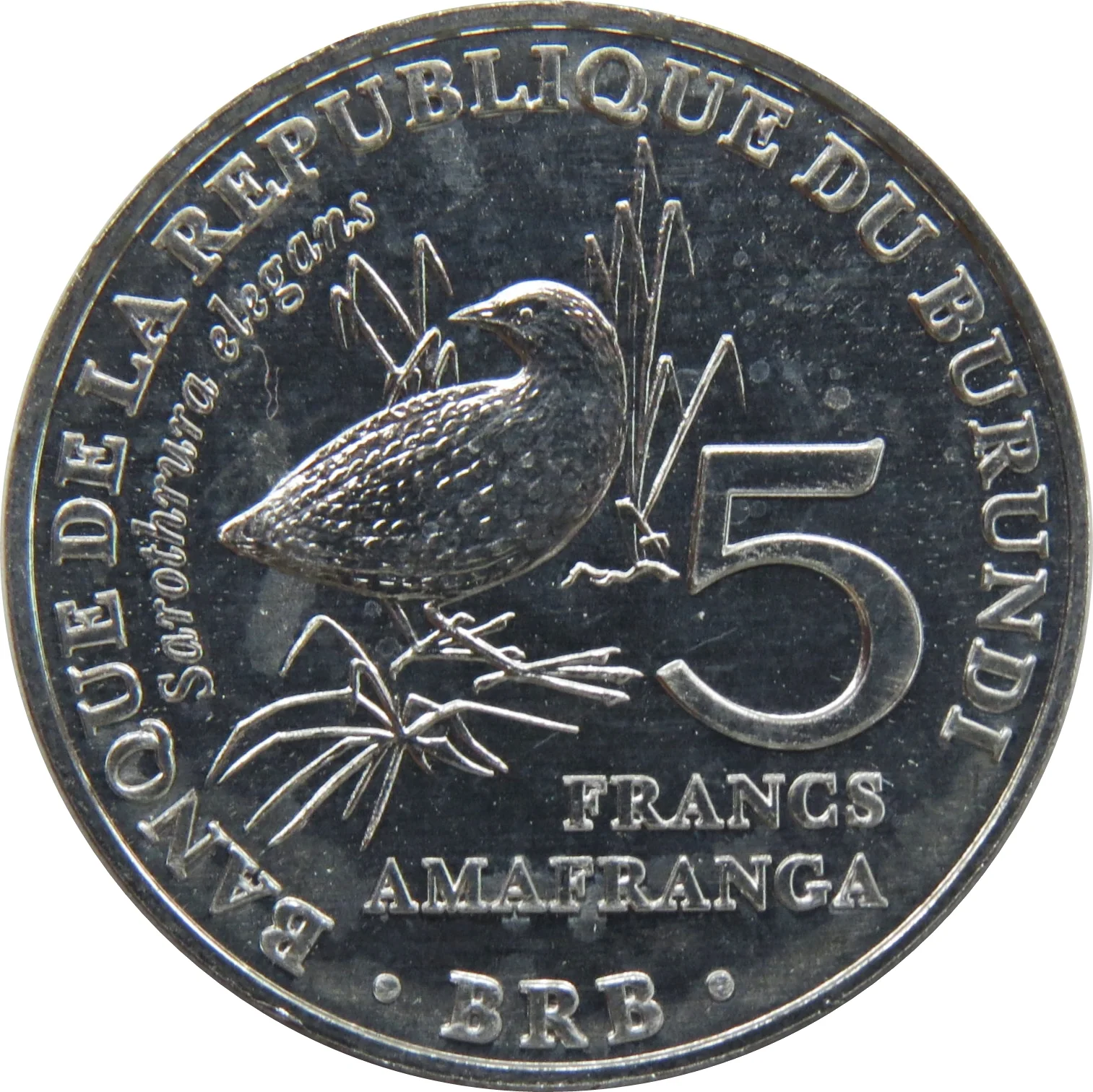
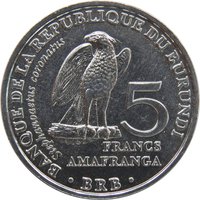
Commemoration: Bird set. Buff-spotted flufftail (Sarothrura elegans)
Burundi
Context
Year: 2014
Issuer: Burundi 
Issuing organization: Bank of the Republic of Burundi
Period:
(since 1966)
Currency:
(since 1962)
Total mintage: 300,000
Material
References
KM: #Click to copy to clipboard26
Numista: #78190
Value
Exchange value: 5 BIF
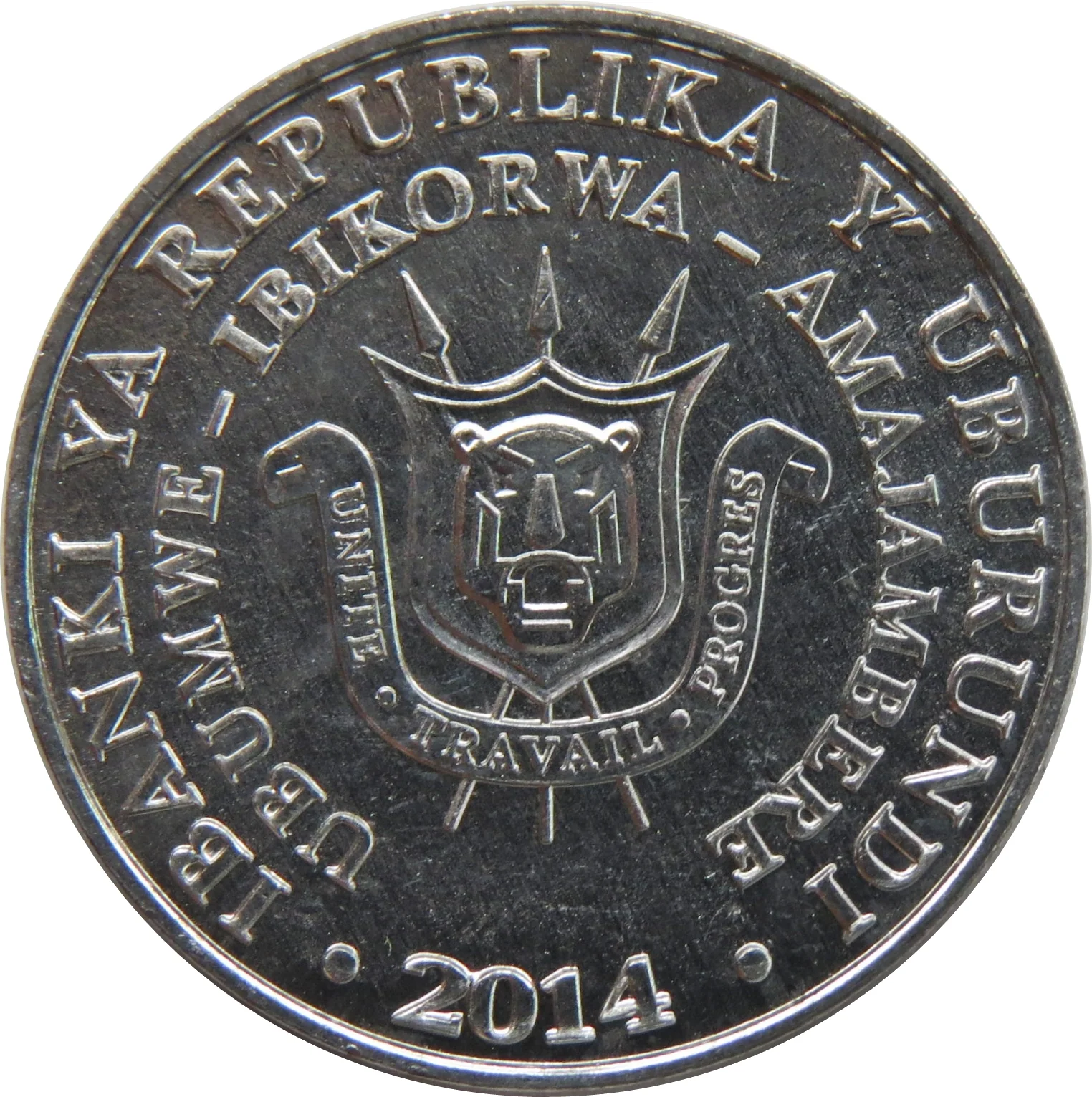
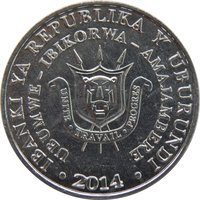
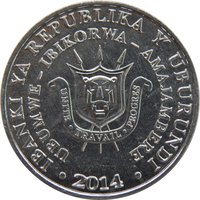
Obverse
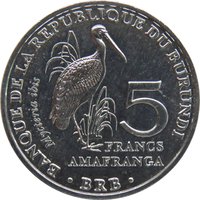
Reverse
Description:
Buff-spotted flufftail at center with value.
Latin name to its left, inscription surrounding.
Latin name to its left, inscription surrounding.
Inscription:
BANQUE DE LA REPUBLIQUE DU BURUNDI
Sarothrura elegans
5 FRANCS
AMAFRANGA
· BRB ·
Sarothrura elegans
5 FRANCS
AMAFRANGA
· BRB ·
Translation:
BANK OF THE REPUBLIC OF BURUNDI
Elegant Flufftail
5 FRANCS
AMAFRANGA
· BRB ·
Elegant Flufftail
5 FRANCS
AMAFRANGA
· BRB ·
Script: Latin
Edge
Plain
Categories
| Animal> Bird |
| Animal> Feline |
| Symbols> Coat of Arms |
| Object> Cold weapons |
Mintings
| Year | Mint Mark | Mintage | Quality | Collection |
|---|---|---|---|---|
| 2014 | — | 300,000 |
Historical background
In 2014, Burundi's currency, the Burundian franc (BIF), faced significant pressure characterized by a sharp and steady depreciation on the official and parallel foreign exchange markets. This decline was driven by a combination of structural economic weaknesses and emerging political uncertainty. The country chronically suffered from a large trade deficit, with low export earnings from its primary commodities (coffee and tea) failing to cover the cost of essential imports like fuel and manufactured goods. This imbalance created persistent demand for hard currencies, particularly the US dollar, which outstripped supply.
The situation was exacerbated by a decline in foreign aid, a crucial source of dollar inflows for the government budget. Key Western donors, including Belgium and the Netherlands, had suspended direct budget support in 2012 due to governance concerns, tightening the foreign currency supply further. Consequently, the Central Bank of Burundi (BRB) struggled to defend the franc, as its foreign exchange reserves were critically low. This forced the BRB to ration US dollar allocations, leading to a growing gap between the official exchange rate and the more depreciated rate on the thriving parallel market, where businesses and individuals turned to meet their needs.
The currency depreciation had severe inflationary consequences, eroding purchasing power and increasing the cost of living for the population. The government's attempts to manage the crisis, including imposing strict foreign exchange controls and seeking new lines of credit, provided little relief. Importantly, the economic turbulence in 4 occurred against the backdrop of a deepening political crisis, as President Pierre Nkurunziza's controversial bid for a third term began to take shape, foreshadowing the severe instability that would erupt in 2015 and further cripple the economy. Thus, the currency situation of 2014 was a clear symptom of Burundi's fragile economic foundations becoming increasingly vulnerable to political shocks.
The situation was exacerbated by a decline in foreign aid, a crucial source of dollar inflows for the government budget. Key Western donors, including Belgium and the Netherlands, had suspended direct budget support in 2012 due to governance concerns, tightening the foreign currency supply further. Consequently, the Central Bank of Burundi (BRB) struggled to defend the franc, as its foreign exchange reserves were critically low. This forced the BRB to ration US dollar allocations, leading to a growing gap between the official exchange rate and the more depreciated rate on the thriving parallel market, where businesses and individuals turned to meet their needs.
The currency depreciation had severe inflationary consequences, eroding purchasing power and increasing the cost of living for the population. The government's attempts to manage the crisis, including imposing strict foreign exchange controls and seeking new lines of credit, provided little relief. Importantly, the economic turbulence in 4 occurred against the backdrop of a deepening political crisis, as President Pierre Nkurunziza's controversial bid for a third term began to take shape, foreshadowing the severe instability that would erupt in 2015 and further cripple the economy. Thus, the currency situation of 2014 was a clear symptom of Burundi's fragile economic foundations becoming increasingly vulnerable to political shocks.
🌱 Common