

10 markkaa – Finland
Add to wishlist
Non-circulating coins
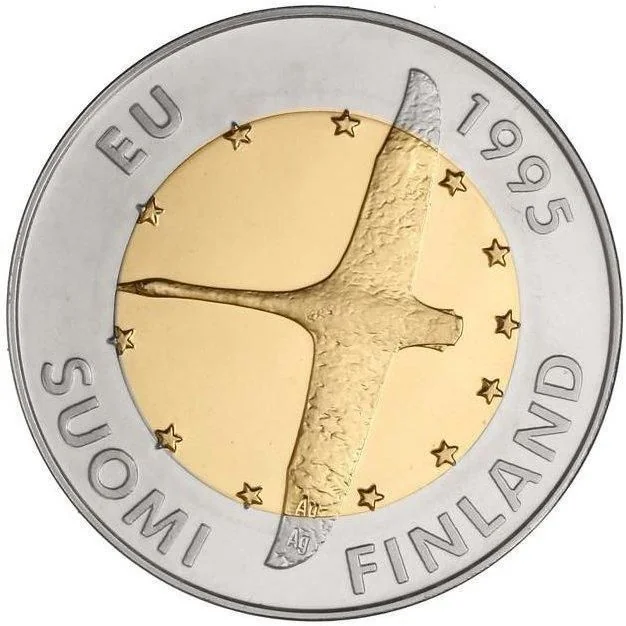
Commemoration: Finland's European Union membership
Finland
Context
Year: 1995
Issuer: Finland
Period:
(since 1919)
Currency:
(1963—2001)
Demonetization: 1 January 2002
Total mintage: 1,900
References
KM: #
Numista: #78009
Value
Exchange value: 10 FIM
Inflation-adjusted value: 17.06 FIM
Obverse
Description:
Swan in circle, date upper right.
Inscription:
EU 1995
SUOMI FINLAND
Au
Ag
SUOMI FINLAND
Au
Ag
Translation:
European Union 1995
Finland Finland
Gold
Silver
Finland Finland
Gold
Silver
Script: Latin
Engravers: Antti Neuvonen, Pertti Mäkinen
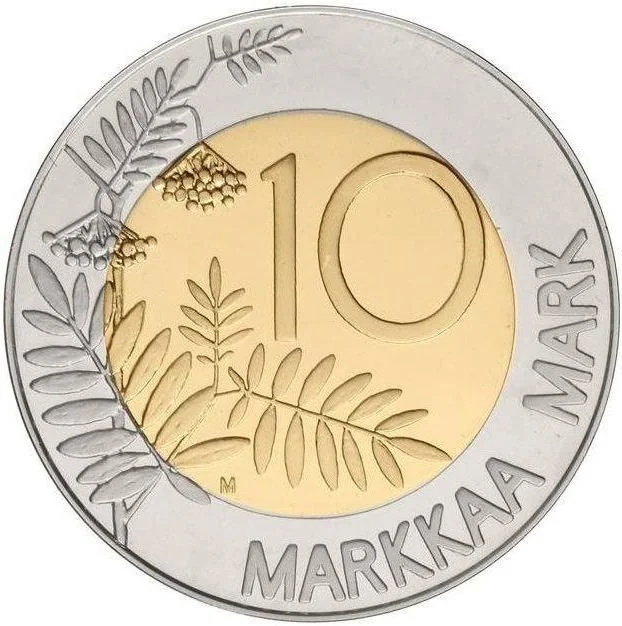
Reverse
Description:
Denomination, branch, mintmark.
Inscription:
10 MARKKAA MARK
M
M
Script: Latin
Engravers: Antti Neuvonen, Pertti Mäkinen
Edge
Plain
Mints
| Name | Mark |
|---|---|
| Mint of Finland | — |
Mintings
| Year | Mint Mark | Mintage | Quality | Collection |
|---|---|---|---|---|
| 1995 | — | 1,900 | Proof |
Historical background
In 1995, Finland's currency situation was defined by a pivotal transition. The country was a member of the European Union's Exchange Rate Mechanism (ERM), having joined in October 1996, but its official currency remained the Finnish markka (FIM). This period was characterized by a managed float, where the Bank of Finland aimed to maintain the markka's value within a fluctuation band against other ERM currencies, primarily anchoring it to the Deutsche Mark. This policy was a crucial step in preparing for eventual Economic and Monetary Union (EMU) membership, requiring strict adherence to convergence criteria on inflation, interest rates, and fiscal stability.
The backdrop to this was the severe Finnish banking crisis and deep recession of the early 1990s. By 1995, the economy was in a strong recovery phase, but the crisis had led to the markka's sharp devaluation in 1991-92, when it was forced to abandon its fixed exchange rate. The subsequent floating and later ERM membership were part of a strategic shift to import monetary credibility and low inflation from the core of Europe. This discipline was seen as essential for stabilizing the economy after the crisis and integrating Finland more closely with Western European markets.
Consequently, 1995 was a year of consolidation and preparation. The government and the Bank of Finland were firmly committed to the path toward adopting the euro, which required maintaining exchange rate stability within the ERM for two years. All major economic policies were geared toward meeting the Maastricht Treaty criteria. This successful alignment allowed Finland to be among the first wave of countries to introduce the euro in 1999, with euro banknotes and coins entering circulation in 2002, marking the end of the markka's era.
The backdrop to this was the severe Finnish banking crisis and deep recession of the early 1990s. By 1995, the economy was in a strong recovery phase, but the crisis had led to the markka's sharp devaluation in 1991-92, when it was forced to abandon its fixed exchange rate. The subsequent floating and later ERM membership were part of a strategic shift to import monetary credibility and low inflation from the core of Europe. This discipline was seen as essential for stabilizing the economy after the crisis and integrating Finland more closely with Western European markets.
Consequently, 1995 was a year of consolidation and preparation. The government and the Bank of Finland were firmly committed to the path toward adopting the euro, which required maintaining exchange rate stability within the ERM for two years. All major economic policies were geared toward meeting the Maastricht Treaty criteria. This successful alignment allowed Finland to be among the first wave of countries to introduce the euro in 1999, with euro banknotes and coins entering circulation in 2002, marking the end of the markka's era.
💎 Extremely Rare