

5 euro – Cyprus
Add to wishlist
Non-circulating coins
Commemoration: Goddess Aphrodite
Cyprus

Obverse
Description:
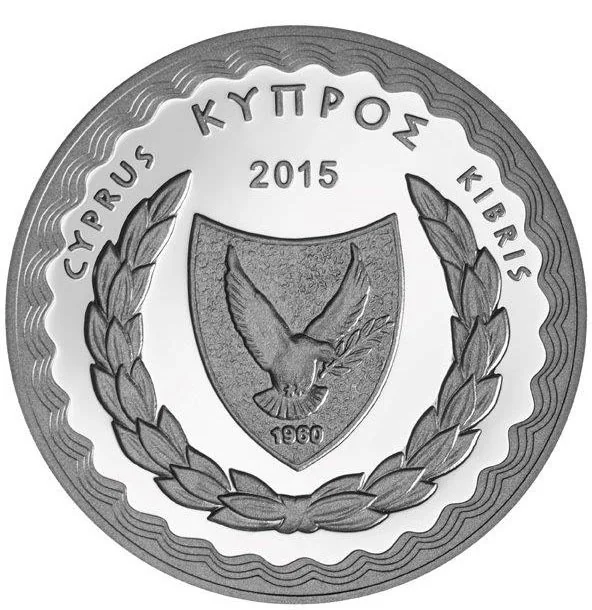
Central Bank of Cyprus emblem with "ΚΥΠΡΟΣ", "CYPRUS", "KIBRIS", "2015", and circular sea waves.
Inscription:
ΚΥΠΡΟΣ CYPRUS KIBRIS
2015
1960
2015
1960
Translation:
Cyprus Cyprus Cyprus
2015
1960
2015
1960
Engraver: George Stamatopoulos
Reverse
Description:
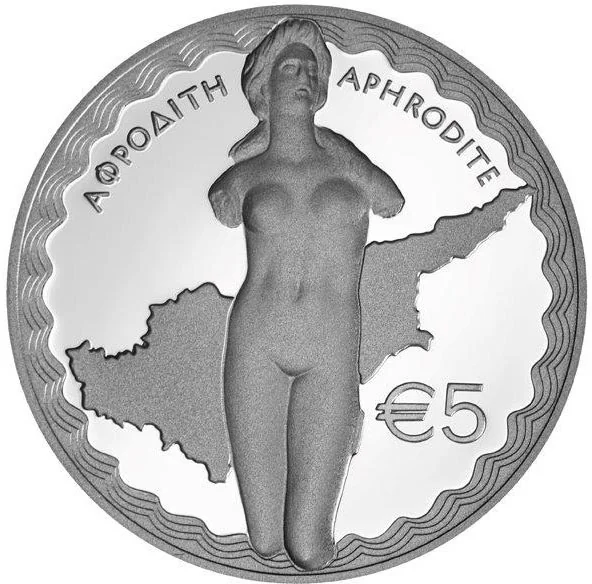
A €5 coin depicting Aphrodite's marble statue against a map of Cyprus and circular sea waves.
Inscription:
ΑΦΡΟΔΙΤΗ APHRODITE
€5
€5
Translation:
Aphrodite Aphrodite
€5
€5
Engraver: George Stamatopoulos
Edge
Plain
Mints
| Name | Mark |
|---|---|
| National Mint of the Bank of Greece | — |
Mintings
| Year | Mint Mark | Mintage | Quality | Collection |
|---|---|---|---|---|
| 2015 | — | 4,000 | Proof |
Historical background
The currency situation in Cyprus in 2015 was defined by its successful adoption of the euro seven years prior, which had fundamentally stabilized the country's monetary framework. Following the 2013 financial crisis, which required a severe €10 billion international bailout and involved the unprecedented "bail-in" of large bank depositors, the immediate threat of a return to a national currency had subsided. By 2015, the Central Bank of Cyprus was operating under the European Central Bank's (ECB) umbrella, with monetary policy set in Frankfurt. The acute crisis had passed, but the economy remained in a fragile state of recovery, burdened by high non-performing loans and a need for continued fiscal consolidation under the terms of the bailout programme.
The primary monetary challenges in 2015 were not about currency sovereignty but about managing the euro within a constrained banking sector and a recession-hit economy. The focus was on restoring the health of the banking system, which had been at the epicenter of the 2013 collapse. Strict capital controls, imposed in 2013 to prevent a bank run, were being gradually lifted throughout 2015, a process completed fully by April of that year. This marked a significant step towards normalizing financial conditions and reintegrating Cyprus into the single currency's full free movement of capital.
Therefore, 2015 represented a year of post-crisis normalization under the euro, rather than a period of currency instability. The debate had shifted from a existential threat to the currency itself to the challenges of operating within it: fostering economic growth, reducing a very high public debt burden, and repairing bank balance sheets under the watchful eye of the ECB and the International Monetary Fund. The euro remained unchallenged as the legal tender, providing stability but also imposing the strict discipline of a common monetary policy not tailored to Cyprus's specific cyclical needs.
The primary monetary challenges in 2015 were not about currency sovereignty but about managing the euro within a constrained banking sector and a recession-hit economy. The focus was on restoring the health of the banking system, which had been at the epicenter of the 2013 collapse. Strict capital controls, imposed in 2013 to prevent a bank run, were being gradually lifted throughout 2015, a process completed fully by April of that year. This marked a significant step towards normalizing financial conditions and reintegrating Cyprus into the single currency's full free movement of capital.
Therefore, 2015 represented a year of post-crisis normalization under the euro, rather than a period of currency instability. The debate had shifted from a existential threat to the currency itself to the challenges of operating within it: fostering economic growth, reducing a very high public debt burden, and repairing bank balance sheets under the watchful eye of the ECB and the International Monetary Fund. The euro remained unchallenged as the legal tender, providing stability but also imposing the strict discipline of a common monetary policy not tailored to Cyprus's specific cyclical needs.
💎 Extremely Rare