

20 Schilling – Austria
Circulating commemorative coins
Commemoration: Grafenegg Palace
Austria
Obverse
Description:
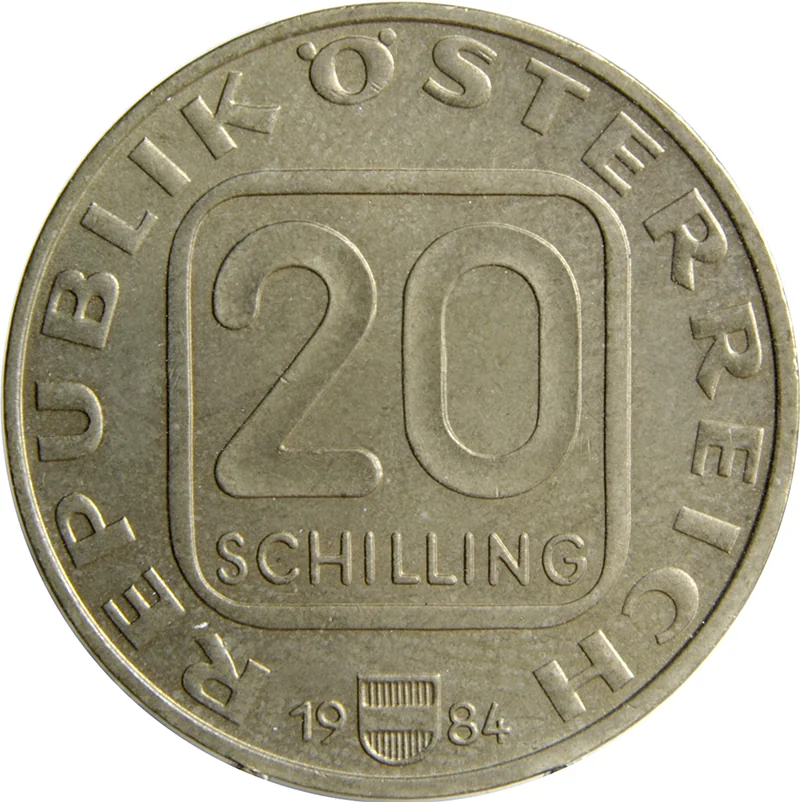
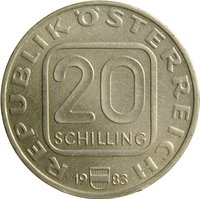
Square frame with rounded corners, face value inside. Surrounding text: "REPUBLIK ÖSTERREICH". Date below, flanking the Austrian shield.
Inscription:
REPUBLIK ÖSTERREICH
20
SCHILLING
19 84
20
SCHILLING
19 84
Translation:
REPUBLIC OF AUSTRIA
20
SCHILLING
19 84
20
SCHILLING
19 84
Script: Latin
Language: German
Engraver: Kurt Bodlak
Reverse
Description:
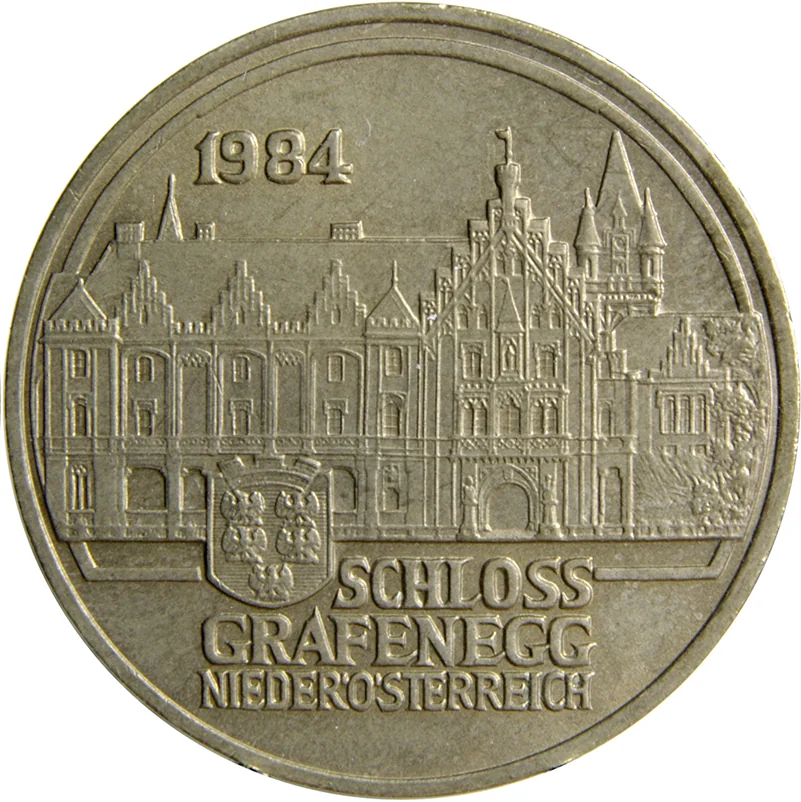
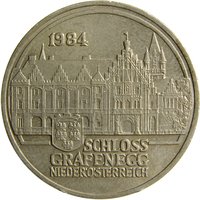
Northern view of Grafenegg Castle. Lower right: Lower Austria coat of arms and "Schloss Grafenegg Niederösterreich". Upper left: mintage year.
Inscription:
1984
SCHLOSS
GRAFENEGG
NIEDERÖSTERREICH
SCHLOSS
GRAFENEGG
NIEDERÖSTERREICH
Translation:
1984
Castle
Grafenegg
Lower Austria
Castle
Grafenegg
Lower Austria
Script: Latin
Language: German
Designer: Josef Kaiser
Edge
19 incuse dots in 9 groups of 2 or 3 (KM#2965.1), or smooth edge (KM#2965.2)
Legend:
••• •• •• •• •• •• •• •• ••
Categories
| Building> Castle or fortification |
| Symbols> Coat of Arms |
Mints
| Name | Mark |
|---|---|
| Münze Österreich | — |
Mintings
| Year | Mint Mark | Mintage | Quality | Collection |
|---|---|---|---|---|
| 1984 | — | 1,203,000 | ||
| 1984 | — | 65,000 | Proof | |
| 1991 | — | 140,000 | ||
| 1992 | — | 100,000 | ||
| 1993 | — | 180,000 |
Historical background
In 1984, Austria's currency situation was defined by stability and successful integration into a European framework, standing in contrast to the inflationary turmoil experienced by some of its neighbours. The Austrian schilling, managed by the Austrian National Bank (OeNB), was firmly anchored through a hard currency policy (Hartwährungspolitik) initiated in the 1970s. This policy pegged the schilling closely to the Deutsche Mark, the currency of its key trading partner, West Germany. This deliberate linkage imported the anti-inflationary credibility of the Bundesbank, resulting in low inflation and low interest rates, which became hallmarks of the Austrian economy.
This stability was further reinforced by Austria's active participation in the European Monetary System (EMS), established in 1979. While not a full member of the Exchange Rate Mechanism (ERM), Austria operated a "hard currency option," shadowing the EMS and particularly the Deutsche Mark. This approach was a cornerstone of national economic policy, fostering a climate of predictability for trade and investment. Consequently, in 1984, the schilling was considered one of the strongest and most stable currencies in Europe, a key factor in Austria's high standard of living and robust social market economy.
The backdrop to this success was a deliberate political and economic choice to prioritize stability over autonomous monetary policy. By tethering the schilling to the Deutsche Mark, Austria effectively ceded control over its interest rates and money supply to the Bundesbank's decisions. This was widely accepted domestically as a necessary trade-off for crushing inflation and securing economic integration with Western Europe. Thus, in 1984, the Austrian currency landscape was one of deliberate dependency, a strategic alignment that provided immense economic benefits and set a precedent for the country's future path toward full European Union membership and the eventual adoption of the euro.
This stability was further reinforced by Austria's active participation in the European Monetary System (EMS), established in 1979. While not a full member of the Exchange Rate Mechanism (ERM), Austria operated a "hard currency option," shadowing the EMS and particularly the Deutsche Mark. This approach was a cornerstone of national economic policy, fostering a climate of predictability for trade and investment. Consequently, in 1984, the schilling was considered one of the strongest and most stable currencies in Europe, a key factor in Austria's high standard of living and robust social market economy.
The backdrop to this success was a deliberate political and economic choice to prioritize stability over autonomous monetary policy. By tethering the schilling to the Deutsche Mark, Austria effectively ceded control over its interest rates and money supply to the Bundesbank's decisions. This was widely accepted domestically as a necessary trade-off for crushing inflation and securing economic integration with Western Europe. Thus, in 1984, the Austrian currency landscape was one of deliberate dependency, a strategic alignment that provided immense economic benefits and set a precedent for the country's future path toward full European Union membership and the eventual adoption of the euro.
🌱 Common