

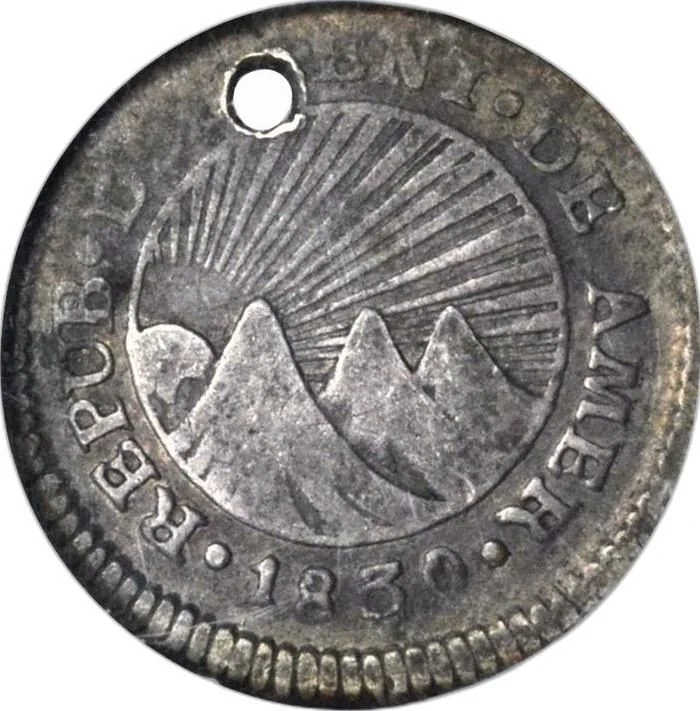
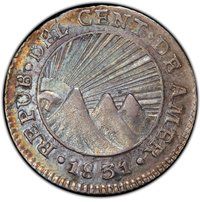
Obverse
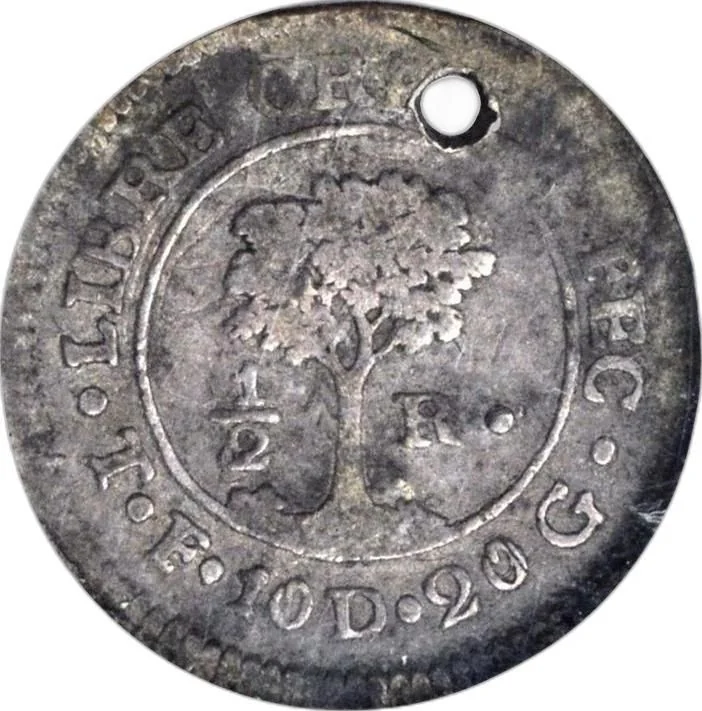
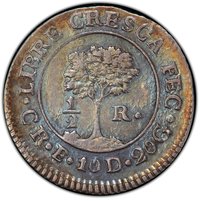
Reverse
Edge
Mints
| Name | Mark |
|---|---|
| Casa Nacional de la Moneda | T |
Mintings
| Year | Mint Mark | Mintage | Quality | Collection |
|---|---|---|---|---|
| 1830 | T | — |
Historical background
By 1830, the currency situation within the Federal Republic of Central America was chaotic and reflected the federation's deepening political and economic disintegration. The federal government, based in Guatemala City, lacked both the authority and the resources to issue a unified, stable currency for its five constituent states: Guatemala, El Salvador, Honduras, Nicaragua, and Costa Rica. Consequently, a bewildering variety of coins circulated simultaneously, including older Spanish colonial pieces (reales and escudos), coins from the Mexican Empire, and even Peruvian and Bolivian currency brought by trade. This patchwork system severely hampered commerce and fostered confusion, as the value of these coins could vary significantly from one town or state to another.
The primary attempt to create a federal currency, the minting of Central American Republic coins in denominations of reales and escudos beginning in the 1820s, was insufficient. Production was limited, primarily occurring at the Guatemala City mint, and these new coins failed to displace the older, more trusted Spanish pieces from circulation. More critically, the individual states began to assert their own economic sovereignty. By 1830, several states were authorizing the use of foreign silver—especially British, Chilean, and Peruvian coins—as legal tender within their own borders, further undermining any pretense of a federal monetary policy.
This monetary fragmentation was both a symptom and a cause of the federation's failure. The lack of a uniform currency discouraged interstate trade, encouraged autarky, and symbolized the weak central authority. For merchants and the public, the system meant constant uncertainty, the hassle of exchanging currencies, and vulnerability to devaluation. Ultimately, the currency chaos of 1830 illustrated that economic ties binding the states were fraying, mirroring the political disputes that would lead to the federation's complete dissolution by 1839.
The primary attempt to create a federal currency, the minting of Central American Republic coins in denominations of reales and escudos beginning in the 1820s, was insufficient. Production was limited, primarily occurring at the Guatemala City mint, and these new coins failed to displace the older, more trusted Spanish pieces from circulation. More critically, the individual states began to assert their own economic sovereignty. By 1830, several states were authorizing the use of foreign silver—especially British, Chilean, and Peruvian coins—as legal tender within their own borders, further undermining any pretense of a federal monetary policy.
This monetary fragmentation was both a symptom and a cause of the federation's failure. The lack of a uniform currency discouraged interstate trade, encouraged autarky, and symbolized the weak central authority. For merchants and the public, the system meant constant uncertainty, the hassle of exchanging currencies, and vulnerability to devaluation. Ultimately, the currency chaos of 1830 illustrated that economic ties binding the states were fraying, mirroring the political disputes that would lead to the federation's complete dissolution by 1839.
✨ Legendary