

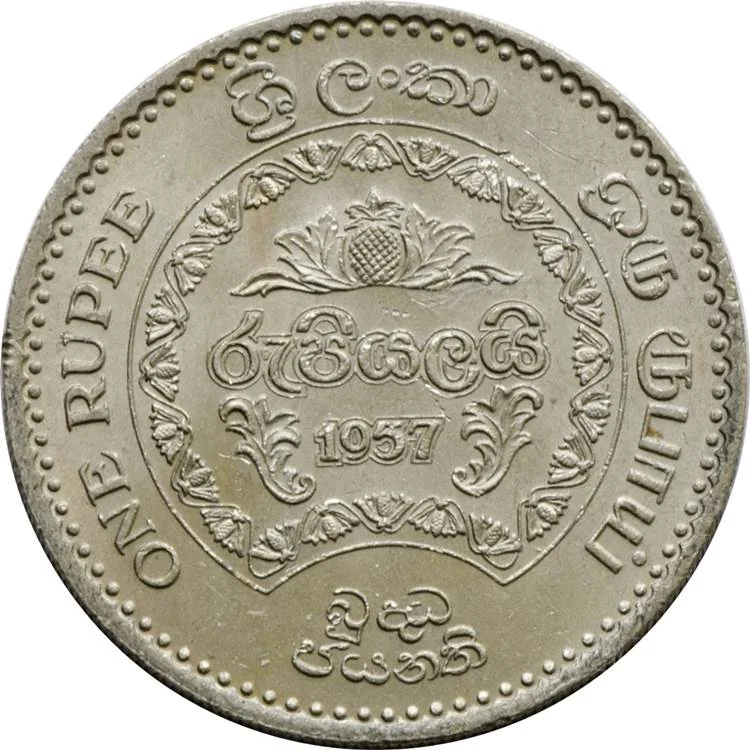
1 rupee (Buddhism) – Ceylon
Add to wishlist
Circulating commemorative coins
Commemoration: 2500th Anniversary of Buddhism
Sri Lanka
Context
Year: 1957
Country: Sri Lanka
Issuer: Ceylon
Ruler: Elizabeth II
Currency:
(1871—1972)
Demonetized: Yes
Total mintage: 2,001,800
Material
Diameter: 28 mm
Weight: 11.31 g
Thickness: 2.2 mm
Shape: Round
Composition: Copper-nickel
Technique: Milled
Alignment: Medal alignment
flip
References
KM: #
Numista: #11351
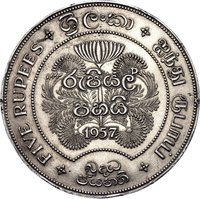
Obverse
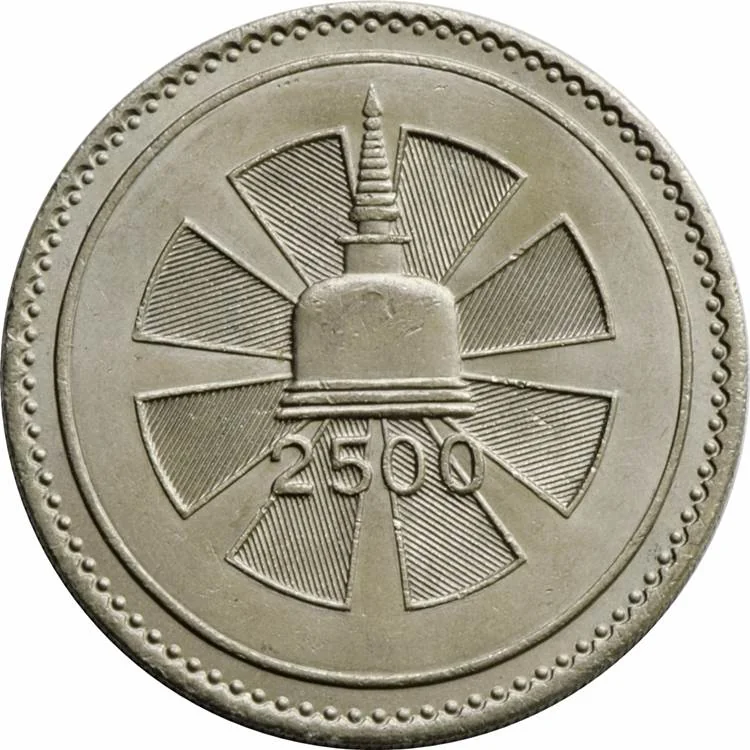
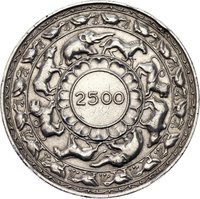
Reverse
Description:
This 'Buddhist motif' depicts a stupa, a sepulchral monument for burial or religious objects. At its simplest, it is a stone-faced earthen mound.
Inscription:
2500
Engraver: B.R. Sindall
Edge
Reeded
Categories
| Building> Religious building |
Mints
| Name | Mark |
|---|---|
| Royal Mint (Tower Hill) | — |
Mintings
| Year | Mint Mark | Mintage | Quality | Collection |
|---|---|---|---|---|
| 1957 | — | 2,000,000 | ||
| 1957 | — | 1,800 | Proof |
Historical background
In 1957, Ceylon (now Sri Lanka) operated under a sterling exchange standard, with its currency, the Ceylon Rupee, pegged to the British Pound Sterling. This system, managed by the Currency Board established in 1884, required full foreign reserve backing for all local currency issued, primarily held in sterling securities in London. While this ensured convertibility and monetary stability, it severely constrained the government's ability to pursue independent monetary policy, especially for development financing, as money supply was directly tied to the balance of payments.
The year fell within a period of significant economic strain and political transition. The post-Korean War collapse of the lucrative rubber and coconut markets had depleted foreign reserves, creating persistent balance of payments deficits. The newly elected government of S.W.R.D. Bandaranaike, which came to power in 1956 on a platform of socialist and nationalist reforms, viewed the colonial-era Currency Board as an impediment to state-led industrialization and economic sovereignty. Pressure was mounting to break from the rigid sterling peg to gain monetary flexibility.
Consequently, 1957 was a pivotal year of study and debate, setting the stage for profound change. The government commissioned the "Central Bank of Ceylon: Its Functions and Organisation" report, authored by a mission from the Federal Reserve Bank of New York led by John Exter. This report, published that year, provided the blueprint for dismantling the Currency Board. It recommended establishing a central bank with the power to issue currency, manage reserves, and direct credit to priority sectors—a direct response to the perceived inflexibility of the 1957 system. Therefore, the currency situation was one of a stable but restrictive regime in its final years, actively being prepared for replacement by a more dynamic, centrally managed system to suit the nation's developmental aspirations.
The year fell within a period of significant economic strain and political transition. The post-Korean War collapse of the lucrative rubber and coconut markets had depleted foreign reserves, creating persistent balance of payments deficits. The newly elected government of S.W.R.D. Bandaranaike, which came to power in 1956 on a platform of socialist and nationalist reforms, viewed the colonial-era Currency Board as an impediment to state-led industrialization and economic sovereignty. Pressure was mounting to break from the rigid sterling peg to gain monetary flexibility.
Consequently, 1957 was a pivotal year of study and debate, setting the stage for profound change. The government commissioned the "Central Bank of Ceylon: Its Functions and Organisation" report, authored by a mission from the Federal Reserve Bank of New York led by John Exter. This report, published that year, provided the blueprint for dismantling the Currency Board. It recommended establishing a central bank with the power to issue currency, manage reserves, and direct credit to priority sectors—a direct response to the perceived inflexibility of the 1957 system. Therefore, the currency situation was one of a stable but restrictive regime in its final years, actively being prepared for replacement by a more dynamic, centrally managed system to suit the nation's developmental aspirations.
🌱 Common