

2 euro (Festival of the Federation) – France
Add to wishlist
Non-circulating coins
Commemoration: 225th Anniversary of the Festival of the Federation
France
Context
Material
Diameter: 25.75 mm
Weight: 8.5 g
Thickness: 2.2 mm
Shape: Round
Alignment: Medal alignment
flip
References
KM: #
Numista: #77126
Value
Exchange value: 2 EUR
Inflation-adjusted value: 2.46 EUR
Obverse
Description:
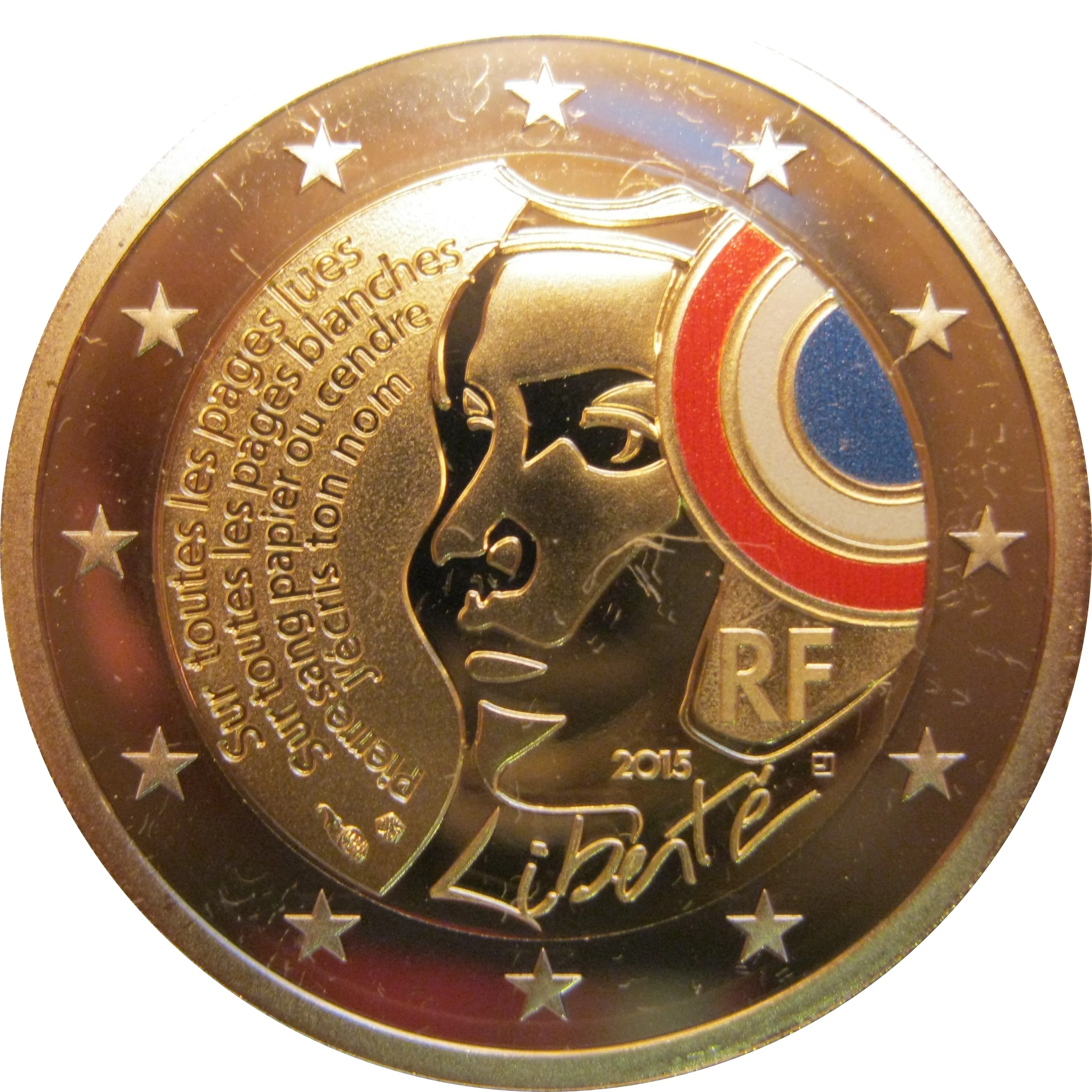
This coin commemorates France's national holiday with a contemporary profile of Marianne in her Phrygian cap. The design includes the tricolour cockade, the letters RF, and the year. A stanza from Paul Eluard's poem 'Liberté' alludes to the national motto, alongside the mint marks. The European Union's 12 stars circle the outer ring.
Inscription:
Sur toutes les pages lues
Sur toutes les pages blanches
Pierre sang papier ou cendre
J'écris ton nom
RF
2015
Liberté
Sur toutes les pages blanches
Pierre sang papier ou cendre
J'écris ton nom
RF
2015
Liberté
Translation:
On all the pages read
On all the blank pages
Stone blood paper or ash
I write your name
RF
2015
Liberty
On all the blank pages
Stone blood paper or ash
I write your name
RF
2015
Liberty
Script: Latin
Language: French
Engraver: Joaquin Jimenez
Reverse
Edge
Legend:
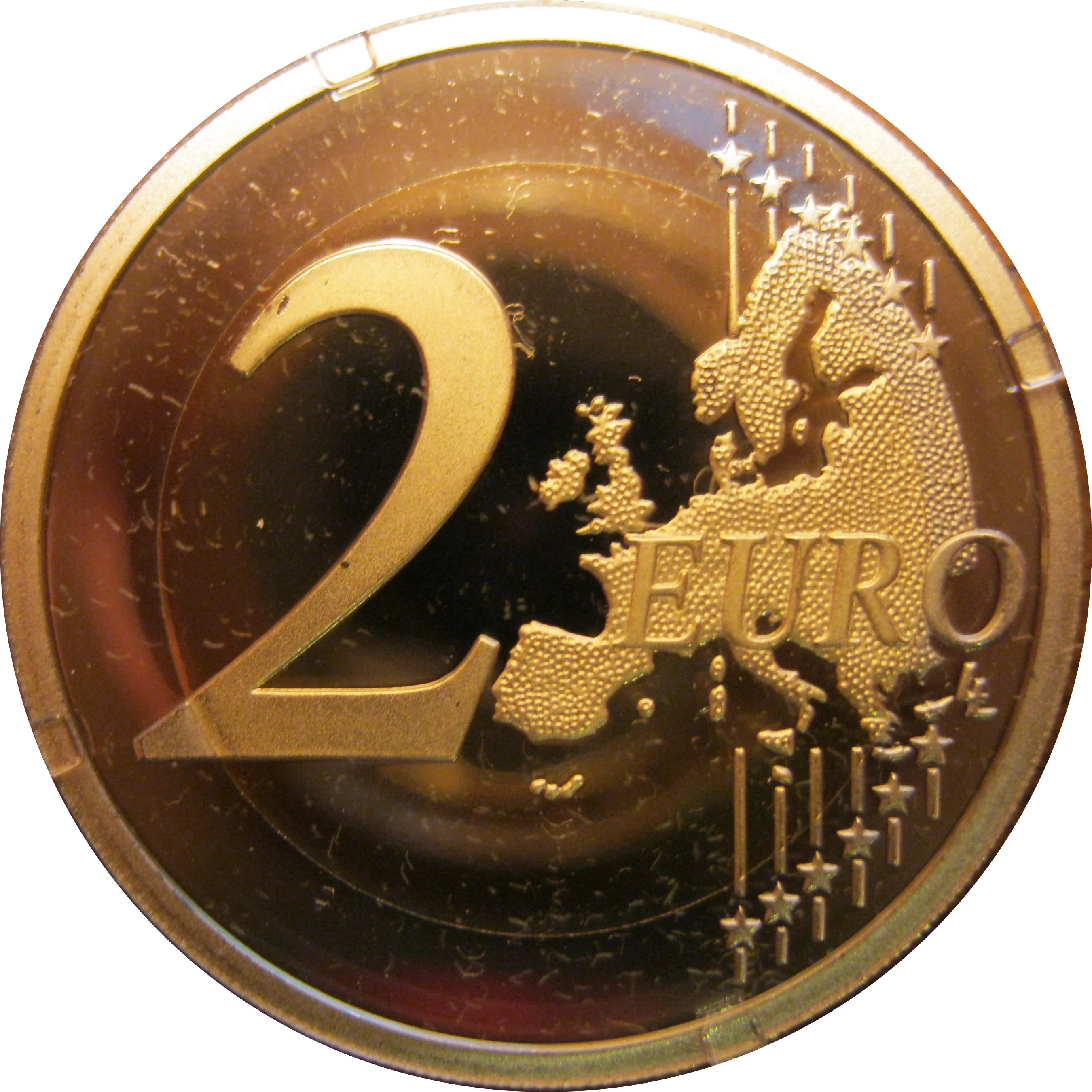
2 ** 2 ** 2 ** 2 ** 2 ** 2 **
Categories
| Map |
| Symbol> Phrygian cap |
Mints
| Name | Mark |
|---|---|
| Monnaie de Paris | — |
Mintings
| Year | Mint Mark | Mintage | Quality | Collection |
|---|---|---|---|---|
| 2015 | — | 10,000 | BU | |
| 2015 | — | 10,000 | Proof |
Historical background
In 2015, France, as a core member of the Eurozone, operated under the euro (€), a currency managed by the European Central Bank (ECB). This meant France had relinquished direct control over its monetary policy, including interest rates and money supply, to the Frankfurt-based institution. The year was dominated by the ECB's unprecedented quantitative easing (QE) program, announced in January and launched in March, which aimed to combat deflationary risks and stimulate the stagnant Eurozone economy by purchasing over €1 trillion in assets. For France, this meant continued ultra-low interest rates and efforts to increase liquidity, providing a supportive monetary environment amidst weak domestic growth.
Domestically, the currency situation was intertwined with France's sluggish economic performance and debates over fiscal policy. While the weak euro boosted French exports somewhat, the country grappled with high unemployment (hovering around 10%) and public debt exceeding 95% of GDP. The Socialist government of President François Hollande faced pressure to reduce deficits within the EU's Stability and Growth Pact rules, leading to austerity measures that constrained spending. This created a tension between the ECB's accommodative monetary stance and the restrictive fiscal policy at the national level, a common theme in Eurozone politics.
Furthermore, 2015 saw the euro itself under pressure from the Greek debt crisis, which peaked in the summer with fears of a "Grexit" (Greek exit from the Eurozone). Although France was not at the epicenter, it was a key player in negotiations, strongly advocating for keeping Greece in the single currency. The crisis underscored the existential risks of the monetary union and highlighted the challenges of a one-size-fits-all currency for economies as diverse as Germany and France. By year's end, the euro had depreciated significantly against the US dollar, partly due to ECB QE and divergent monetary policies with the US Federal Reserve, offering some competitive relief to French exporters but also reflecting broader economic concerns.
Domestically, the currency situation was intertwined with France's sluggish economic performance and debates over fiscal policy. While the weak euro boosted French exports somewhat, the country grappled with high unemployment (hovering around 10%) and public debt exceeding 95% of GDP. The Socialist government of President François Hollande faced pressure to reduce deficits within the EU's Stability and Growth Pact rules, leading to austerity measures that constrained spending. This created a tension between the ECB's accommodative monetary stance and the restrictive fiscal policy at the national level, a common theme in Eurozone politics.
Furthermore, 2015 saw the euro itself under pressure from the Greek debt crisis, which peaked in the summer with fears of a "Grexit" (Greek exit from the Eurozone). Although France was not at the epicenter, it was a key player in negotiations, strongly advocating for keeping Greece in the single currency. The crisis underscored the existential risks of the monetary union and highlighted the challenges of a one-size-fits-all currency for economies as diverse as Germany and France. By year's end, the euro had depreciated significantly against the US dollar, partly due to ECB QE and divergent monetary policies with the US Federal Reserve, offering some competitive relief to French exporters but also reflecting broader economic concerns.

🌟 Limited