

500 ringgit (Independence) – Malaysia
Add to wishlist
Non-circulating coins
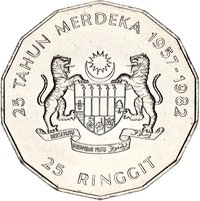
Commemoration: 25th Anniversary of Independence
Malaysia
Context
Material
Diameter: 26.5 mm
Weight: 10.25 g
Gold Weight:: 9.22 g
Thickness: 1.4 mm
Shape: Tetradecagonal
Composition: 90% Gold
Magnetic: No
Technique: Milled
Alignment: Medal alignment
flip
References
KM: #
Numista: #77051
Value
Exchange value: 500 MYR
Bullion value: $1406.19
Obverse
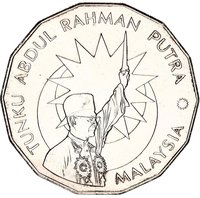
Reverse
Edge
Categories
| Symbols> Coat of Arms |
Mints
| Name | Mark |
|---|---|
| Royal Mint | — |
Mintings
| Year | Mint Mark | Mintage | Quality | Collection |
|---|---|---|---|---|
| 1982 | — | 20,000 | ||
| 1982 | — | 1,000 | Proof |
Historical background
In 1982, Malaysia's currency situation was characterized by stability and cautious optimism under the framework of a managed float. The Malaysian Ringgit (MYR) was pegged to a trade-weighted basket of currencies of its major trading partners, a system adopted in 1975 to move away from a sole peg to the US Dollar. This basket peg provided greater stability against exchange rate fluctuations, particularly important as the US Dollar was exceptionally strong in the early 1980s. The primary focus of Bank Negara Malaysia (the central bank) was on maintaining exchange rate stability to foster a predictable environment for trade and investment, which were crucial drivers of the nation's export-oriented economy, then heavily reliant on commodities like palm oil, rubber, and tin.
The broader economic context, however, presented significant challenges. Malaysia, like many nations, was grappling with the global recession of the early 1980s, triggered by tight monetary policies in developed nations and a collapse in commodity prices. This led to a deterioration in Malaysia's terms of trade and a growing current account deficit. While the Ringgit's value was managed, underlying pressures were building. The government, under Prime Minister Mahathir Mohamad, was also embarking on an ambitious heavy industrialization drive, which increased import demands and public spending, adding latent pressures on the balance of payments.
Consequently, 1982 represented a period of relative calm before a necessary policy shift. The managed basket peg successfully avoided the volatility of a free float, but the structural economic imbalances and the strong US Dollar made the peg increasingly expensive to defend. This set the stage for a significant devaluation two years later; in 1984, the Ringgit was sharply devalued by approximately 14% against the US Dollar to restore export competitiveness and address the widening current account deficit, marking a pivotal adjustment from the policies of the early 1980s.
The broader economic context, however, presented significant challenges. Malaysia, like many nations, was grappling with the global recession of the early 1980s, triggered by tight monetary policies in developed nations and a collapse in commodity prices. This led to a deterioration in Malaysia's terms of trade and a growing current account deficit. While the Ringgit's value was managed, underlying pressures were building. The government, under Prime Minister Mahathir Mohamad, was also embarking on an ambitious heavy industrialization drive, which increased import demands and public spending, adding latent pressures on the balance of payments.
Consequently, 1982 represented a period of relative calm before a necessary policy shift. The managed basket peg successfully avoided the volatility of a free float, but the structural economic imbalances and the strong US Dollar made the peg increasingly expensive to defend. This set the stage for a significant devaluation two years later; in 1984, the Ringgit was sharply devalued by approximately 14% against the US Dollar to restore export competitiveness and address the widening current account deficit, marking a pivotal adjustment from the policies of the early 1980s.
✨ Legendary