

250 francs (Treaty of the BeNeLux) – Belgium
Add to wishlist
Non-circulating coins
Commemoration: 50 Years Treaty of the BeNeLux
Belgium
Context
Material
References
KM: #
Numista: #7700
Value
Exchange value: 250 BEF
Bullion value: $42.54
Inflation-adjusted value: 485.94 BEF
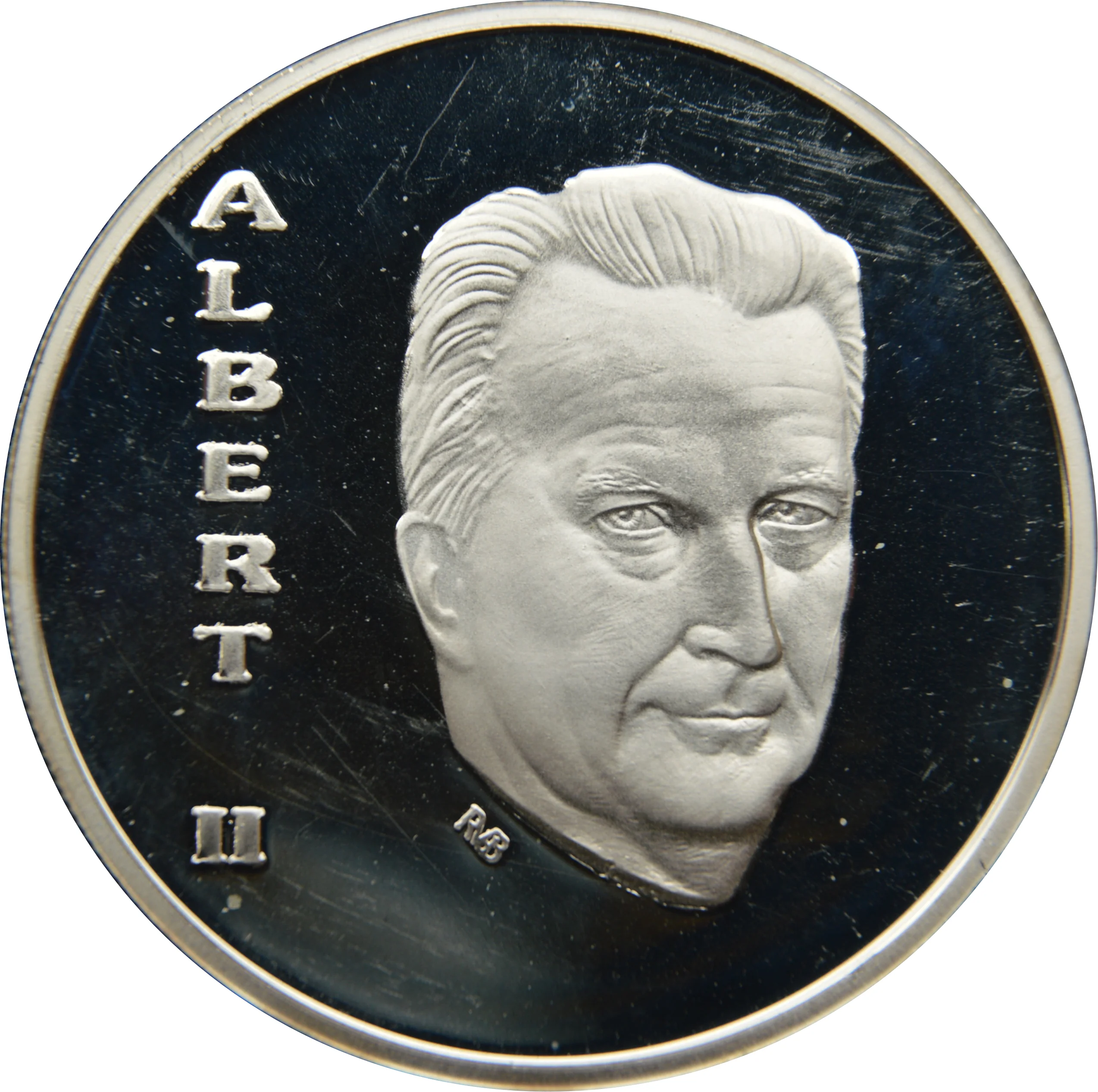
Obverse
Description:
King Albert II in right profile. Name left, designer initials below.
Inscription:
ALBERT II
RVB
RVB
Script: Latin
Engraver: Roland van den Broucke
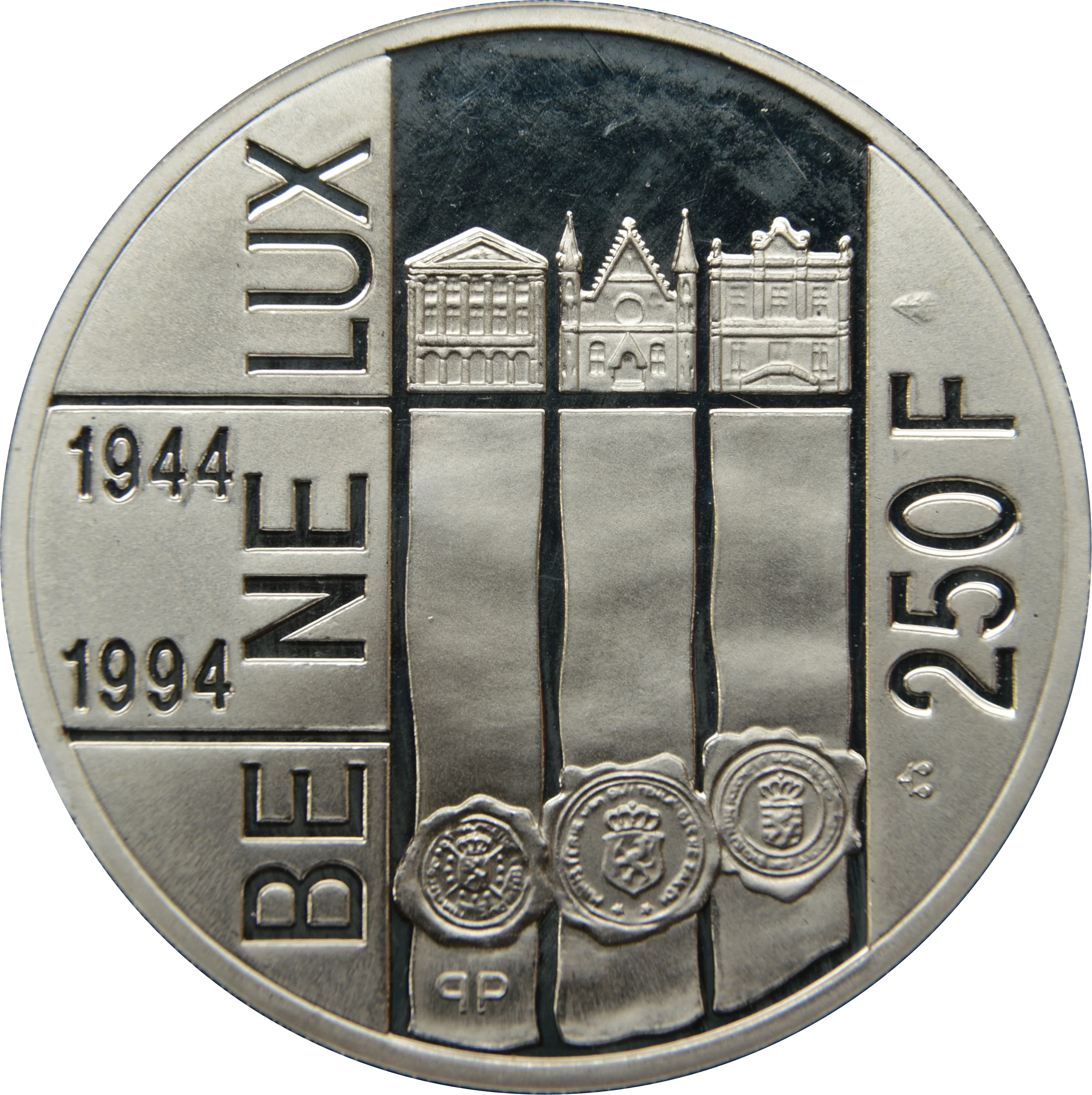
Reverse
Description:
Three parliament buildings (Belgium, Netherlands, Luxembourg) with national seal ribbons below. Left side: dates and country abbreviations. Right side: value, privy, and mint mark. Quality mark at bottom.
Inscription:
BE NE LUX
1944-1994
250 F
qp
1944-1994
250 F
qp
Translation:
Be light to the Netherlands
1944-1994
250 Francs
1944-1994
250 Francs
Script: Latin
Engraver: Jan Alfons Keustermans
Edge
Reeded
Categories
| Symbols> Coat of Arms |
| Building> Governmental building |
| Event> Treaty |
Mints
| Name | Mark |
|---|---|
| Royal Mint of Belgium | — |
Mintings
| Year | Mint Mark | Mintage | Quality | Collection |
|---|---|---|---|---|
| 1994 | — | 90,000 | ||
| 1994 | — | 31,800 | Proof |
Historical background
In 1994, Belgium's currency situation was firmly anchored within the European Monetary System (EMS), operating under the Belgian franc (BEF). The country was a core and committed participant in the process of European economic and monetary integration, having been a founding member of the European Economic Community. The Belgian franc was pegged within the Exchange Rate Mechanism (ERM), a system designed to reduce exchange rate variability and achieve monetary stability in Europe in preparation for a single currency. This period followed the significant turbulence of the 1992-1993 EMS crises, which had forced a widening of the ERM fluctuation bands to ±15%, providing the Belgian franc with much greater breathing room and helping to ensure its stability.
Domestically, the Belgian franc faced ongoing challenges related to the country's high public debt, which exceeded 130% of GDP, one of the highest in the industrialized world. This debt burden created persistent pressure on the currency and required high interest rates to maintain investor confidence and the franc's ERM parity. The National Bank of Belgium, therefore, prioritized exchange rate stability and low inflation as its core policies, effectively using the EMS framework as an external discipline to anchor monetary policy and control inflationary pressures, which were kept relatively in check.
The year 1994 was a quiet but crucial preparatory phase on the path to the Euro. Belgium was actively working to meet the strict convergence criteria (on inflation, interest rates, budget deficits, and debt) outlined in the 1992 Maastricht Treaty. While the debt criterion was a formidable obstacle, the government was implementing fiscal consolidation measures. The stability of the Belgian franc within the loosened ERM bands during this period was seen as a key success, building the necessary credibility for Belgium to eventually qualify for the first wave of Economic and Monetary Union (EMU) and adopt the Euro in 1999.
Domestically, the Belgian franc faced ongoing challenges related to the country's high public debt, which exceeded 130% of GDP, one of the highest in the industrialized world. This debt burden created persistent pressure on the currency and required high interest rates to maintain investor confidence and the franc's ERM parity. The National Bank of Belgium, therefore, prioritized exchange rate stability and low inflation as its core policies, effectively using the EMS framework as an external discipline to anchor monetary policy and control inflationary pressures, which were kept relatively in check.
The year 1994 was a quiet but crucial preparatory phase on the path to the Euro. Belgium was actively working to meet the strict convergence criteria (on inflation, interest rates, budget deficits, and debt) outlined in the 1992 Maastricht Treaty. While the debt criterion was a formidable obstacle, the government was implementing fiscal consolidation measures. The stability of the Belgian franc within the loosened ERM bands during this period was seen as a key success, building the necessary credibility for Belgium to eventually qualify for the first wave of Economic and Monetary Union (EMU) and adopt the Euro in 1999.

🌱 Fairly Common