

1000 Dalasis (World Wildlife Fund) – The Gambia
Non-circulating coins
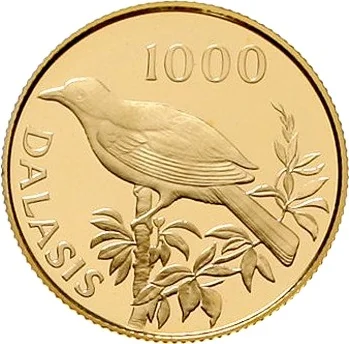
Commemoration: 25th anniversary of the World Wildlife Fund (WWF)
Gambia
Context
Year: 1987
Country: Gambia 
Issuer: The Gambia
Period:
(since 1970)
Currency:
(since 1971)
Total mintage: 5,000
Material
References
KM: #Click to copy to clipboard25
Numista: #76863
Value
Exchange value: 1000 GMD
Bullion value: $1531.51
Obverse
Description:
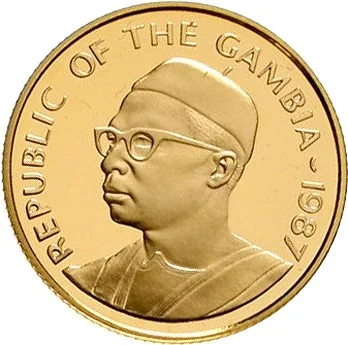
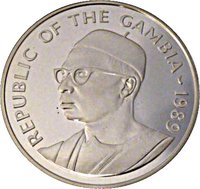
Bust of Sir Dawda Kairaba Jawara on left, caption and date encircling.
Inscription:
REPUBLIC OF THE GAMBIA - 1987
Script: Latin
Engraver: Michael Rizzello
Reverse
Edge
Mintings
| Year | Mint Mark | Mintage | Quality | Collection |
|---|---|---|---|---|
| 1987 | — | 5,000 | Prooflike |
Historical background
In 1987, The Gambia's currency situation was characterized by its reliance on the Gambian dalasi, which had been introduced in 1971 to replace the Gambian pound. However, the decade preceding 1987 was one of significant economic strain. The country, heavily dependent on groundnut exports, suffered from severe droughts in the early 1970s and a sharp decline in world prices for its primary commodity. This led to persistent trade deficits, dwindling foreign exchange reserves, and mounting external debt, placing substantial pressure on the dalasi's value and the country's overall monetary stability.
The government's response, under President Sir Dawda Jawara, was a series of structural adjustment programs (SAPs) negotiated with the International Monetary Fund (IMF) and the World Bank, beginning with a major program in 1985/86. A cornerstone of these reforms was a move towards a more flexible and market-determined exchange rate. In 1986, The Gambia officially shifted from a fixed peg to a managed float of the dalasi. By 1987, this policy was in effect, leading to a significant devaluation intended to boost the competitiveness of exports, discourage imports, and correct the balance of payments deficit, albeit at the cost of higher inflation for consumers.
Consequently, the currency situation in 1987 was one of transition and adjustment. The dalasi was depreciating under the new floating regime, a painful but deliberate policy tool to restructure the economy. This period was marked by austerity measures, rising costs of living, and economic hardship for many Gambians, but it was viewed by international financial institutions as a necessary correction to stabilize the macroeconomic foundation and attract foreign aid and investment for future growth.
The government's response, under President Sir Dawda Jawara, was a series of structural adjustment programs (SAPs) negotiated with the International Monetary Fund (IMF) and the World Bank, beginning with a major program in 1985/86. A cornerstone of these reforms was a move towards a more flexible and market-determined exchange rate. In 1986, The Gambia officially shifted from a fixed peg to a managed float of the dalasi. By 1987, this policy was in effect, leading to a significant devaluation intended to boost the competitiveness of exports, discourage imports, and correct the balance of payments deficit, albeit at the cost of higher inflation for consumers.
Consequently, the currency situation in 1987 was one of transition and adjustment. The dalasi was depreciating under the new floating regime, a painful but deliberate policy tool to restructure the economy. This period was marked by austerity measures, rising costs of living, and economic hardship for many Gambians, but it was viewed by international financial institutions as a necessary correction to stabilize the macroeconomic foundation and attract foreign aid and investment for future growth.
✨ Legendary