

3 Rubles – Russian Federation
Non-circulating coins
Commemoration: The Millennium of Founding the City of Kazan
Russia
Context
Year: 2005
Country: Russia 
Issuer: Russian Federation
Period:
(since 1991)
Currency:
(since 1998)
Total mintage: 10,000
Material
References
Value
Exchange value: 3 RUB
Bullion value: $88.08
Inflation-adjusted value: 17.49 RUB
Obverse
Description:
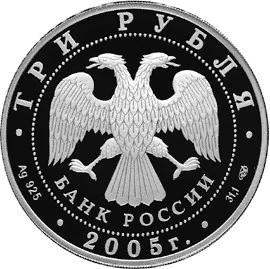
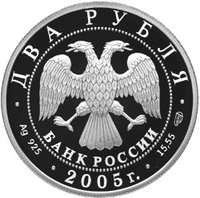
Center: Bank of Russia emblem [two-headed eagle, wings down, with "БАНК РОССИИ" below], circled by dots. Rim inscriptions: top – "ТРИ РУБЛЯ", bottom – year "2005". Left: metal/fineness. Right: metal content/mint mark.
Inscription:
ТРИ РУБЛЯ
БАНК РОССИИ
• Ag 925 • 2005 г. • 31,1 СПМД •
БАНК РОССИИ
• Ag 925 • 2005 г. • 31,1 СПМД •
Translation:
THREE RUBLES
BANK OF RUSSIA
• Ag 925 • 2005 • 31.1 SPMD •
BANK OF RUSSIA
• Ag 925 • 2005 • 31.1 SPMD •
Language: Russian
Designer and engraver: Alexander Vasilyevich Baklanov
Reverse
Description:
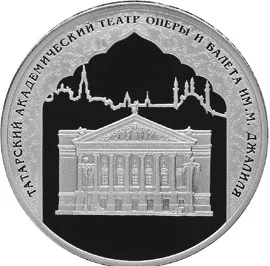
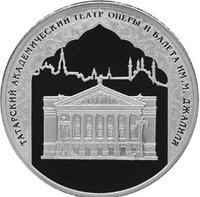
The cartouche features the theatre's building against Kazan's skyline, encircled by the inscription "ТАТАРСКИЙ АКАДЕМИЧЕСКИЙ ТЕАТР ОПЕРЫ И БАЛЕТА ИМ. М. ДЖАЛИЛЯ" on a matted, ornamented field.
Inscription:
ТАТАРСКИЙ АКАДЕМИЧЕСКИЙ ТЕАТР ОПЕРЫ И БАЛЕТА ИМ. М. ДЖАЛИЛЯ
Translation:
M. JALIL TATAR ACADEMIC THEATRE OF OPERA AND BALLET
Script: Cyrillic
Language: Russian
Engraver: Elena Ivanovna Novikova
Designer: Anton Dmitrievich Schablykin
Edge
300 corrugations
Mints
| Name | Mark |
|---|---|
| Saint Petersburg | (СПМД) |
Mintings
| Year | Mint Mark | Mintage | Quality | Collection |
|---|---|---|---|---|
| 2005 | СПМД | 10,000 | Proof |
Historical background
In 2005, the Russian Federation's currency situation was characterized by robust stability and significant accumulation of reserves, marking a period of stark contrast to the financial crises of the 1990s. This stability was underpinned by a potent combination of high global oil prices—with Urals crude averaging over $50 per barrel—and a strict fiscal policy embodied by the newly created Stabilization Fund. The fund sequestered windfall oil revenues, insulating the budget and the economy from commodity price volatility. The Central Bank of Russia (CBR) maintained a managed float regime, allowing the ruble to appreciate gradually against a bi-currency basket (USD and EUR) to combat inflation, which remained a persistent concern despite falling to a historically low 10.9% that year.
The period saw sustained upward pressure on the ruble from strong capital inflows, driven by both high commodity export earnings and renewed foreign investor interest in Russia's growing economy. To prevent excessive appreciation that could harm non-oil exports, the CBR actively intervened in foreign exchange markets, purchasing billions of dollars. These interventions led to a massive expansion of international reserves, which soared past $180 billion, positioning Russia among the world's top reserve holders. This reserve stockpile served as a critical safety net and a symbol of regained economic sovereignty.
However, this stable facade contained underlying vulnerabilities and policy tensions. The CBR faced a complex "trilemma," balancing currency stability, independent monetary policy, and free capital flows. Sterilizing its forex interventions to curb money supply growth was costly and increasingly difficult. Furthermore, the ruble's real effective exchange rate appreciated significantly, raising competitiveness concerns for domestic industry. While 2005 represented a peak of post-crisis calm and strength, the economy's deepening dependence on raw material exports and the challenges of managing large-scale petrodollar inflows highlighted structural issues that would later be tested by the 2008-2009 global financial crisis.
The period saw sustained upward pressure on the ruble from strong capital inflows, driven by both high commodity export earnings and renewed foreign investor interest in Russia's growing economy. To prevent excessive appreciation that could harm non-oil exports, the CBR actively intervened in foreign exchange markets, purchasing billions of dollars. These interventions led to a massive expansion of international reserves, which soared past $180 billion, positioning Russia among the world's top reserve holders. This reserve stockpile served as a critical safety net and a symbol of regained economic sovereignty.
However, this stable facade contained underlying vulnerabilities and policy tensions. The CBR faced a complex "trilemma," balancing currency stability, independent monetary policy, and free capital flows. Sterilizing its forex interventions to curb money supply growth was costly and increasingly difficult. Furthermore, the ruble's real effective exchange rate appreciated significantly, raising competitiveness concerns for domestic industry. While 2005 represented a peak of post-crisis calm and strength, the economy's deepening dependence on raw material exports and the challenges of managing large-scale petrodollar inflows highlighted structural issues that would later be tested by the 2008-2009 global financial crisis.
💎 Extremely Rare