

2 euro – Belgium
Add to wishlist
Non-circulating coins
Commemoration: 2015 - European Year for Development
Belgium
Obverse
Description:
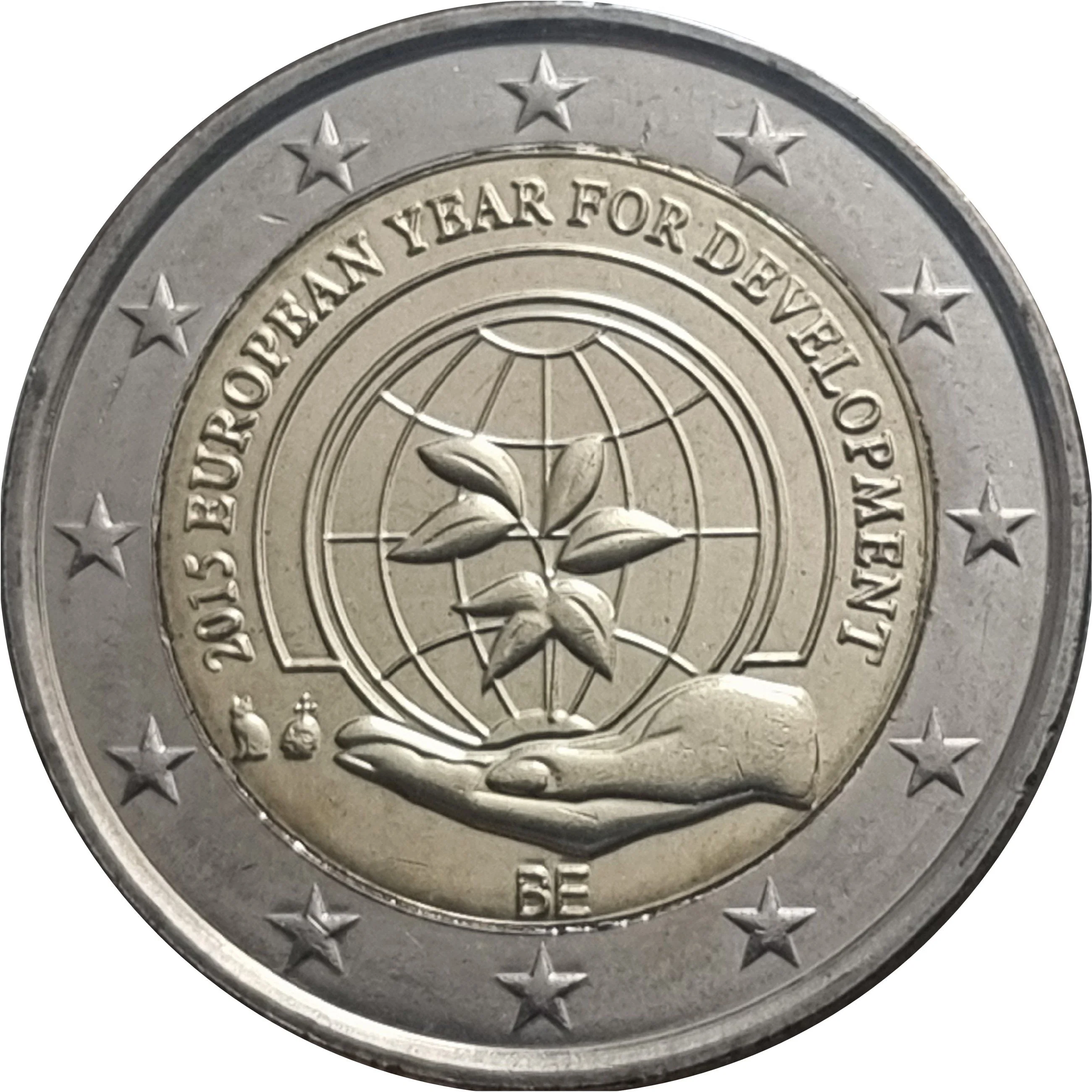
The inner design shows a hand holding a globe with a plant, above which is the arched inscription ‘2015 EUROPEAN YEAR FOR DEVELOPMENT’. Beneath the hand is the country code ‘BE’, to its left the mintmaster’s mark and the Brussels mint mark (the helmeted profile of Archangel Michael). The outer ring features the 12 stars of the EU.
Inscription:
2015 EUROPEAN YEAR FOR DEVELOPMENT
BE
BE
Translation:
2015 EUROPEAN YEAR FOR DEVELOPMENT
BE
BE
Script: Latin
Engraver: Luc Luycx
Reverse
Edge
Reeded with inscription
Legend:
2 ** 2 ** 2 ** 2 ** 2 ** 2 **
Mints
| Name | Mark |
|---|---|
| Royal Mint of Belgium | — |
Mintings
| Year | Mint Mark | Mintage | Quality | Collection |
|---|---|---|---|---|
| 2015 | — | 235,000 | BU | |
| 2015 | — | 15,000 | Proof |
Historical background
In 2015, Belgium, as a founding member of the Eurozone, operated exclusively with the euro (€), having fully replaced the Belgian franc in 2002. The country's monetary policy was therefore not set domestically but by the European Central Bank (ECB), which was engaged in expansive measures to combat low inflation and stimulate the euro area economy following the European debt crisis. For Belgium, this meant benefiting from historically low interest rates, which helped manage its significant public debt—one of the highest in Europe at around 106% of GDP—while also supporting economic growth that was projected at approximately 1.4% for the year.
Domestically, the currency situation was stable, but the euro's external value was a key economic factor. A notably weak euro, partly driven by the ECB's quantitative easing program launched in March 2015, provided a crucial boost to Belgium's export-oriented economy. Major sectors like chemicals, pharmaceuticals, and machinery benefited from increased competitiveness in global markets. However, this environment also kept inflationary pressures exceptionally low, a concern shared across the continent.
The year was not without monetary-related tensions, primarily political rather than economic. There was no serious discussion of leaving the euro, but the common currency was a backdrop to broader EU stresses, including the Greek government-debt crisis and the "Grexit" debate. Furthermore, Belgium's complex federal structure meant that fiscal policy—the primary tool left to national authorities—was often a subject of intense negotiation between regional governments, with debates on taxation and spending occurring within the constraints of Eurozone stability and deficit rules.
Domestically, the currency situation was stable, but the euro's external value was a key economic factor. A notably weak euro, partly driven by the ECB's quantitative easing program launched in March 2015, provided a crucial boost to Belgium's export-oriented economy. Major sectors like chemicals, pharmaceuticals, and machinery benefited from increased competitiveness in global markets. However, this environment also kept inflationary pressures exceptionally low, a concern shared across the continent.
The year was not without monetary-related tensions, primarily political rather than economic. There was no serious discussion of leaving the euro, but the common currency was a backdrop to broader EU stresses, including the Greek government-debt crisis and the "Grexit" debate. Furthermore, Belgium's complex federal structure meant that fiscal policy—the primary tool left to national authorities—was often a subject of intense negotiation between regional governments, with debates on taxation and spending occurring within the constraints of Eurozone stability and deficit rules.
🌱 Common