

1 Sapeque – French Indochina
Context
Years: 1887–1902
Issuer: French Indochina
Period:
(1870—1940)
Currency:
(1880—1952)
Demonetized: Yes
Total mintage: 35,000,200
Material
Diameter: 20 mm
Weight: 2.01 g
Thickness: 0.8 mm
Shape: Round with a square hole
Composition: Bronze
Magnetic: No
Technique: Milled
Alignment: Coin alignment
flip
References
KM: #Click to copy to clipboard6
Numista: #11331
Value
Exchange value: 0.002 ICFP
Obverse
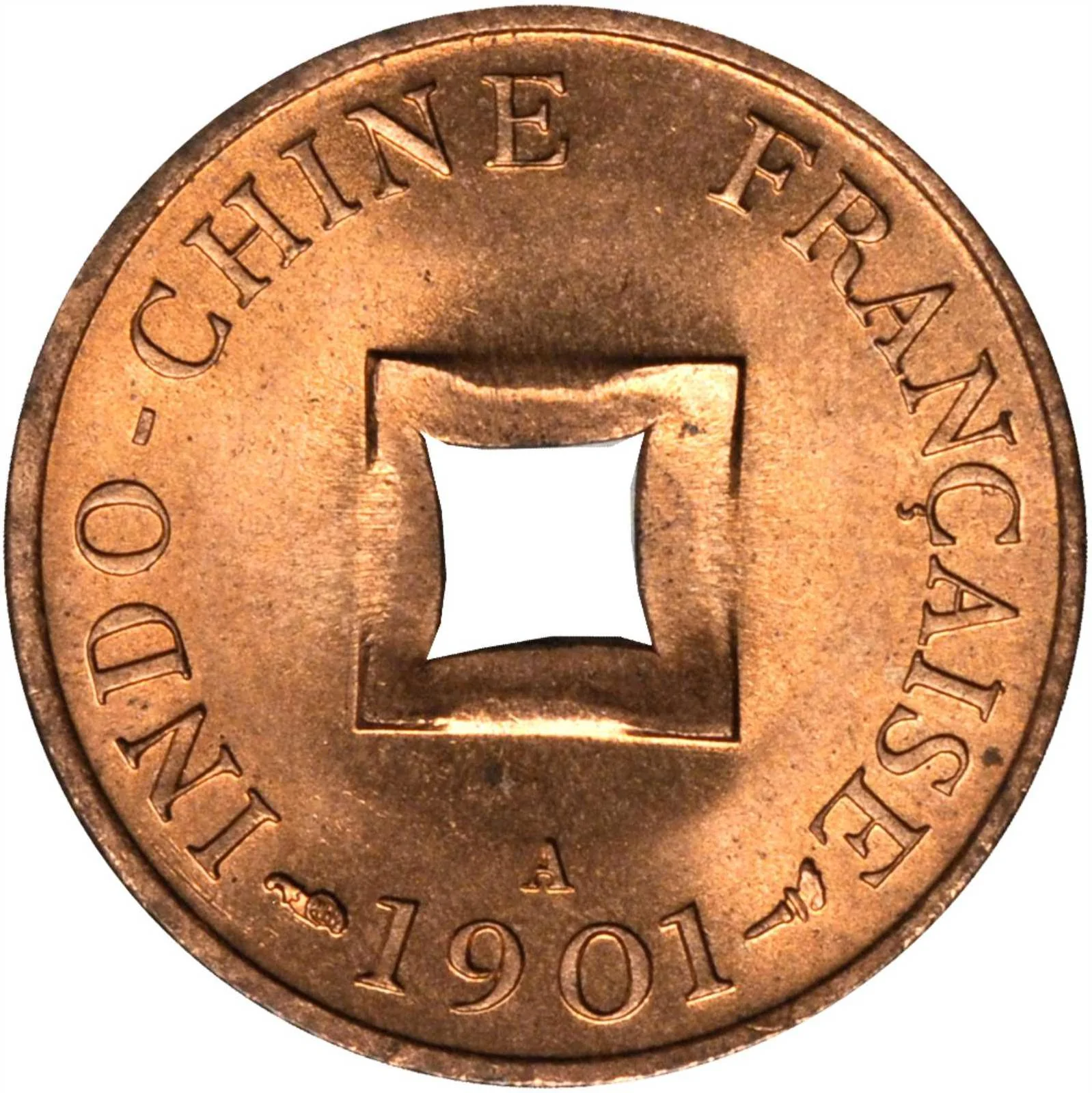
Description:
Lettering around square hole, date beneath.
Inscription:
INDO-CHINE FRANÇAISE
A
1901
A
1901
Translation:
FRENCH INDO-CHINA
A
1901
A
1901
Script: Latin
Language: French
Engraver: Jean-Auguste Barre
Reverse
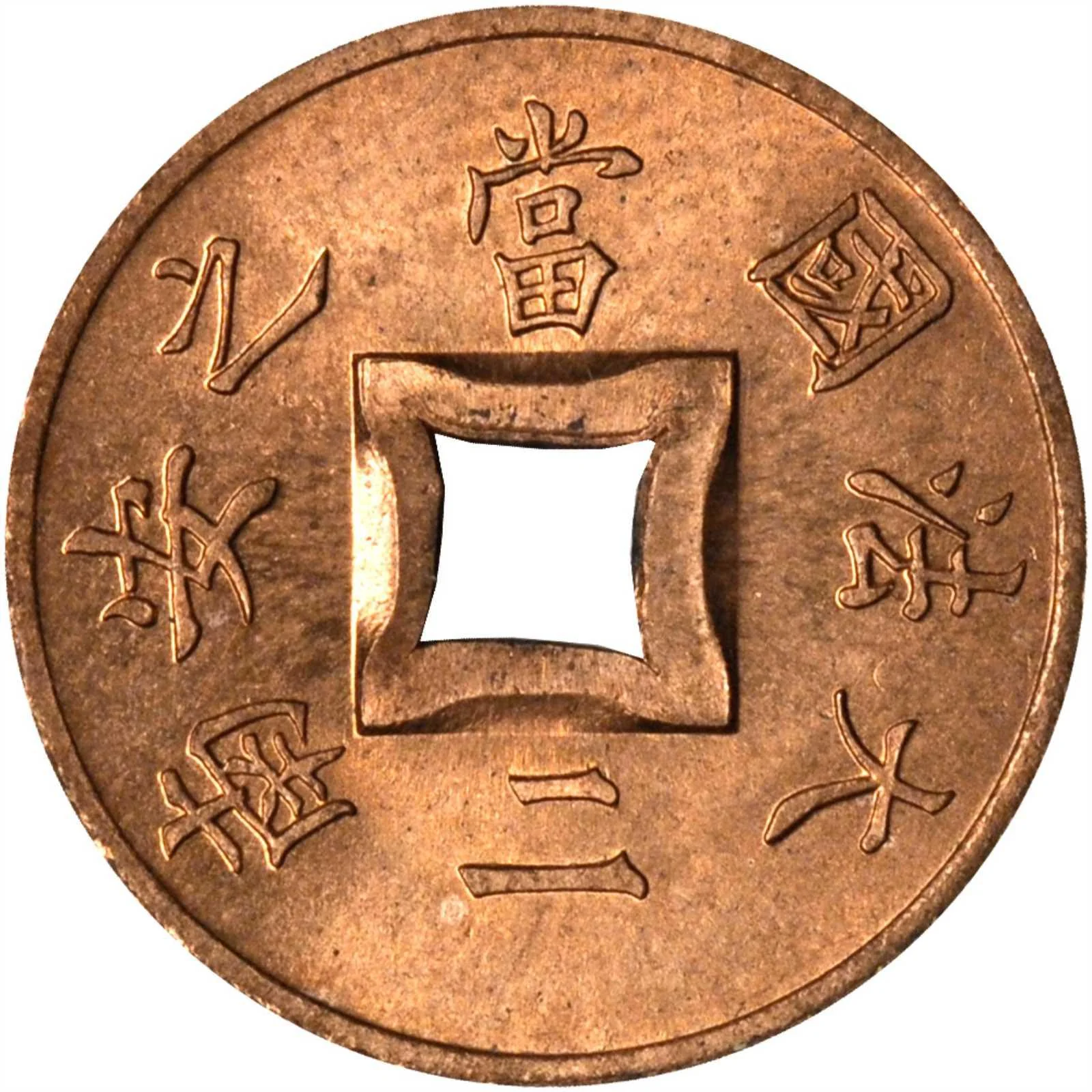
Description:
Chinese characters encircling a square opening.
Inscription:
南安之國法大
當二
當二
Translation:
State of Nan'an, Legal Tally
Value Two
Value Two
Script: Chinese
Language: Classical Chinese
Engraver: Jean-Auguste Barre
Edge
Plain
Mints
| Name | Mark |
|---|---|
| Monnaie de Paris | (A) |
Mintings
| Year | Mint Mark | Mintage | Quality | Collection |
|---|---|---|---|---|
| 1887 | A | 5,000,000 | ||
| 1888 | A | 5,000,000 | ||
| 1889 | A | 100 | Proof | |
| 1892 | A | 1,636,000 | ||
| 1893 | A | 864,000 | ||
| 1894 | A | 2,500,000 | ||
| 1897 | A | 2,829,000 | ||
| 1898 | A | 2,171,000 | ||
| 1899 | A | 5,000,000 | ||
| 1900 | A | 100 | Proof | |
| 1900 | A | 2,657,000 | ||
| 1901 | A | 4,843,000 | ||
| 1902 | A | 2,500,000 |
Historical background
In 1887, the currency situation in French Indochina was complex and transitional, reflecting the region's recent political consolidation. The French had formally established the Indochinese Union just that year, bringing together the protectorates of Annam, Tonkin, and Cambodia with the colony of Cochinchina. Each territory historically operated with its own monetary systems, primarily based on silver in various forms: Mexican and Spanish silver dollars (piastres), local silver ingots, and copper-alloy cash coins with square holes strung together in strings. This patchwork created significant challenges for colonial administration and trade.
The French colonial authorities were actively attempting to impose monetary order by promoting the French Indochinese Piastre. First minted in 1885, this silver coin was intended to become the unified standard, replacing the plethora of foreign and local silver in circulation. However, in 1887, its adoption was still incomplete and faced resistance. The traditional economies, particularly in Annam and Tonkin, remained deeply attached to the familiar zinc and copper-alloy cash coins for everyday transactions, while larger commerce and international trade still relied heavily on the older Mexican silver dollars.
Consequently, the monetary landscape was one of competing systems operating simultaneously. The colonial government fixed exchange rates between the new piastre, the old silver dollars, and the strings of cash coins, but these official rates often conflicted with fluctuating market values, leading to instability and opportunities for arbitrage. This period was therefore characterized by a tense duality: a top-down effort to create a modern, centralized currency for colonial economic integration, existing uneasily alongside deeply entrenched, localized metallic currencies that sustained the daily life of the majority of the population.
The French colonial authorities were actively attempting to impose monetary order by promoting the French Indochinese Piastre. First minted in 1885, this silver coin was intended to become the unified standard, replacing the plethora of foreign and local silver in circulation. However, in 1887, its adoption was still incomplete and faced resistance. The traditional economies, particularly in Annam and Tonkin, remained deeply attached to the familiar zinc and copper-alloy cash coins for everyday transactions, while larger commerce and international trade still relied heavily on the older Mexican silver dollars.
Consequently, the monetary landscape was one of competing systems operating simultaneously. The colonial government fixed exchange rates between the new piastre, the old silver dollars, and the strings of cash coins, but these official rates often conflicted with fluctuating market values, leading to instability and opportunities for arbitrage. This period was therefore characterized by a tense duality: a top-down effort to create a modern, centralized currency for colonial economic integration, existing uneasily alongside deeply entrenched, localized metallic currencies that sustained the daily life of the majority of the population.
🌱 Fairly Common