

2½ cents – Netherlands Antilles
Add to wishlist
Netherlands
Context
Years: 1979–1985
Country: Netherlands
Issuer: Netherlands Antilles
Ruler: Juliana
Currency:
(since 1828)
Demonetized: Yes
Total mintage: 9,138,000
Material
References
KM: #
Numista: #7660
Value
Exchange value: 0.025 ANG
Inflation-adjusted value: 0.08 ANG
Obverse
Description:
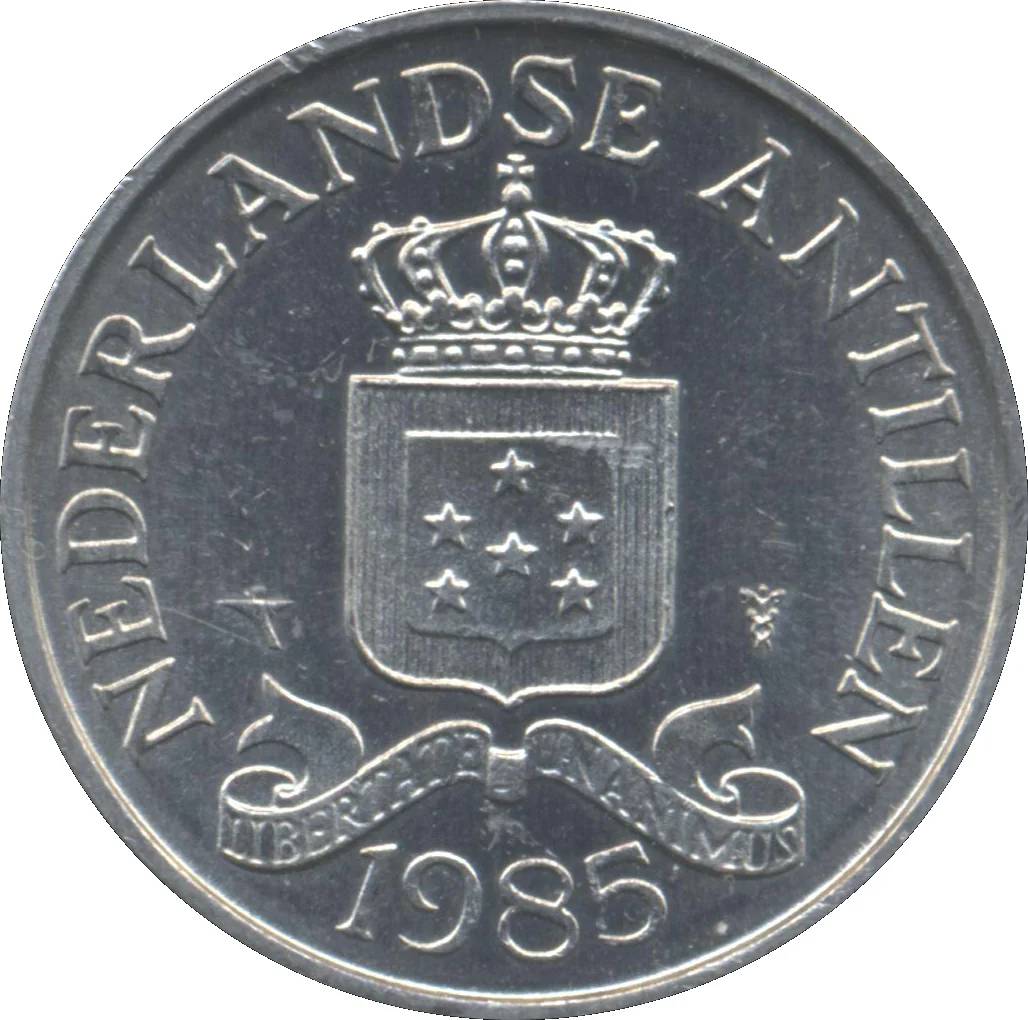
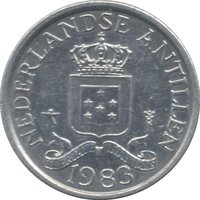
Coat of arms of the Netherlands Antilles with motto.
Inscription:
NEDERLANDSE ANTILLEN
LIBERTATE UNANIMUS
1985
LIBERTATE UNANIMUS
1985
Translation:
Unanimous in Freedom
1985
1985
Script: Latin
Engraver: Geurt Brinkgreve
Reverse
Description:
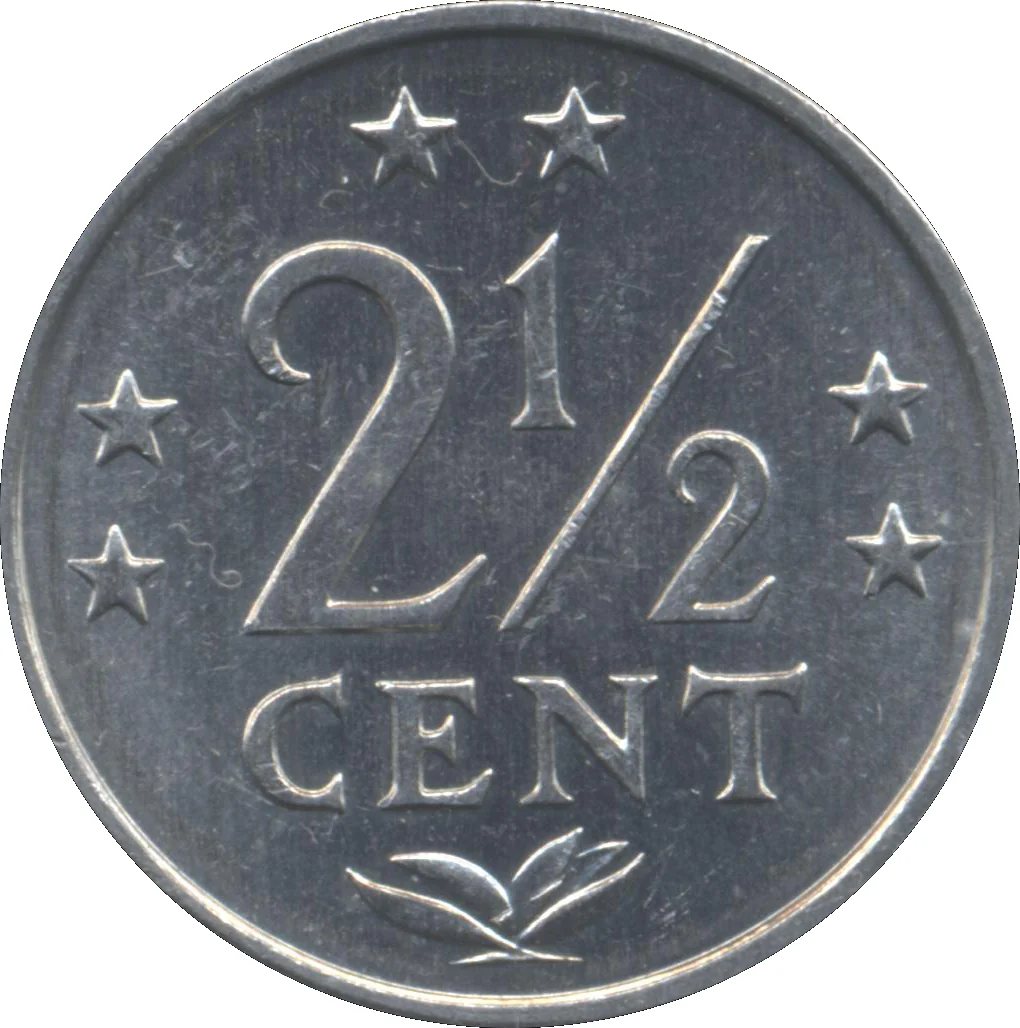
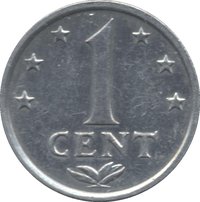
Two stars flank and crown the value, with agave leaves below.
Inscription:
2½
CENT
CENT
Script: Latin
Engraver: Geurt Brinkgreve
Edge
Plain
Categories
| Symbol> Crown |
| Symbols> Coat of Arms |
Mints
| Name | Mark |
|---|---|
| Royal Dutch Mint | — |
Mintings
| Year | Mint Mark | Mintage | Quality | Collection |
|---|---|---|---|---|
| 1979 | — | 2,012,000 | ||
| 1979 | — | — | Proof | |
| 1980 | — | 2,018,000 | ||
| 1981 | — | 1,023,000 | ||
| 1982 | — | 1,010,000 | ||
| 1983 | — | 1,025,000 | ||
| 1984 | — | 1,026,000 | ||
| 1985 | — | 1,024,000 |
Historical background
In 1979, the currency situation in the Netherlands Antilles was defined by the Antillean guilder (ANG), a stable and long-established currency pegged to the U.S. dollar. This peg, set at a fixed rate of 1.79 ANG to 1 USD, had been in place since 1971 and was managed by the central bank of the islands, the Bank van de Nederlandse Antillen (Bank of the Netherlands Antilles). This arrangement provided crucial monetary stability for the federation's open, tourism-dependent economy, insulating it from exchange rate volatility and fostering confidence for international trade and investment, particularly with its largest economic partner, the United States.
The currency's stability, however, existed within a complex political and economic context. The federation was undergoing significant change, having lost Aruba (which would soon begin its push for a "Status Aparte") and with remaining islands like Curaçao and Sint Maarten experiencing growing economic and political autonomy. Furthermore, the local economy was still grappling with the aftermath of the 1970s oil shocks and the 1975 closure of the Shell refinery on Curaçao, a major economic pillar. The fixed peg, while a source of stability, also meant the islands imported U.S. monetary policy, which could sometimes be misaligned with local economic conditions.
Thus, the currency regime in 1979 was a cornerstone of economic policy, symbolizing both the Netherlands Antilles' connection to the global economy and its enduring administrative ties to the Kingdom of the Netherlands. It functioned effectively as a tool for managing a small, open economy, but its future would become intertwined with the escalating political discussions about the constitutional future and eventual dissolution of the Netherlands Antilles federation itself.
The currency's stability, however, existed within a complex political and economic context. The federation was undergoing significant change, having lost Aruba (which would soon begin its push for a "Status Aparte") and with remaining islands like Curaçao and Sint Maarten experiencing growing economic and political autonomy. Furthermore, the local economy was still grappling with the aftermath of the 1970s oil shocks and the 1975 closure of the Shell refinery on Curaçao, a major economic pillar. The fixed peg, while a source of stability, also meant the islands imported U.S. monetary policy, which could sometimes be misaligned with local economic conditions.
Thus, the currency regime in 1979 was a cornerstone of economic policy, symbolizing both the Netherlands Antilles' connection to the global economy and its enduring administrative ties to the Kingdom of the Netherlands. It functioned effectively as a tool for managing a small, open economy, but its future would become intertwined with the escalating political discussions about the constitutional future and eventual dissolution of the Netherlands Antilles federation itself.
🌱 Very Common