

1 Dollar – Guyana
Circulating commemorative coins
Commemoration: FAO - Food for all / Proclamation of Republic
Guyana
Context
Year: 1970
Issuer: Guyana 
Issuing organization: Bank of Guyana
Period:
(since 1970)
Currency:
(since 1965)
Total mintage: 505,000
Material
References
KM: #Click to copy to clipboard36
Numista: #7634
Value
Exchange value: 1 GYD
Obverse
Description:
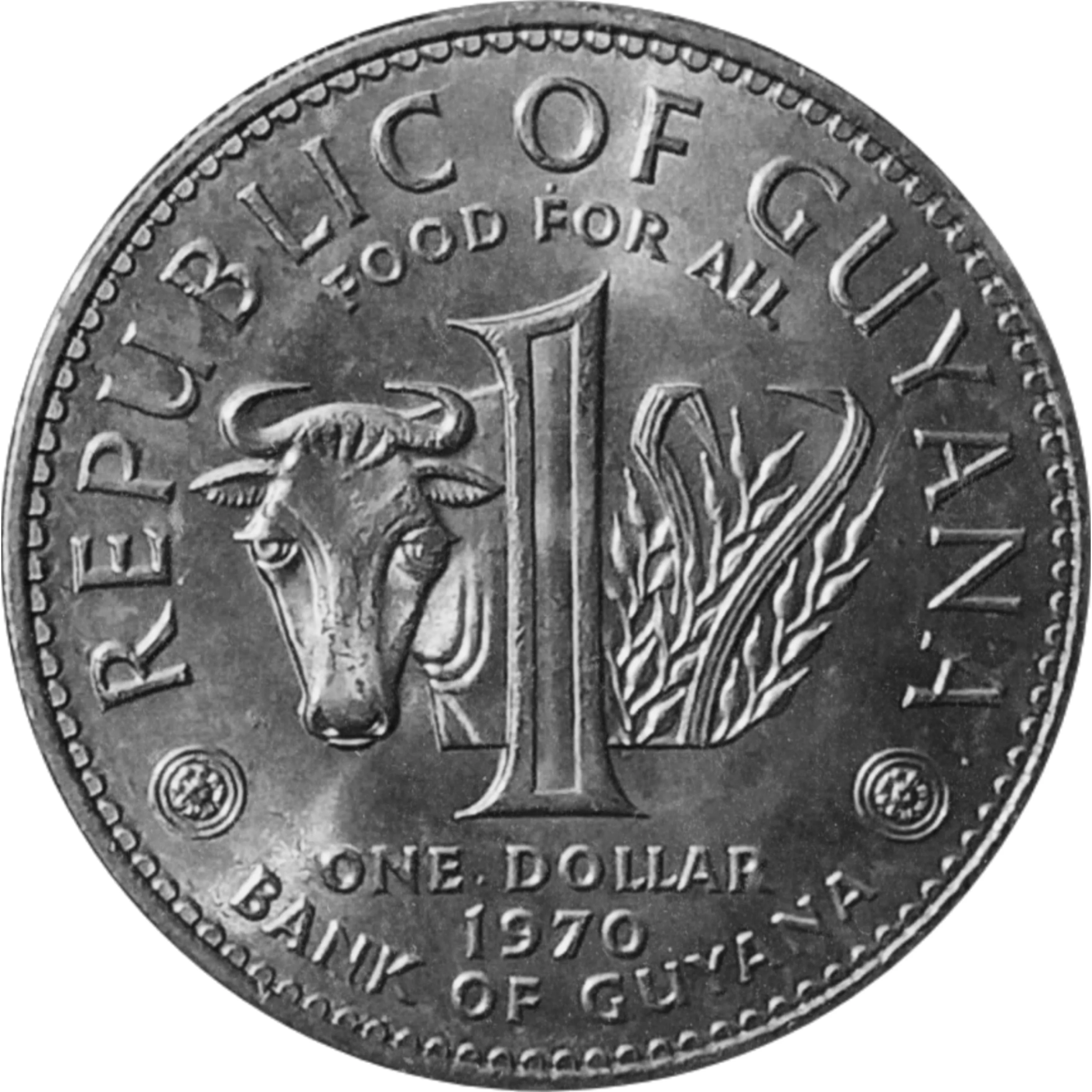
Bull left, stalks right of value.
Inscription:
REPUBLIC OF GUYANA
FOOD FOR ALL
1
ONE DOLLAR
1970
BANK OF GUYANA
FOOD FOR ALL
1
ONE DOLLAR
1970
BANK OF GUYANA
Script: Latin
Reverse
Description:
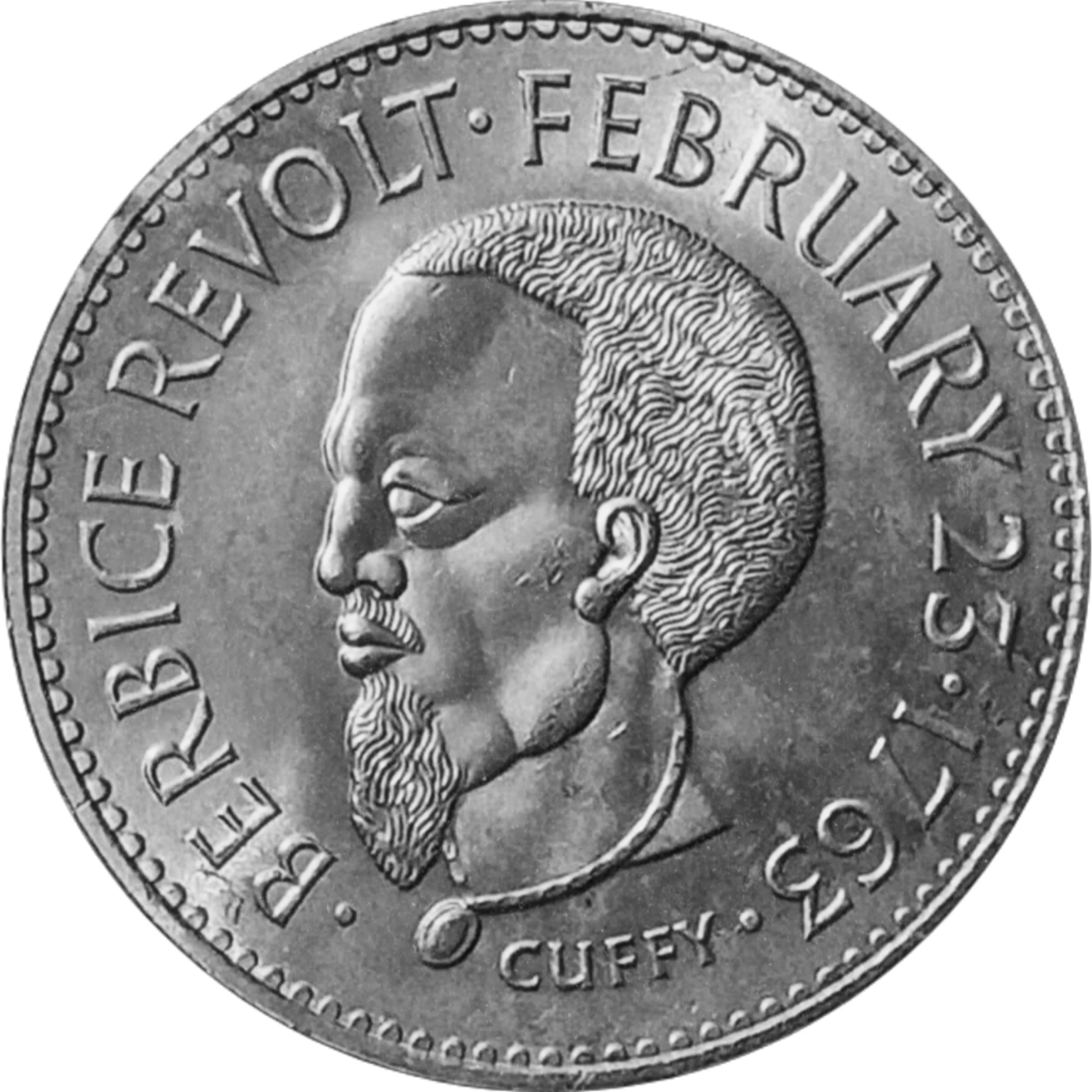
Chief Cuffy has departed.
Inscription:
BERBICE REVOLT FEBRUARY 23 1763
CUFFY
CUFFY
Script: Latin
Edge
Reeded
Categories
| Mustache/Beard |
| Organization> FAO |
| Animal> Cow |
| Person> Military leader |
Mints
| Name | Mark |
|---|---|
| Royal Mint (Tower Hill) | — |
Mintings
| Year | Mint Mark | Mintage | Quality | Collection |
|---|---|---|---|---|
| 1970 | — | 500,000 | ||
| 1970 | — | 5,000 | Proof |
Historical background
In 1970, Guyana's currency situation was intrinsically linked to its political transformation, as the nation transitioned to a cooperative republic and severed its final constitutional ties with the British monarchy. The official currency remained the Guyanese dollar (GYD), which had been introduced in 1965 to replace the British West Indies dollar, establishing a distinct national monetary identity. It was pegged to the British pound sterling at a fixed rate of GYD$4.80 to £1, a legacy of colonial economic structures that continued to orient Guyana's financial system towards London.
Economically, the period was one of strain and cautious state control under Prime Minister Forbes Burnham's People's National Congress (PNC). The government was pursuing a path of "cooperative socialism," which involved nationalizing key foreign-owned industries, particularly the dominant sugar and bauxite sectors. This ambitious agenda, combined with fluctuating global commodity prices, placed pressure on foreign reserves and the stability of the currency peg. While not in a crisis of hyperinflation or devaluation in 1970 specifically, the foundational pressures were building, setting the stage for the economic challenges of the coming decade.
Ultimately, the currency situation reflected a young nation navigating its sovereignty. The fixed peg provided a semblance of stability for international trade but within an economic model increasingly focused on state intervention and decolonization. The financial policies of 1970 were thus a balancing act—maintaining external monetary linkages while attempting to forge an independent, socialist-oriented domestic economy, a tension that would define Guyana's financial trajectory throughout the 1970s.
Economically, the period was one of strain and cautious state control under Prime Minister Forbes Burnham's People's National Congress (PNC). The government was pursuing a path of "cooperative socialism," which involved nationalizing key foreign-owned industries, particularly the dominant sugar and bauxite sectors. This ambitious agenda, combined with fluctuating global commodity prices, placed pressure on foreign reserves and the stability of the currency peg. While not in a crisis of hyperinflation or devaluation in 1970 specifically, the foundational pressures were building, setting the stage for the economic challenges of the coming decade.
Ultimately, the currency situation reflected a young nation navigating its sovereignty. The fixed peg provided a semblance of stability for international trade but within an economic model increasingly focused on state intervention and decolonization. The financial policies of 1970 were thus a balancing act—maintaining external monetary linkages while attempting to forge an independent, socialist-oriented domestic economy, a tension that would define Guyana's financial trajectory throughout the 1970s.
🌱 Common