

10 lire – Vatican City
Add to wishlist
Circulating commemorative coins
Commemoration: Jubilee
Vatican City
Context
Year: 1933
Issuer: Vatican City
Ruler: Pius XI
Currency:
(1929—2001)
Demonetized: Yes
Total mintage: 50,000
Material
References
KM: #
Numista: #7618
Value
Exchange value: 10 VAL
Bullion value: $20.28
Obverse
Description:
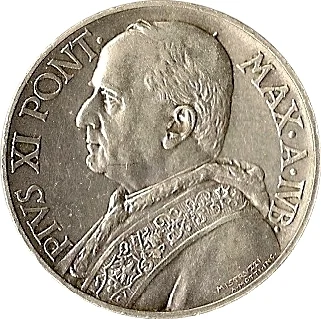
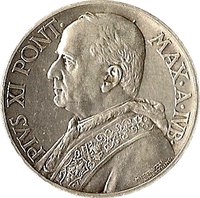
Portrait of Pope Pius XI (1876-1958) with his Latin name and title "Pontifex Maximus."
Inscription:
PIVS XI PONT· MAX·A·IVB
MISTRVZZI
A·MOTTI·INC
MISTRVZZI
A·MOTTI·INC
Script: Latin
Engraver: Aurelio Mistruzzi
Reverse
Description:
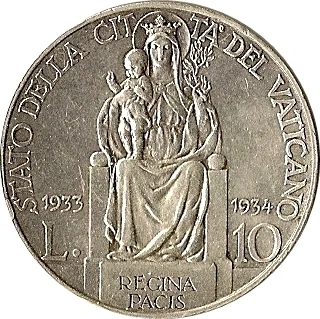
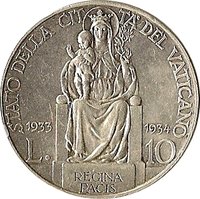
Virgin and Child, Queen of Peace
Inscription:
STATO DELLA CITTA' DEL VATICANO
1933 1934
L.10
REGINA PACIS
1933 1934
L.10
REGINA PACIS
Script: Latin
Engraver: Aurelio Mistruzzi
Edge
Categories
| Person> Religious figure |
| Religion> Religious objects |
Mints
| Name | Mark |
|---|---|
| Rome | — |
Mintings
| Year | Mint Mark | Mintage | Quality | Collection |
|---|---|---|---|---|
| 1933 | — | 50,000 |
Historical background
In 1933, Vatican City's currency situation was intrinsically tied to its unique status as a newly established sovereign entity. The Lateran Treaty of 1929, which created the state, granted it the right to issue its own coinage. However, lacking a central bank or a true national economy, its monetary system was a practical hybrid. The Vatican lira was pegged at par with the Italian lira, making the Italian currency the de facto circulating medium within the tiny city-state's walls. Vatican coins, minted for ceremonial and commemorative purposes, held legal tender status but circulated alongside, and were often overshadowed by, Italian banknotes and coinage.
This arrangement was both a necessity and a strategic choice. Economically, the Vatican's operations—funded by donations, investments, and tourism—were deeply enmeshed with Italy. Adopting the Italian lira ensured seamless financial transactions and stability. Politically, it avoided the complexities of establishing an independent monetary policy for a non-commercial state with a minuscule permanent population. The issuance of its own coinage, therefore, served more as a symbol of sovereignty and a source of numismatic revenue than as a functional economic tool.
The year 1933 itself did not bring a major monetary shift, but the context was shaped by global economic turbulence. The Great Depression impacted the Vatican's investments and the flow of Peter's Pence donations from worldwide faithful. While the lira's stability was managed by the Bank of Italy, the broader financial pressures underscored the Vatican's fiscal vulnerability despite its symbolic monetary autonomy. Thus, the currency situation reflected the broader reality of the Papal State: a sovereign entity in political and religious affairs, yet economically dependent on and integrated with its Italian host.
This arrangement was both a necessity and a strategic choice. Economically, the Vatican's operations—funded by donations, investments, and tourism—were deeply enmeshed with Italy. Adopting the Italian lira ensured seamless financial transactions and stability. Politically, it avoided the complexities of establishing an independent monetary policy for a non-commercial state with a minuscule permanent population. The issuance of its own coinage, therefore, served more as a symbol of sovereignty and a source of numismatic revenue than as a functional economic tool.
The year 1933 itself did not bring a major monetary shift, but the context was shaped by global economic turbulence. The Great Depression impacted the Vatican's investments and the flow of Peter's Pence donations from worldwide faithful. While the lira's stability was managed by the Bank of Italy, the broader financial pressures underscored the Vatican's fiscal vulnerability despite its symbolic monetary autonomy. Thus, the currency situation reflected the broader reality of the Papal State: a sovereign entity in political and religious affairs, yet economically dependent on and integrated with its Italian host.
🌟 Limited