

200 bolivars (Independence) – Venezuela
Add to wishlist
Non-circulating coins
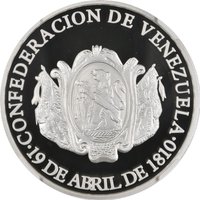
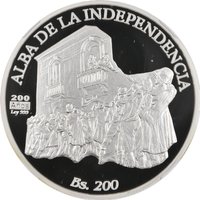
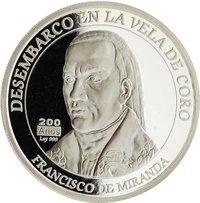
Commemoration: 200th Anniversary of Independence
Venezuela
Context
Year: 2010
Issuer: Venezuela
Period:
(since 1999)
Currency:
(2008—2018)
Demonetization: 2010
Total mintage: 1,500
Material
Diameter: 32 mm
Weight: 31.1 g
Gold Weight:: 31.07 g
Thickness: 2.4 mm
Shape: Round
Composition: 99.9% Gold
Standard: Silver ounce
Magnetic: No
Technique: Milled
Alignment: Coin alignment
flip
References
Y: #
Numista: #76028
Value
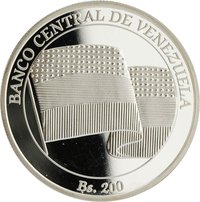
Exchange value: 200 VEF
Bullion value: $4795.46
Obverse
Reverse
Edge
Reeded
Categories
| Symbols> Coat of Arms |
Mintings
| Year | Mint Mark | Mintage | Quality | Collection |
|---|---|---|---|---|
| 2010 | — | 1,500 |
Historical background
In 2010, Venezuela's currency situation was characterized by a complex system of exchange controls that had been in place since 2003. The country operated with a fixed official exchange rate, which was set at 2.15 bolívares fuertes (VEF) to the US dollar for "essential" imports like food and medicine, and a second, slightly depreciated rate of 2.6 for other priority sectors. This system was administered by the Commission for the Administration of Currency Exchange (CADIVI), which required applicants to justify their need for foreign currency. While intended to stem capital flight and preserve international reserves, the controls created significant economic distortions.
Beneath this official framework, a thriving parallel black market for dollars had already become an entrenched feature of the economy. Due to strict quotas, lengthy delays, and widespread corruption in accessing the official rate, businesses and individuals who could not obtain government approval turned to the illegal market. By the end of 2010, the black-market rate had diverged dramatically, trading at approximately 8.2 bolívares per dollar, more than three times the primary official rate. This gap created a powerful incentive for arbitrage and corruption, as those with political connections could obtain cheap dollars from the state and sell them for a massive profit.
President Hugo Chávez, who remained in power, defended the controls as a necessary shield against economic "sabotage." However, the reality was that the overvalued bolívar, combined with high inflation (ending the year at nearly 27%), was severely harming domestic industry. The cheap dollars for imports undermined local production, while the scarcity of legally available currency stifled business investment and led to recurring shortages of consumer goods. Thus, 2010 represented a point where the systemic flaws of the currency control regime were clearly visible, setting the stage for the deeper economic crises and repeated devaluations that would follow in the subsequent decade.
Beneath this official framework, a thriving parallel black market for dollars had already become an entrenched feature of the economy. Due to strict quotas, lengthy delays, and widespread corruption in accessing the official rate, businesses and individuals who could not obtain government approval turned to the illegal market. By the end of 2010, the black-market rate had diverged dramatically, trading at approximately 8.2 bolívares per dollar, more than three times the primary official rate. This gap created a powerful incentive for arbitrage and corruption, as those with political connections could obtain cheap dollars from the state and sell them for a massive profit.
President Hugo Chávez, who remained in power, defended the controls as a necessary shield against economic "sabotage." However, the reality was that the overvalued bolívar, combined with high inflation (ending the year at nearly 27%), was severely harming domestic industry. The cheap dollars for imports undermined local production, while the scarcity of legally available currency stifled business investment and led to recurring shortages of consumer goods. Thus, 2010 represented a point where the systemic flaws of the currency control regime were clearly visible, setting the stage for the deeper economic crises and repeated devaluations that would follow in the subsequent decade.
✨ Legendary