

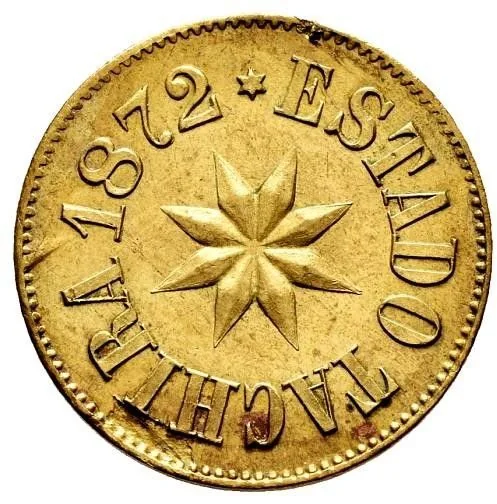
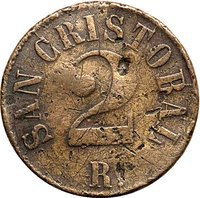
Obverse
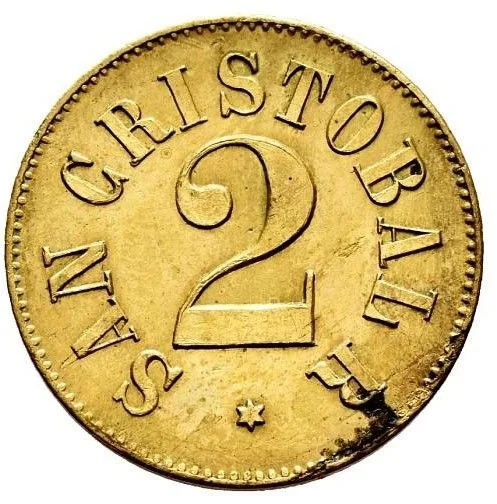
Reverse
Edge
Mints
| Name | Mark |
|---|---|
| San Cristóbal | — |
Mintings
| Year | Mint Mark | Mintage | Quality | Collection |
|---|---|---|---|---|
| 1872 | — | — |
Historical background
In 1872, the state of Táchira, located in the Venezuelan Andes, operated within a national context of profound monetary disorder. Following decades of devastating civil wars, particularly the Federal War (1859-1863), the country's financial system was fractured. The central government in Caracas struggled to assert authority, and the nation was plagued by a severe shortage of metallic coinage, leading to a chaotic circulation of diverse and often devalued currencies. This national crisis formed the essential backdrop for Táchira's specific monetary experience, which was further complicated by its unique geographic and economic position.
Táchira's economy was predominantly agricultural and pastoral, with strong commercial ties across the border with Colombia. This cross-border trade was crucial and created a practical reliance on Colombian currency, primarily silver pesos and gold coins, which were seen as more stable and trustworthy than many Venezuelan issues. Within Venezuela itself, a bewildering array of money circulated, including worn Spanish colonial coins, privately issued tokens or fichas from haciendas and merchants, and heavily discounted paper money from previous governments. The state government in Táchira had little power to control this monetary mosaic, leaving daily transactions to be negotiated based on the perceived value and origin of each coin.
Consequently, the currency situation in Táchira in 1872 was characterized by a de facto bimonetary system, where stable Colombian hard currency coexisted with a variety of devalued and irregular Venezuelan mediums of exchange. This environment created significant challenges for local commerce, pricing, and savings, favoring those with access to foreign coin and disadvantaging those tied to the unstable national currency. It was a period of monetary pragmatism born of necessity, reflecting both Táchira's regional isolation from Caracas and its integration into a more stable cross-border economic zone, setting a precedent for financial autonomy that would mark the state's character for decades.
Táchira's economy was predominantly agricultural and pastoral, with strong commercial ties across the border with Colombia. This cross-border trade was crucial and created a practical reliance on Colombian currency, primarily silver pesos and gold coins, which were seen as more stable and trustworthy than many Venezuelan issues. Within Venezuela itself, a bewildering array of money circulated, including worn Spanish colonial coins, privately issued tokens or fichas from haciendas and merchants, and heavily discounted paper money from previous governments. The state government in Táchira had little power to control this monetary mosaic, leaving daily transactions to be negotiated based on the perceived value and origin of each coin.
Consequently, the currency situation in Táchira in 1872 was characterized by a de facto bimonetary system, where stable Colombian hard currency coexisted with a variety of devalued and irregular Venezuelan mediums of exchange. This environment created significant challenges for local commerce, pricing, and savings, favoring those with access to foreign coin and disadvantaging those tied to the unstable national currency. It was a period of monetary pragmatism born of necessity, reflecting both Táchira's regional isolation from Caracas and its integration into a more stable cross-border economic zone, setting a precedent for financial autonomy that would mark the state's character for decades.
✨ Legendary