

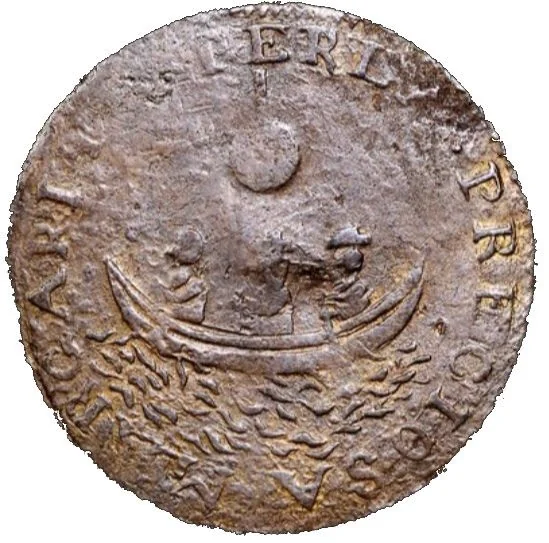
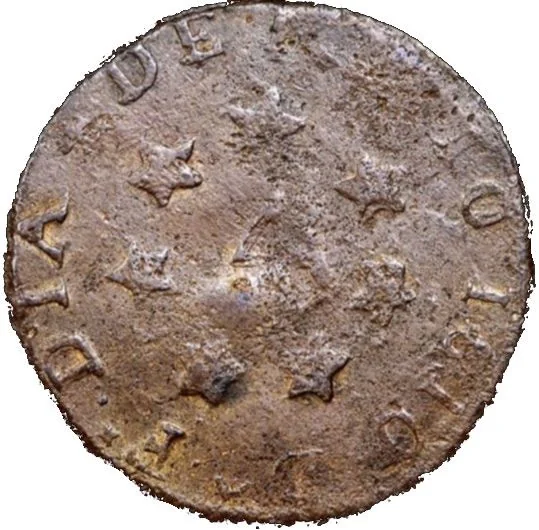
4 Maravedis – Margarita
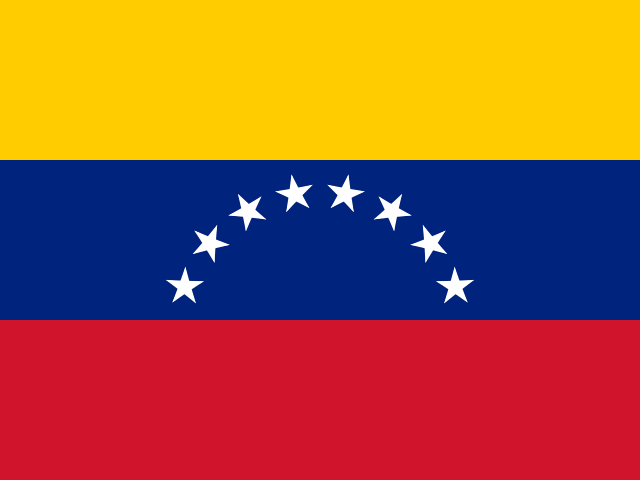
Venezuela
Obverse
Reverse
Description:
Denomination encircled by seven stars and surrounding legend.
Inscription:
★★★
4
★★★★
DA FX DIA 4 DE MAIO 1810
4
★★★★
DA FX DIA 4 DE MAIO 1810
Translation:
On the 4th of May 1810
Script: Latin
Language: Portuguese
Edge
Categories
| Transportation> Watercraft |
| Symbol> Sun |
Mintings
| Year | Mint Mark | Mintage | Quality | Collection |
|---|---|---|---|---|
| 1810 | — | — |
Historical background
In 1810, the island of Margarita, off the coast of Venezuela, found itself in a complex and deteriorating currency situation, caught between the collapsing old order and the uncertain birth of a new one. As a key part of the Captaincy General of Venezuela, the island's economy had long operated on the Spanish colonial monetary system, relying on a mix of Spanish silver coins like reales and pesos, and lower-value copper monedas de cobre. However, the outbreak of the Peninsular War in 1808 severely disrupted the supply of these coins from the metropolis, creating a critical shortage of circulating currency just as political tensions were rising.
This scarcity was acutely felt in daily commerce, hindering trade and causing significant hardship for the island's population. To address the crisis, local authorities and merchants resorted to provisional measures. These included the circulation of foreign coins (particularly from other Caribbean islands), the use of stamped copper tokens issued by local merchants, and the continued acceptance of worn and clipped Spanish coins at negotiated values. This created a fragmented and unreliable monetary environment where the value of money was unstable and trust in its worth was increasingly fragile.
The currency crisis of 1810 was not merely an economic issue but a deeply political one. When Margarita joined the Venezuelan independence movement on May 4, 1810, following the establishment of the Junta Suprema de Caracas, the monetary instability became intertwined with the revolutionary struggle. The new patriot authorities inherited the chaotic currency system and faced the immediate challenge of funding the cause, a problem that would lead to early experiments with paper money and forced loans. Thus, the currency situation on the island reflected the broader transition: it was a tangible symptom of the broken colonial link and a pressing problem for the nascent republican government trying to establish its sovereignty and economic viability.
This scarcity was acutely felt in daily commerce, hindering trade and causing significant hardship for the island's population. To address the crisis, local authorities and merchants resorted to provisional measures. These included the circulation of foreign coins (particularly from other Caribbean islands), the use of stamped copper tokens issued by local merchants, and the continued acceptance of worn and clipped Spanish coins at negotiated values. This created a fragmented and unreliable monetary environment where the value of money was unstable and trust in its worth was increasingly fragile.
The currency crisis of 1810 was not merely an economic issue but a deeply political one. When Margarita joined the Venezuelan independence movement on May 4, 1810, following the establishment of the Junta Suprema de Caracas, the monetary instability became intertwined with the revolutionary struggle. The new patriot authorities inherited the chaotic currency system and faced the immediate challenge of funding the cause, a problem that would lead to early experiments with paper money and forced loans. Thus, the currency situation on the island reflected the broader transition: it was a tangible symptom of the broken colonial link and a pressing problem for the nascent republican government trying to establish its sovereignty and economic viability.
✨ Legendary