

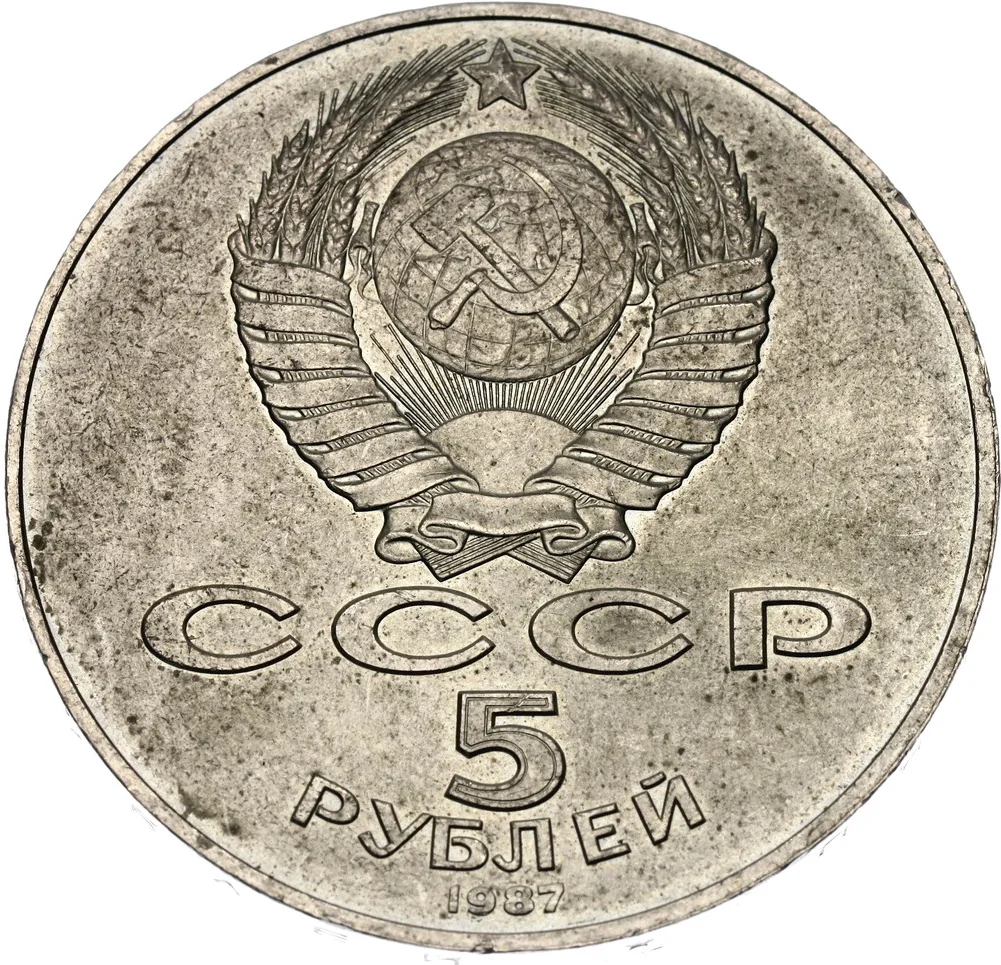
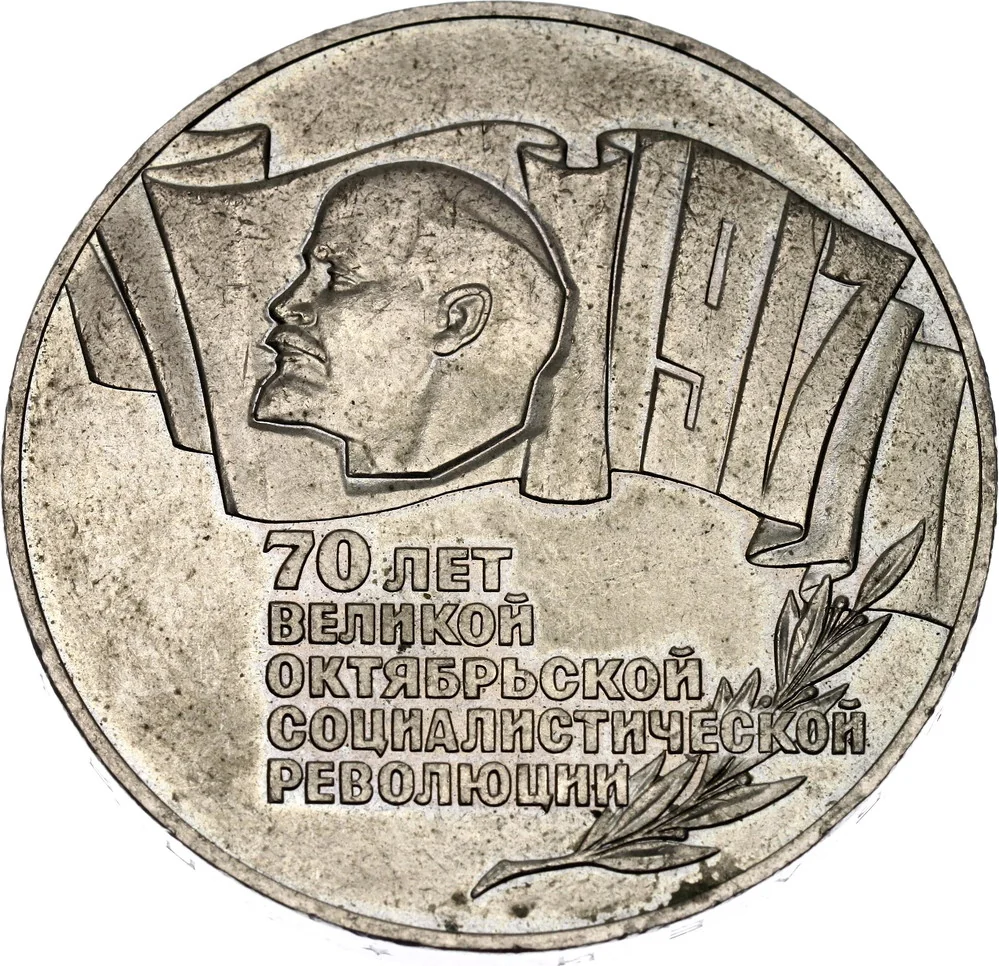
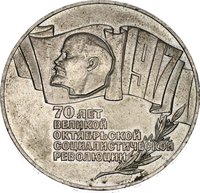
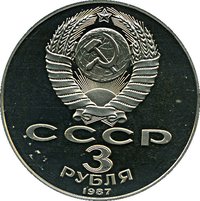
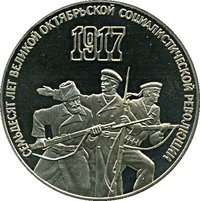
5 Rubles (October Revolution) – Soviet Union
Circulating commemorative coins
Commemoration: 70th Anniversary of the October Revolution
Russia
Context
Year: 1987
Country: Russia 
Issuer: Soviet Union 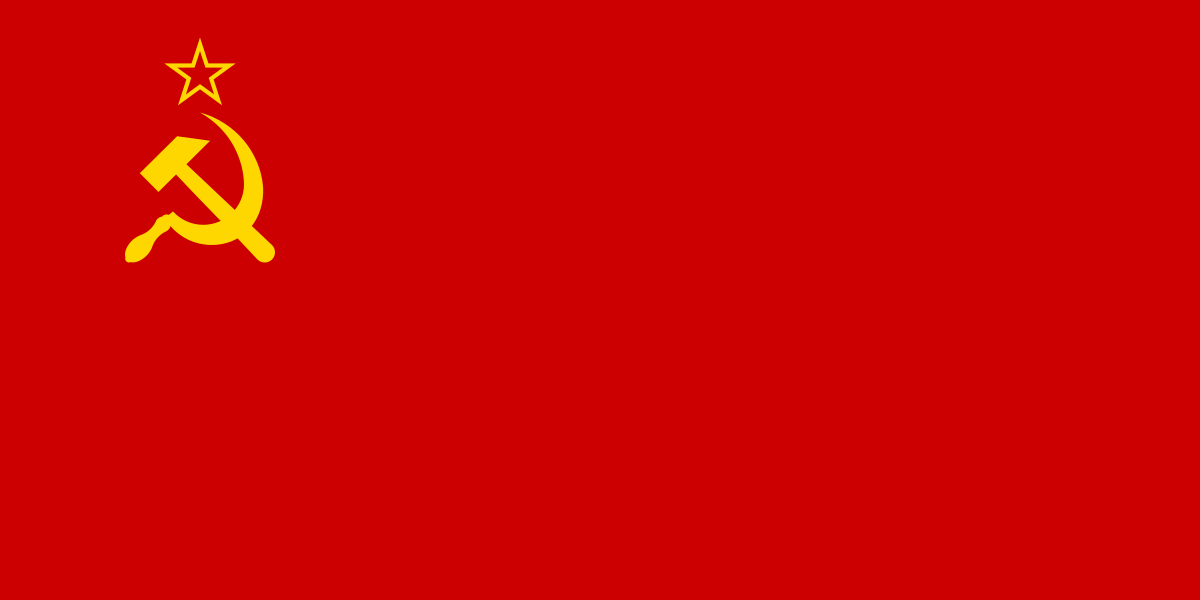
Period:
(1922—1991)
Currency:
(1961—1991)
Demonetization: 1991
Total mintage: 1,500,000
Material
Diameter: 39 mm
Weight: 29 g
Thickness: 3.1 mm
Shape: Round
Composition: Copper-nickel
Technique: Milled
Alignment: Medal alignment
flip
References
Y: #Click to copy to clipboard208
Numista: #7569
Value
Exchange value: 5 SUR
Obverse
Reverse
Edge
Smooth with inscription
Legend:
ПЯТЬ РУБЛЕЙ * ПЯТЬ РУБЛЕЙ *
Translation:
FIVE RUBLES * FIVE RUBLES *
Language: Russian
Categories
| Event> Revolution |
| Person> Politician |
| Symbols> Coat of Arms |
| Symbol> Hammer and sickle |
Mints
| Name | Mark |
|---|---|
| Saint Petersburg | — |
Mintings
| Year | Mint Mark | Mintage | Quality | Collection |
|---|---|---|---|---|
| 1987 | — | 1,300,000 | ||
| 1987 | — | 200,000 | Proof |
Historical background
By 1987, the Soviet Union's currency situation was characterized by a profound and growing contradiction between the official economic facade and a deteriorating monetary reality. The ruble was a non-convertible currency, meaning it could not be legally exchanged for foreign currencies or used outside the USSR, isolating the Soviet economy from the global market. Officially, the state maintained a stable exchange rate (approximately 0.6 rubles to 1 US dollar), but this was a meaningless fiction for most citizens, as access to hard currency was severely restricted. The real economic story was one of mounting "monetary overhang"—a massive accumulation of rubles in savings accounts and under mattresses because there was little of value to buy with them. Chronic shortages of desirable consumer goods, due to systemic inefficiencies in central planning, meant that money was losing its primary function as a medium of exchange.
This monetary imbalance was a direct symptom of the deeper crisis of the "planned economy," which Mikhail Gorbachev's policies of perestroika (restructuring) were attempting, and failing, to address. While earlier reforms had tinkered with the system, 1987 marked a significant shift with the Law on State Enterprise, which aimed to make enterprises self-financing and reduce ministerial control. However, without accompanying price liberalization or a market for goods, this merely increased the money supply as enterprises granted higher wages without corresponding increases in productivity or output. The result was that even more rubles chased the same limited goods, exacerbating shortages and fueling a booming black market where the ruble's real value was a fraction of its official worth.
Consequently, the population's relationship with the ruble was one of deep distrust and practical duality. For everyday transactions within the state system, the ruble was used for subsidized essentials, but its purchasing power was hollow. For anything scarce or of quality, citizens relied on blat (connections), barter, or the shadow economy. Meanwhile, a privileged few with access to special stores or foreign travel used certificates and hard currency rubles, creating a multi-tiered monetary system. By 1987, this unsustainable currency situation underscored that the USSR's economic problems were not just structural but fundamentally monetary, setting the stage for the hyperinflation and currency crises that would erupt in the final years of the Soviet state.
This monetary imbalance was a direct symptom of the deeper crisis of the "planned economy," which Mikhail Gorbachev's policies of perestroika (restructuring) were attempting, and failing, to address. While earlier reforms had tinkered with the system, 1987 marked a significant shift with the Law on State Enterprise, which aimed to make enterprises self-financing and reduce ministerial control. However, without accompanying price liberalization or a market for goods, this merely increased the money supply as enterprises granted higher wages without corresponding increases in productivity or output. The result was that even more rubles chased the same limited goods, exacerbating shortages and fueling a booming black market where the ruble's real value was a fraction of its official worth.
Consequently, the population's relationship with the ruble was one of deep distrust and practical duality. For everyday transactions within the state system, the ruble was used for subsidized essentials, but its purchasing power was hollow. For anything scarce or of quality, citizens relied on blat (connections), barter, or the shadow economy. Meanwhile, a privileged few with access to special stores or foreign travel used certificates and hard currency rubles, creating a multi-tiered monetary system. By 1987, this unsustainable currency situation underscored that the USSR's economic problems were not just structural but fundamentally monetary, setting the stage for the hyperinflation and currency crises that would erupt in the final years of the Soviet state.
🌱 Common