

5 centavos – Honduras
Add to wishlist
Honduras
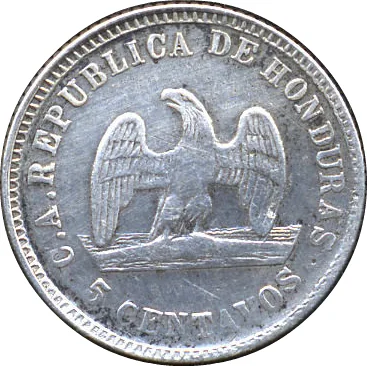
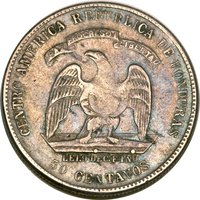
Obverse
Description:
Eagle with exposed chest, legend encircling, value below.
Inscription:
C.A. REPUBLICA DE HONDURAS
5 CENTAVOS
5 CENTAVOS
Translation:
C.A. Republic of Honduras
5 Centavos
5 Centavos
Script: Latin
Language: Spanish
Engraver: George H. Lovett
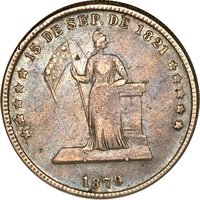
Reverse
Description:
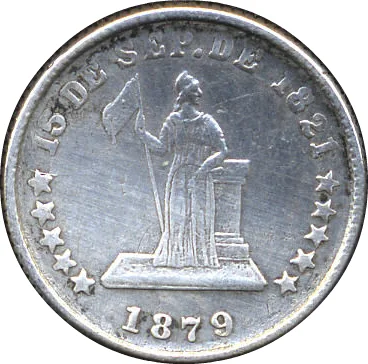
Standing Liberty holding a flag in her right hand, her left arm resting on a column. Stars and legend encircle the design, with the date below.
Inscription:
*****15 DE SEP. DE 1821*****
1879
1879
Translation:
*****15TH OF SEP. OF 1821*****
1879
1879
Script: Latin
Language: Spanish
Engraver: George H. Lovett
Edge
Mints
| Name | Mark |
|---|---|
| Casa Nacional de la Moneda | — |
Mintings
| Year | Mint Mark | Mintage | Quality | Collection |
|---|---|---|---|---|
| 1879 | — | — |
Historical background
In 1879, Honduras was grappling with a complex and unstable currency situation, deeply intertwined with its economic fragility and political turbulence. The nation’s monetary system was characterized by a severe shortage of official coinage and the widespread circulation of a chaotic mix of foreign silver, most notably the Peruvian peso and coins from other Latin American nations. This reliance on foreign specie was a direct result of Honduras's underdeveloped mining sector and lack of a strong, centralized minting authority, leaving its economy vulnerable to external monetary flows and valuations.
The primary unit of account was the peso, but its value in real transactions was inconsistent and often depreciated. Compounding this disorder was the circulation of privately issued tokens and paper notes from local merchants and regional haciendas, used to facilitate trade and pay laborers in the absence of sufficient government-issued currency. This patchwork system led to frequent confusion, fraud, and hindered both domestic commerce and foreign investment, as trust in the medium of exchange was low.
This monetary disarray occurred within the broader context of the Liberal Reforms under President Marco Aurelio Soto, who was attempting to modernize the Honduran state and attract foreign capital, particularly for the burgeoning banana industry. The currency chaos of 1879 highlighted a critical obstacle to these goals: a modernizing economy required a stable and unified monetary system. The situation would eventually lead to later reforms, including the establishment of the peso plata as a standard and, decades later, the creation of the Lempira, but in 1879, Honduras remained mired in a period of monetary fragmentation and instability.
The primary unit of account was the peso, but its value in real transactions was inconsistent and often depreciated. Compounding this disorder was the circulation of privately issued tokens and paper notes from local merchants and regional haciendas, used to facilitate trade and pay laborers in the absence of sufficient government-issued currency. This patchwork system led to frequent confusion, fraud, and hindered both domestic commerce and foreign investment, as trust in the medium of exchange was low.
This monetary disarray occurred within the broader context of the Liberal Reforms under President Marco Aurelio Soto, who was attempting to modernize the Honduran state and attract foreign capital, particularly for the burgeoning banana industry. The currency chaos of 1879 highlighted a critical obstacle to these goals: a modernizing economy required a stable and unified monetary system. The situation would eventually lead to later reforms, including the establishment of the peso plata as a standard and, decades later, the creation of the Lempira, but in 1879, Honduras remained mired in a period of monetary fragmentation and instability.
✨ Legendary