

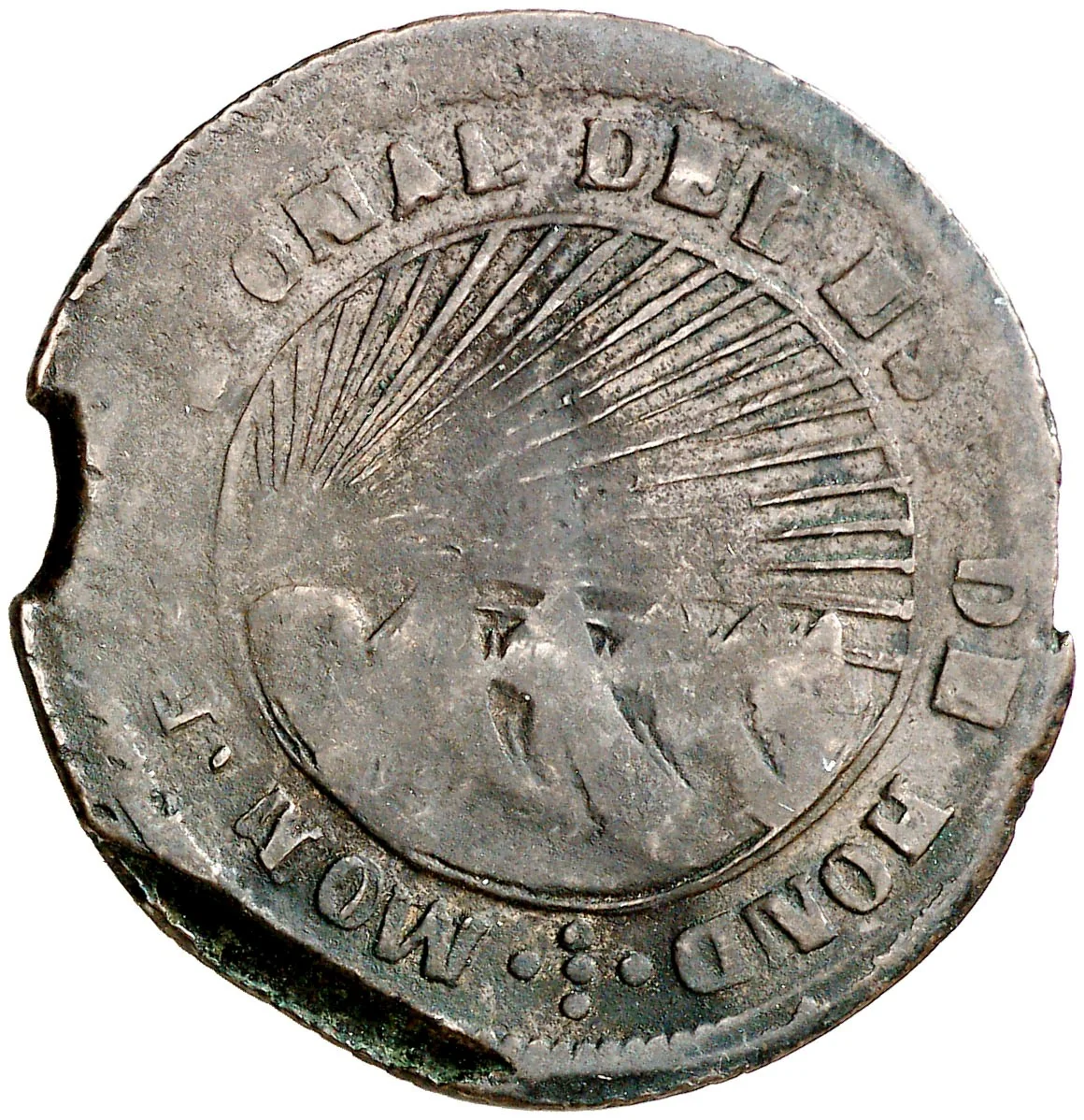
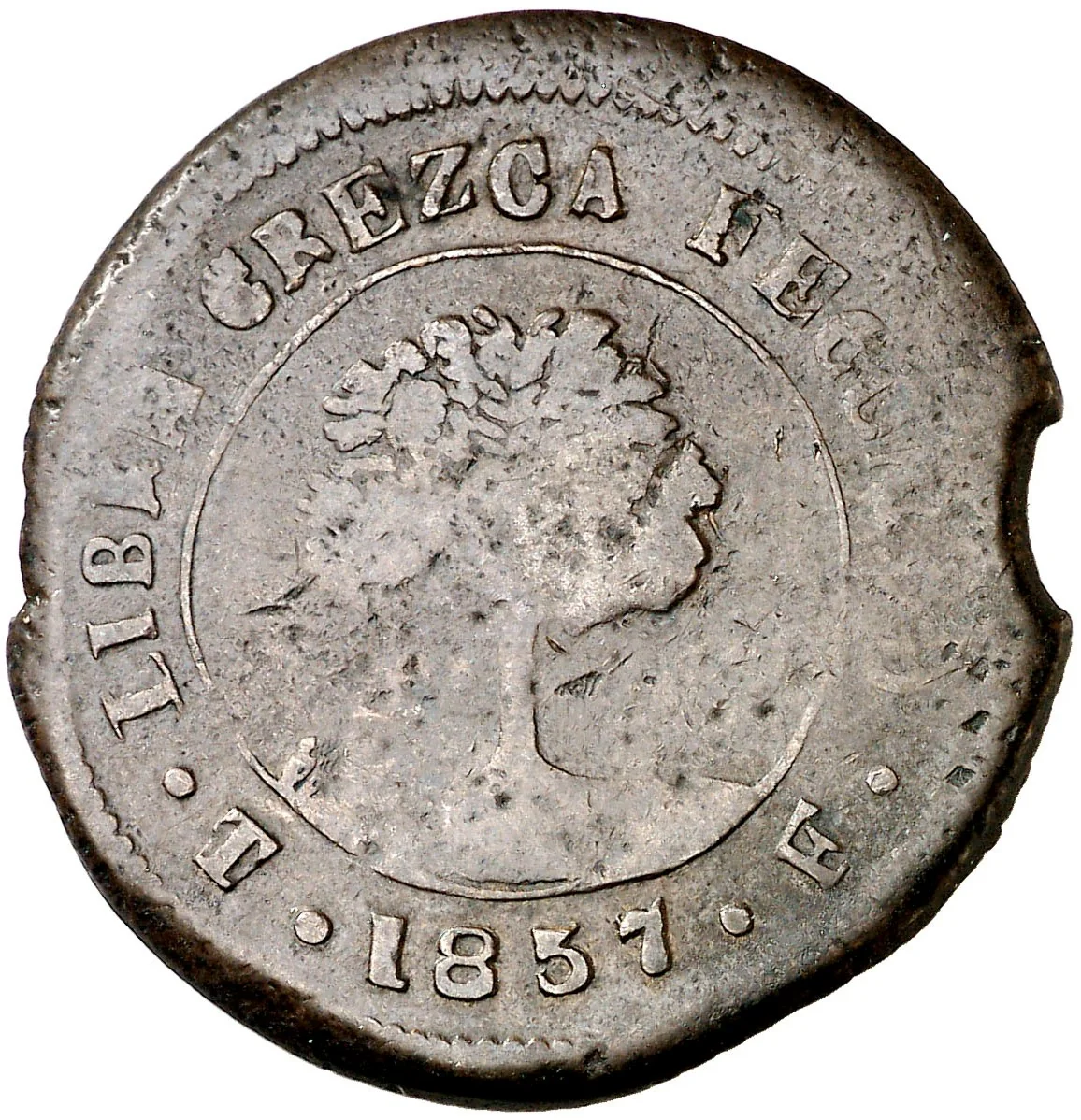
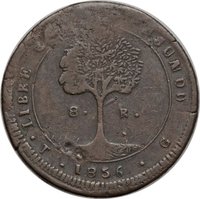
Obverse
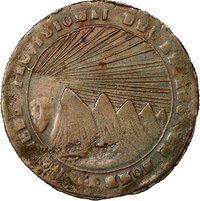
Reverse
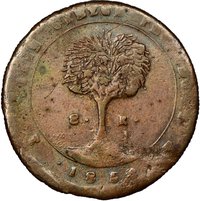
Edge
Mints
| Name | Mark |
|---|---|
| Casa Nacional de la Moneda | T |
Mintings
| Year | Mint Mark | Mintage | Quality | Collection |
|---|---|---|---|---|
| 1857 | T | — |
Historical background
In 1857, Honduras found itself in a precarious monetary situation characterized by severe currency scarcity and rampant counterfeiting, a legacy of the turbulent Central American post-independence period. Following the dissolution of the Federal Republic of Central America in the late 1830s, Honduras, like its neighbors, struggled to establish a stable national economy. The country lacked a unified, state-issued currency, leading to a chaotic circulation of a variety of coins. These included worn and clipped Spanish colonial pieces (reales), coins from other Central American republics, and those from Peru, Mexico, and Bolivia. This patchwork system was inherently unstable and hampered commerce.
The primary crisis stemmed from a flood of debased and counterfeit coins, particularly low-quality pesos sencillos from other nations, which drove out the better silver. This classic example of Gresham's Law ("bad money drives out good") crippled legitimate trade and state revenues. The Honduran government, under President José Santos Guardiola, recognized that economic stability was impossible without monetary reform. The solution was seen in the creation of a distinctive, nationally minted coin that would be trusted within its borders and could restore confidence.
Consequently, 1857 marks a pivotal year with the authorization of Honduras's first national coinage. The government contracted with the mint in Guatemala (a former federal partner) to produce the new Honduran Real. These coins, bearing the national coat of arms and the denomination, were intentionally minted with a high silver content (.903 fineness) to ensure their acceptance and to drive out the inferior foreign currency. This decisive step laid the foundational framework for a sovereign Honduran monetary system, aiming to unify the economy and assert national identity amidst regional instability.
The primary crisis stemmed from a flood of debased and counterfeit coins, particularly low-quality pesos sencillos from other nations, which drove out the better silver. This classic example of Gresham's Law ("bad money drives out good") crippled legitimate trade and state revenues. The Honduran government, under President José Santos Guardiola, recognized that economic stability was impossible without monetary reform. The solution was seen in the creation of a distinctive, nationally minted coin that would be trusted within its borders and could restore confidence.
Consequently, 1857 marks a pivotal year with the authorization of Honduras's first national coinage. The government contracted with the mint in Guatemala (a former federal partner) to produce the new Honduran Real. These coins, bearing the national coat of arms and the denomination, were intentionally minted with a high silver content (.903 fineness) to ensure their acceptance and to drive out the inferior foreign currency. This decisive step laid the foundational framework for a sovereign Honduran monetary system, aiming to unify the economy and assert national identity amidst regional instability.
✨ Legendary