


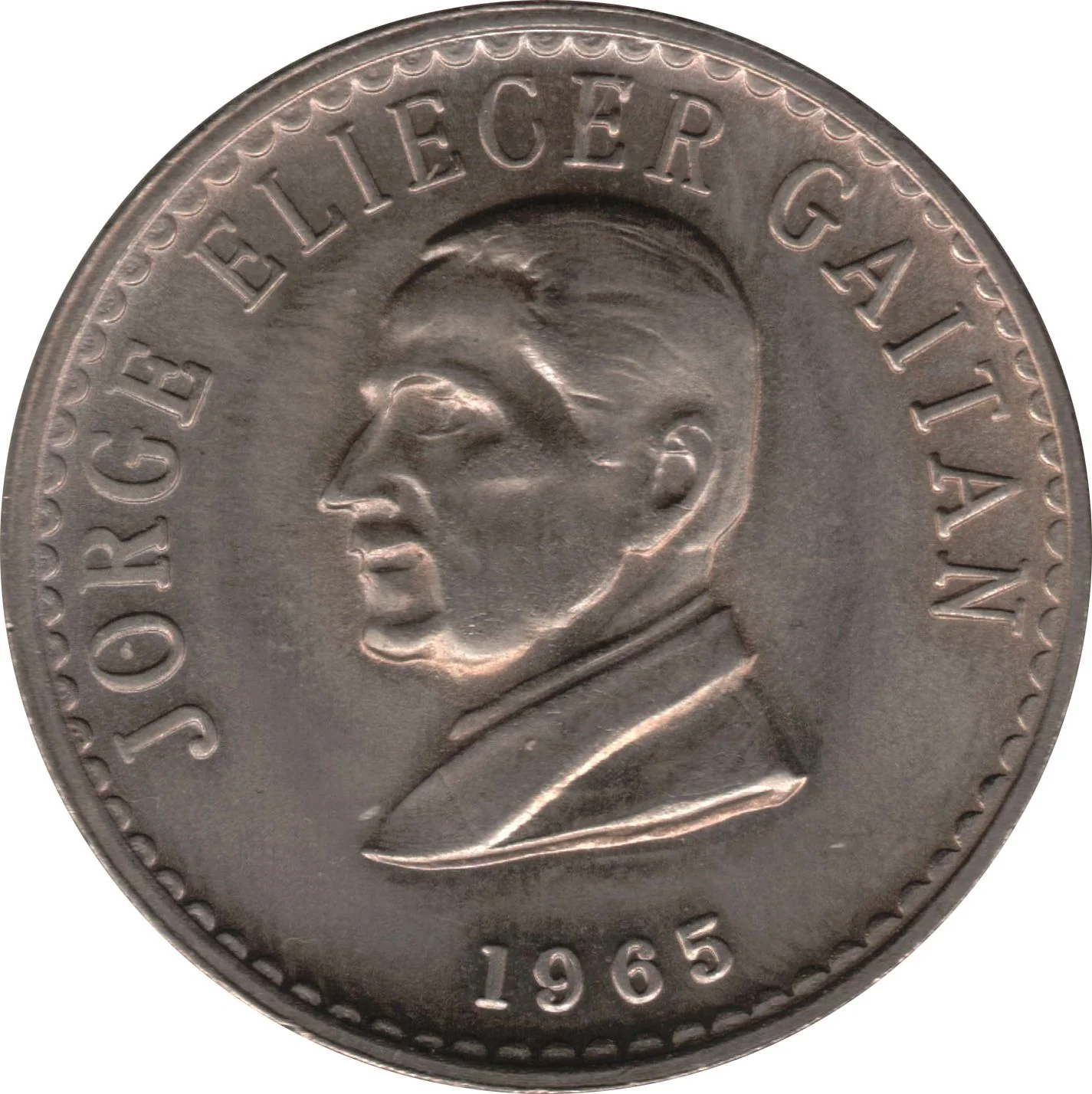
50 centavos – Colombia
Add to wishlist
Colombia
Context
Material
Diameter: 30.5 mm
Weight: 12.6 g
Shape: Round
Composition: Copper-nickel
Technique: Milled
Alignment: Coin alignment

flip
References
KM: #
Numista: #7537
Value
Exchange value: 0.50 COP
Inflation-adjusted value: 1052.97 COP
Obverse
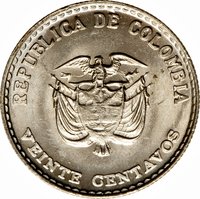
Reverse
Description:
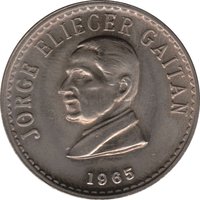
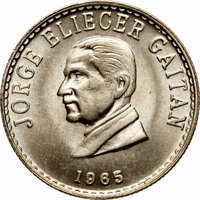
Jorge Eliecer Gaitán, left-facing portrait. Name above, date below.
Inscription:
JORGE ELIECER GAITAN
1965
1965
Script: Latin
Edge
Reeded
Categories
| Symbols> Coat of Arms |
| Person> Politician |
Mintings
| Year | Mint Mark | Mintage | Quality | Collection |
|---|---|---|---|---|
| 1965 | — | 600,000 |
Historical background
In 1965, Colombia's currency situation was characterized by a managed exchange rate system under significant pressure. The country operated with a fixed but adjustable peg to the U.S. dollar, a structure maintained by the Banco de la República. However, this system was strained by persistent macroeconomic challenges, including high inflation and recurring balance of payments deficits. A key policy of the era was the "crawling peg" (minidevaluaciones), introduced in the late 1960s, which was being conceptually developed to address these very issues. This approach aimed to make small, frequent devaluations to maintain export competitiveness and avoid the disruptive large devaluations that had previously caused economic shocks.
The underlying economic context was difficult. Colombia was experiencing moderate inflation—around 10-15% annually—which was high by international standards of the time and eroded the peso's real value. This inflation was fueled by expansionary fiscal policies, growth in money supply, and structural factors within the developing economy. Furthermore, the country was grappling with the aftermath of the period known as La Violencia and the early challenges of the National Front coalition government, which created an environment of social and political instability that undermined investor confidence and complicated economic management.
Consequently, the peso faced steady depreciation pressure. The fixed official rate often diverged from black-market rates, indicating a lack of confidence in the currency's stability. The government's response involved a complex system of exchange controls and multiple rates for different transactions (e.g., for coffee exports, essential imports, and financial flows) to conserve scarce foreign reserves and manage the balance of payments. Thus, 1965 represents a point of transition, where the limitations of the existing rigid system were becoming clear, setting the stage for the more formal adoption of the crawling peg mechanism in the following years to try to achieve a more controlled and predictable devaluation path.
The underlying economic context was difficult. Colombia was experiencing moderate inflation—around 10-15% annually—which was high by international standards of the time and eroded the peso's real value. This inflation was fueled by expansionary fiscal policies, growth in money supply, and structural factors within the developing economy. Furthermore, the country was grappling with the aftermath of the period known as La Violencia and the early challenges of the National Front coalition government, which created an environment of social and political instability that undermined investor confidence and complicated economic management.
Consequently, the peso faced steady depreciation pressure. The fixed official rate often diverged from black-market rates, indicating a lack of confidence in the currency's stability. The government's response involved a complex system of exchange controls and multiple rates for different transactions (e.g., for coffee exports, essential imports, and financial flows) to conserve scarce foreign reserves and manage the balance of payments. Thus, 1965 represents a point of transition, where the limitations of the existing rigid system were becoming clear, setting the stage for the more formal adoption of the crawling peg mechanism in the following years to try to achieve a more controlled and predictable devaluation path.
🌱 Common