

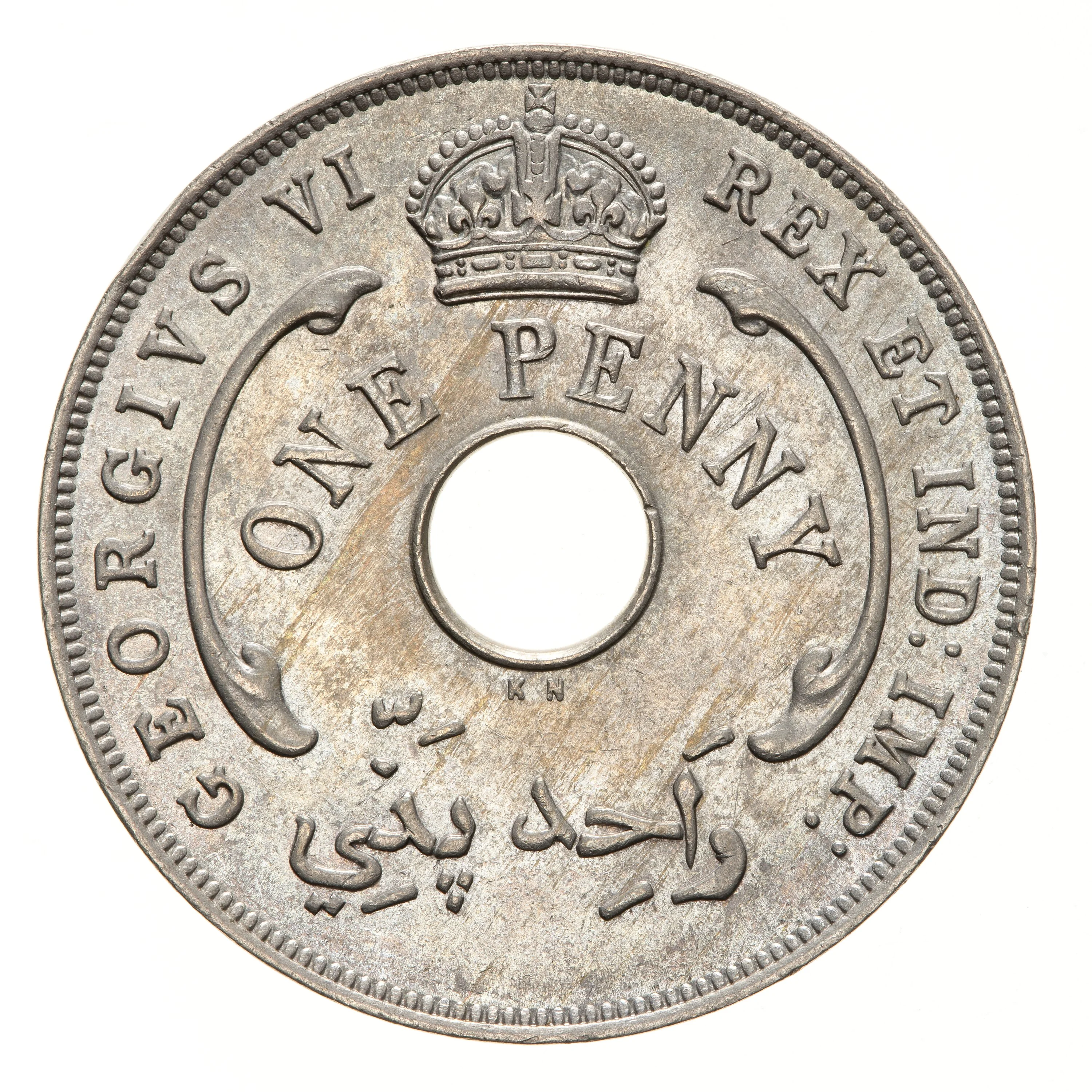
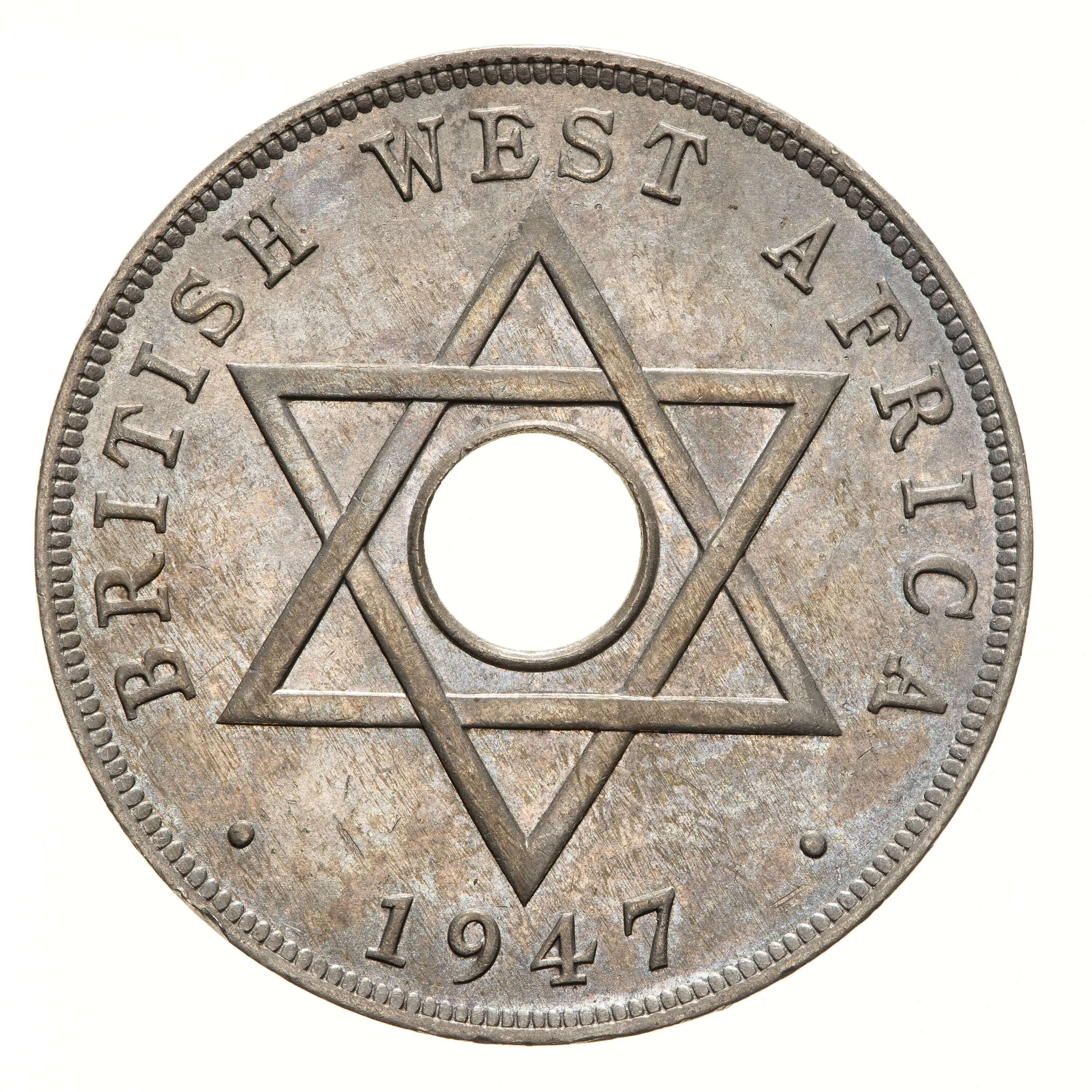
1 penny – British West Africa
Add to wishlist
Context
Years: 1937–1947
Country: Western African States
Issuer: British West Africa
Ruler: George VI
Currency:
(1907—1968)
Demonetized: Yes
Total mintage: 243,261,000
Material
Diameter: 30.8 mm
Weight: 9.45 g
Thickness: 1.6 mm
Shape: Round with a round hole
Composition: Copper-nickel
Technique: Milled
Alignment: Medal alignment
flip
References
KM: #
Numista: #7535
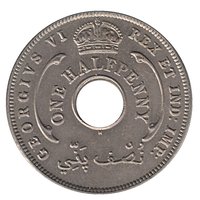
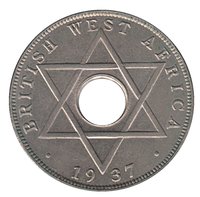
Obverse
Reverse
Edge
Plain
Mints
| Name | Mark |
|---|---|
| Royal Mint (Tower Hill) | — |
| Heaton and Sons / The Mint Birmingham | H |
| Kings Norton Metal Company | KN |
| Pretoria | SA |
Mintings
| Year | Mint Mark | Mintage | Quality | Collection |
|---|---|---|---|---|
| 1937 | H | 11,999,000 | ||
| 1937 | H | — | Proof | |
| 1937 | KN | 11,999,000 | ||
| 1937 | KN | — | Proof | |
| 1940 | H | 2,400,000 | ||
| 1940 | KN | 2,400,000 | ||
| 1940 | — | 3,840,000 | ||
| 1940 | — | — | Proof | |
| 1941 | — | 6,960,000 | ||
| 1941 | — | — | Proof | |
| 1942 | — | 18,840,000 | ||
| 1943 | — | 28,920,000 | ||
| 1943 | H | 7,140,000 | ||
| 1944 | — | 19,440,000 | ||
| 1945 | — | 6,072,000 | ||
| 1945 | — | — | Proof | |
| 1945 | H | 9,000,000 | ||
| 1945 | KN | 9,557,000 | ||
| 1946 | KN | 11,976,000 | ||
| 1946 | SA | 1,020,000 | ||
| 1946 | H | 10,446,000 | ||
| 1947 | H | 12,443,000 | ||
| 1947 | KN | 9,829,000 | ||
| 1947 | SA | 58,980,000 |
Historical background
In 1937, the currency situation in British West Africa was defined by the exclusive use of the British West African Pound (BWA£), a currency board system established in 1912. This arrangement saw the West African Currency Board (WACB) in London issue currency fully backed by sterling reserves, ensuring a fixed and stable parity with the Pound Sterling. The system was highly colonial in nature, designed primarily to facilitate trade with Britain, guarantee convertibility for British businesses, and integrate the region's economy into the imperial framework. Local currencies, like cowries or manillas, had been largely demonetized, leaving the BWA£ as the sole legal tender for all official transactions across Nigeria, the Gold Coast (Ghana), Sierra Leone, and the Gambia.
The currency board system provided notable monetary stability and low inflation, but it came with significant economic constraints for the colonies. There was no central bank to conduct independent monetary policy or provide credit for local development. The money supply was entirely passive, expanding or contracting based on the region's balance of payments with Britain, rather than the needs of the domestic economy. This meant that surplus earnings from key exports like cocoa, palm oil, and groundnuts were often accumulated as sterling reserves in London rather than being available for local investment, a point of growing criticism among emerging nationalist intellectuals and merchants.
By 1937, this rigid system was firmly entrenched, but the seeds of future change were being sown. The Great Depression had exposed the vulnerabilities of colonial export-dependent economies, and there was increasing local agitation for greater financial autonomy and institutions that could foster industrialization. While the outbreak of World War Two in 1939 would temporarily reinforce the sterling area system, the post-war period would see these pressures culminate in the establishment of central banks and national currencies, ending the era of the unified British West African Pound.
The currency board system provided notable monetary stability and low inflation, but it came with significant economic constraints for the colonies. There was no central bank to conduct independent monetary policy or provide credit for local development. The money supply was entirely passive, expanding or contracting based on the region's balance of payments with Britain, rather than the needs of the domestic economy. This meant that surplus earnings from key exports like cocoa, palm oil, and groundnuts were often accumulated as sterling reserves in London rather than being available for local investment, a point of growing criticism among emerging nationalist intellectuals and merchants.
By 1937, this rigid system was firmly entrenched, but the seeds of future change were being sown. The Great Depression had exposed the vulnerabilities of colonial export-dependent economies, and there was increasing local agitation for greater financial autonomy and institutions that could foster industrialization. While the outbreak of World War Two in 1939 would temporarily reinforce the sterling area system, the post-war period would see these pressures culminate in the establishment of central banks and national currencies, ending the era of the unified British West African Pound.
🌱 Very Common