

10 cents – Canada
Add to wishlist
Canada
Context
Material
References
KM: #
Numista: #7518
Value
Exchange value: 0.10 CAD
Inflation-adjusted value: 0.86 CAD
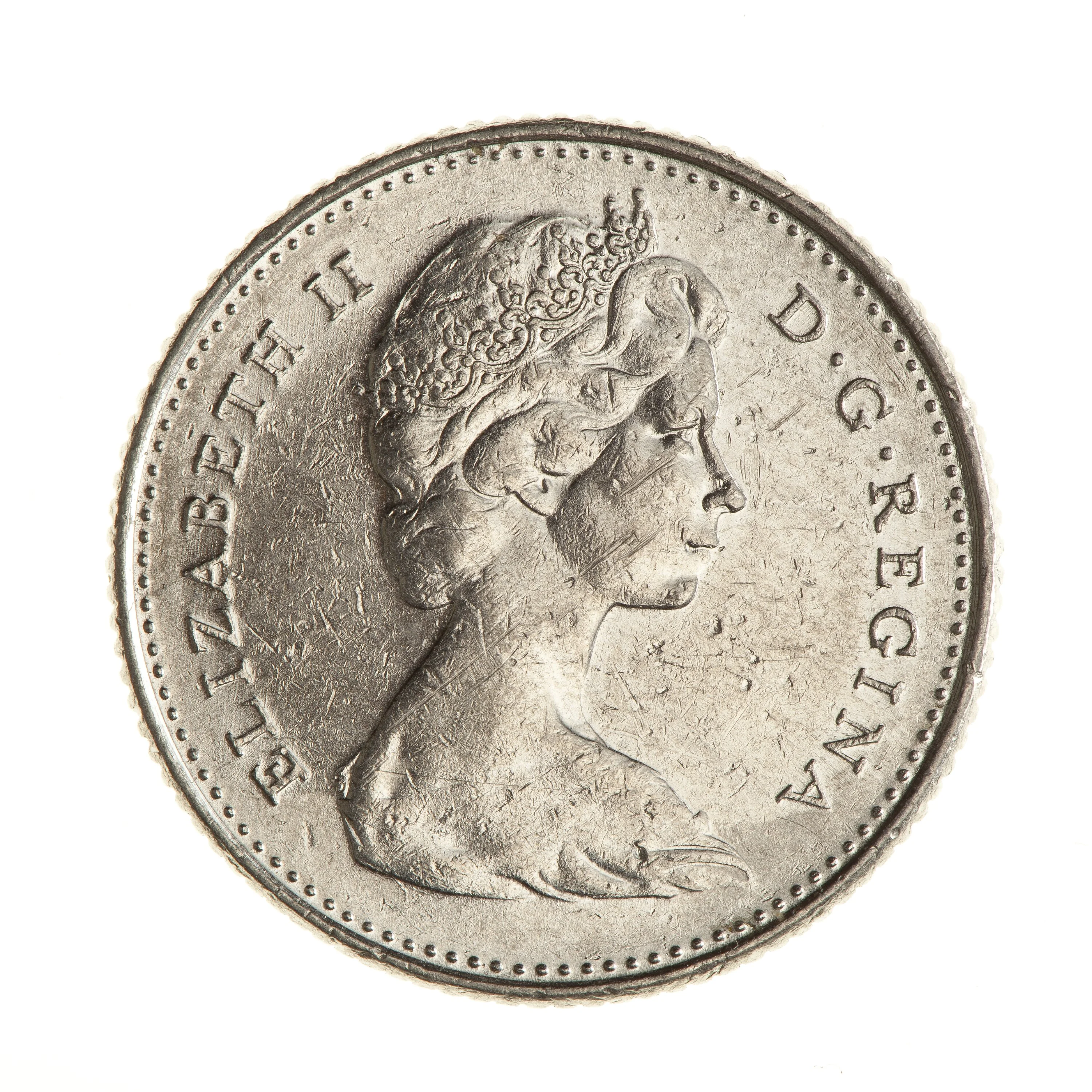
Obverse
Description:
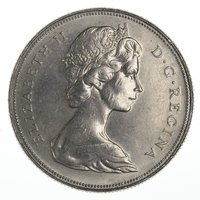
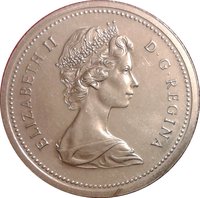
Bust of Queen Elizabeth II at age 37, wearing a tiara and facing right.
Inscription:
ELIZABETH II D·G·REGINA
Translation:
Elizabeth II, by the Grace of God, Queen
Script: Latin
Language: Latin
Designer: Arnold Machin
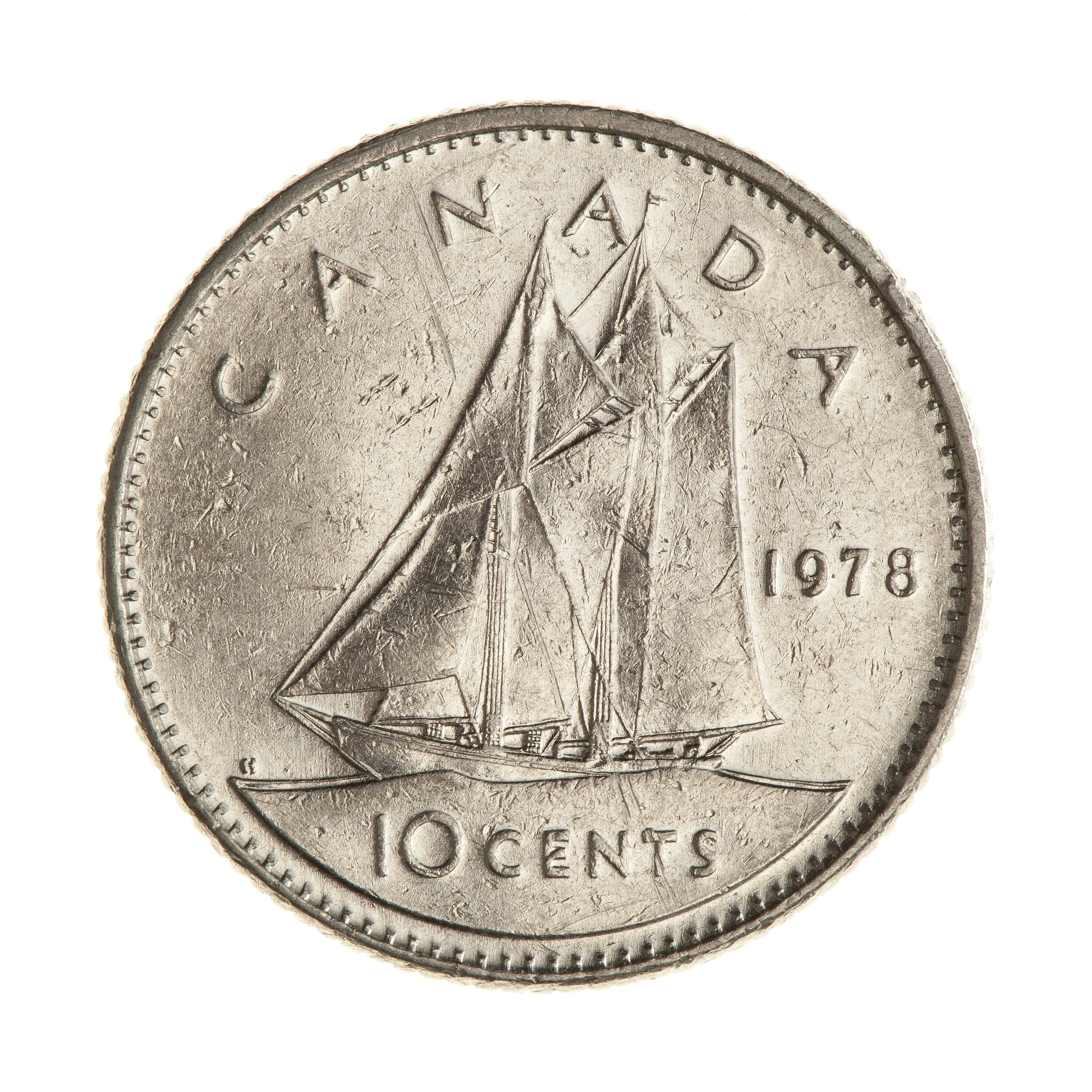
Reverse
Description:
The Bluenose, a celebrated racing schooner and symbol of Nova Scotia, under sail with its face value and "CANADA".
Inscription:
CANADA
1970
10 CENTS
H
1970
10 CENTS
H
Script: Latin
Designer: Emanuel Otto Hahn
Edge
Reeded
Categories
| Transportation> Watercraft |
Mints
| Name | Mark |
|---|---|
| Royal Canadian Mint of Ottawa | — |
| Royal Canadian Mint of Winnipeg | — |
Mintings
| Year | Mint Mark | Mintage | Quality | Collection |
|---|---|---|---|---|
| 1969 | — | 326,203 | Prooflike | |
| 1969 | — | — | ||
| 1970 | — | 349,120 | Prooflike | |
| 1970 | — | 5,249,296 | ||
| 1971 | — | 33,517 | BU | |
| 1971 | — | 253,311 | Prooflike | |
| 1971 | — | 66,860 | ||
| 1972 | — | 38,198 | BU | |
| 1972 | — | 224,275 | Prooflike | |
| 1972 | — | 36,349 | ||
| 1973 | — | 243,695 | Prooflike | |
| 1973 | — | 119,891 | ||
| 1973 | — | 49,376 | BU | |
| 1974 | — | 44,296 | BU | |
| 1974 | — | 213,589 | Prooflike | |
| 1974 | — | 85,230 | ||
| 1975 | — | 36,581 | BU | |
| 1975 | — | 197,372 | Prooflike | |
| 1975 | — | 97,263 | ||
| 1976 | — | 115,906 | ||
| 1976 | — | 171,737 | Prooflike | |
| 1977 | — | 225,307 | Prooflike | |
| 1977 | — | 186,775 | ||
| 1978 | — | 260,000 | Prooflike | |
| 1978 | — | 188,000 |
Historical background
In 1969, Canada’s currency situation was defined by a period of significant transition and national identity formation, centered on the ongoing process of decimalization. Just two years prior, in 1967, the country had completed the switch from the old British-style pounds, shillings, and pence system to a decimal-based dollar and cent system. This modernizing move, which aligned Canada with its largest trading partner, the United States, was still fresh, and the new currency designs—featuring Canadian themes like birds and historical figures—were still being fully integrated into public life. The economy was robust, with the Canadian dollar trading at a slight premium to the US dollar for much of the year, supported by strong resource exports and controlled inflation.
A key symbolic development in 1969 was the government's announcement that a new series of banknotes would be issued, beginning in 1970, which would exclude the portrait of the reigning monarch, Queen Elizabeth II, from the $1, $2, and $5 denominations. This decision, part of Prime Minister Pierre Trudeau's vision of promoting a distinct Canadian identity, was controversial and reflected a broader national conversation about sovereignty and cultural independence. However, the Queen's portrait was retained on the higher-value $20 note, a compromise that highlighted the ongoing tensions between Canada's British heritage and its evolving self-image.
Economically, the year was one of relative stability before coming storms. The Canadian dollar remained firmly within the Bretton Woods system of fixed exchange rates, pegged to the US dollar within a narrow band. However, international pressures on this system were mounting, leading to a revaluation of the German Mark and foreshadowing the global monetary crises of the early 1970s. Domestically, the Bank of Canada maintained a focus on price stability, setting the stage for the inflationary challenges that would define the next decade. Thus, 1969 stands as a final chapter of monetary certainty, with Canada's modern decimal currency newly established but on the cusp of a new era of floating exchange rates and economic volatility.
A key symbolic development in 1969 was the government's announcement that a new series of banknotes would be issued, beginning in 1970, which would exclude the portrait of the reigning monarch, Queen Elizabeth II, from the $1, $2, and $5 denominations. This decision, part of Prime Minister Pierre Trudeau's vision of promoting a distinct Canadian identity, was controversial and reflected a broader national conversation about sovereignty and cultural independence. However, the Queen's portrait was retained on the higher-value $20 note, a compromise that highlighted the ongoing tensions between Canada's British heritage and its evolving self-image.
Economically, the year was one of relative stability before coming storms. The Canadian dollar remained firmly within the Bretton Woods system of fixed exchange rates, pegged to the US dollar within a narrow band. However, international pressures on this system were mounting, leading to a revaluation of the German Mark and foreshadowing the global monetary crises of the early 1970s. Domestically, the Bank of Canada maintained a focus on price stability, setting the stage for the inflationary challenges that would define the next decade. Thus, 1969 stands as a final chapter of monetary certainty, with Canada's modern decimal currency newly established but on the cusp of a new era of floating exchange rates and economic volatility.
🌱 Very Common