

8 reales – Mexico
Add to wishlist
Non-circulating coins
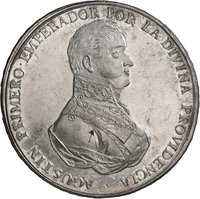
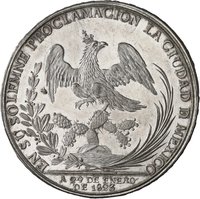
Commemoration: Agustin de Iturbide I - Proclamation in Guadalajara
Mexico
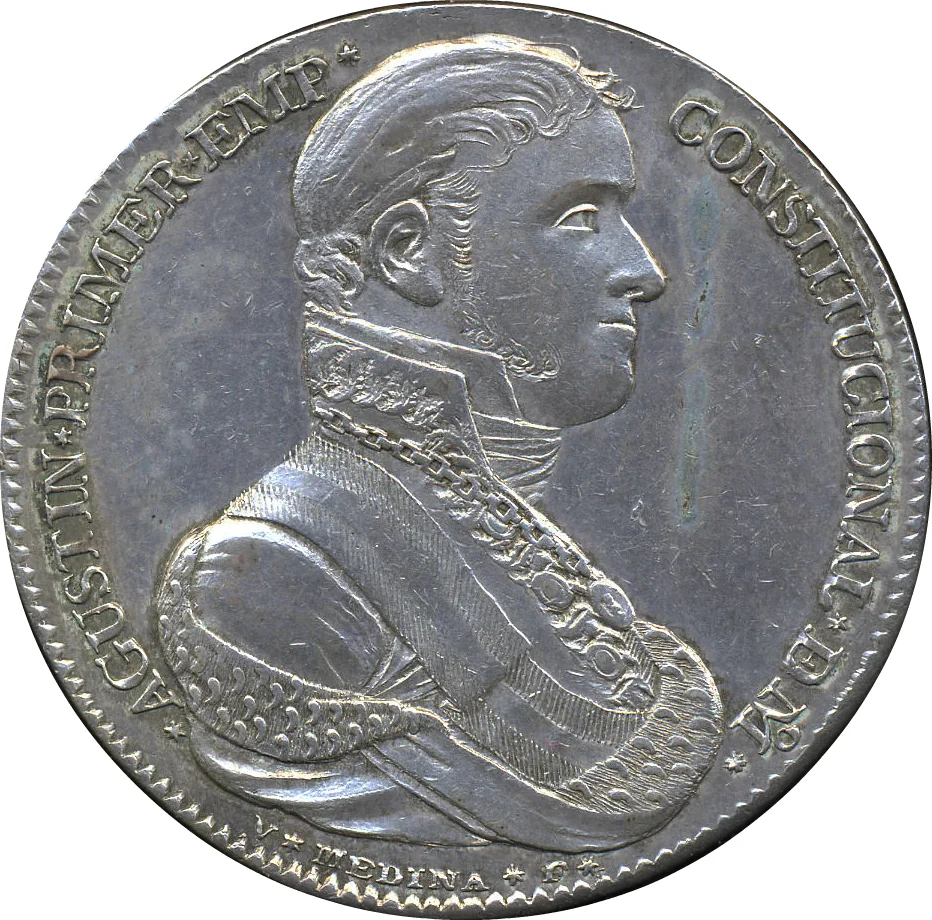
Obverse
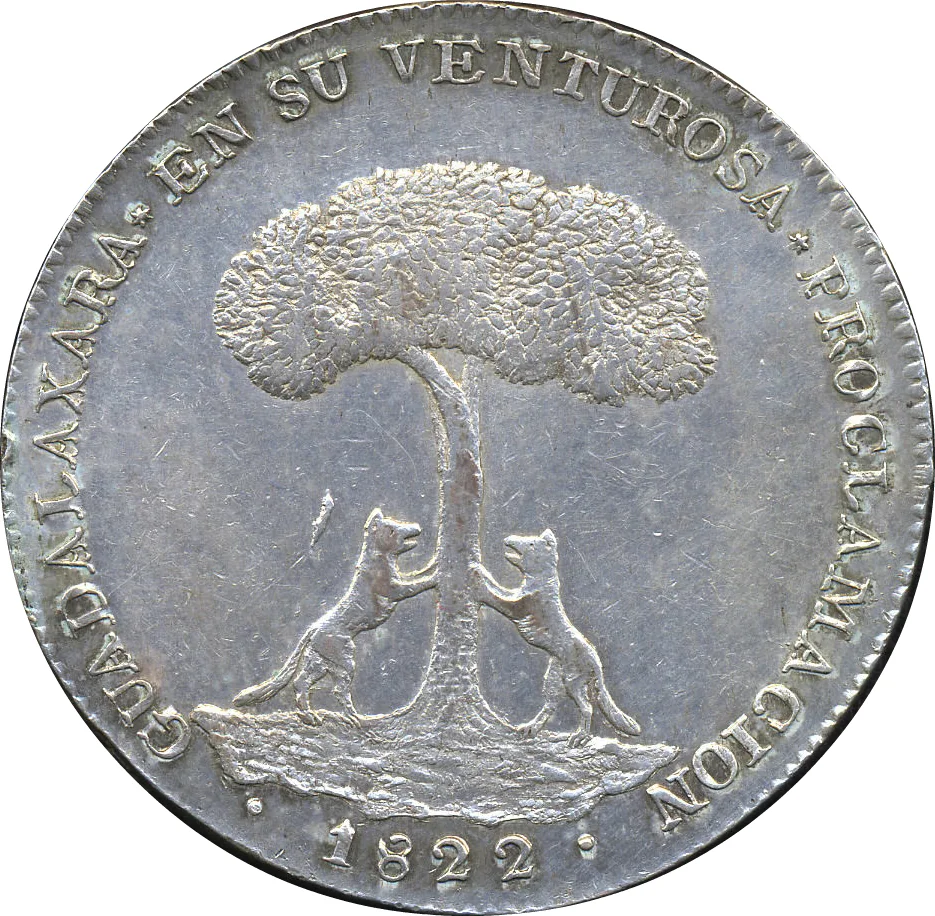
Reverse
Edge
Categories
| Symbols> Coat of Arms |
| Person> Politician |
| Plant> Tree |
Mintings
| Year | Mint Mark | Mintage | Quality | Collection |
|---|---|---|---|---|
| 1822 | — | — |
Historical background
Following its independence in 1821, the newly sovereign Mexican Empire faced immediate and severe monetary instability in 1822. The decade-long war of independence had devastated mines, disrupted agriculture and commerce, and left the government of Agustín de Iturbide with an empty treasury and massive debts. To finance its operations, the imperial government resorted to printing paper money, known as billetes del Imperio Mexicano. These bills were not backed by silver or gold, but by a promise of future redemption, making them essentially fiat currency in an economy deeply accustomed to the solid, silver peso fuerte.
This flood of unsecured paper currency led to rapid inflation and widespread public distrust. Merchants and the populace, skeptical of the government's ability to honor the notes, began to refuse them or accept them only at a steep discount. The situation created a chaotic dual-system where the old Spanish colonial silver coins (like the real and the 8-real "piece of eight") remained the trusted standard, while the new paper bills rapidly depreciated. This effectively undermined the government's attempt to establish a unified national currency and symbolized its weak fiscal authority.
The currency crisis of 1822 was therefore a direct symptom of the broader political and economic fragility of the nascent state. Iturbide's short-lived empire lacked the institutional strength and precious metal reserves to support its monetary policy. The failed experiment with paper money eroded public confidence, exacerbated economic hardship, and contributed to the financial chaos that would plague Mexico for its first decades of independence, setting a difficult precedent for the republic that would soon follow.
This flood of unsecured paper currency led to rapid inflation and widespread public distrust. Merchants and the populace, skeptical of the government's ability to honor the notes, began to refuse them or accept them only at a steep discount. The situation created a chaotic dual-system where the old Spanish colonial silver coins (like the real and the 8-real "piece of eight") remained the trusted standard, while the new paper bills rapidly depreciated. This effectively undermined the government's attempt to establish a unified national currency and symbolized its weak fiscal authority.
The currency crisis of 1822 was therefore a direct symptom of the broader political and economic fragility of the nascent state. Iturbide's short-lived empire lacked the institutional strength and precious metal reserves to support its monetary policy. The failed experiment with paper money eroded public confidence, exacerbated economic hardship, and contributed to the financial chaos that would plague Mexico for its first decades of independence, setting a difficult precedent for the republic that would soon follow.
✨ Legendary