

10 Patacas – Macau
China
Context
Material
References
KM: #Click to copy to clipboard83
Numista: #7475
Value
Exchange value: 10 MOP
Inflation-adjusted value: 16.42 MOP
Obverse
Description:
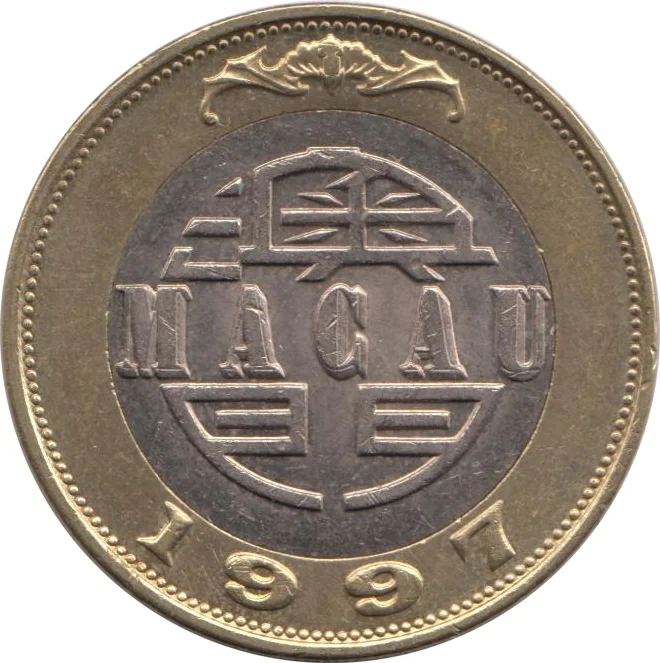
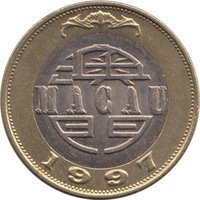
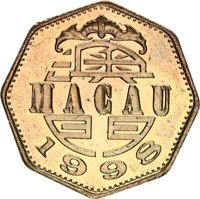
Bat above stylized "Macau" characters, with "MACAU" and date below.
Inscription:
M A C A U
1 9 9 7
1 9 9 7
Translation:
MACAU
1997
1997
Languages: Portuguese, English
Engraver: Justino Lei
Reverse
Description:
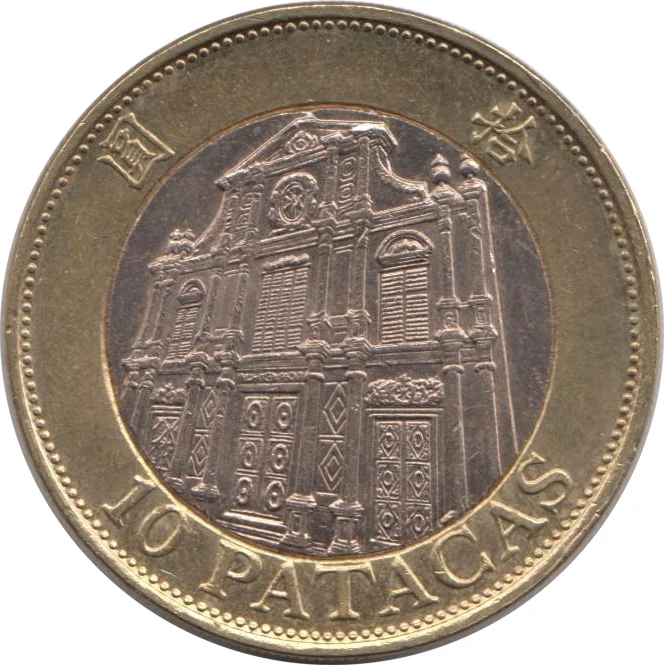
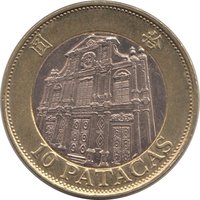
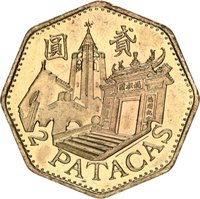
St. Domingo's Church within the circled value.
Inscription:
10 PATACAS
Engraver: Justino Lei
Edge
Reeded-smooth (4 times)
Categories
| Building> Religious building |
Mints
| Name | Mark |
|---|---|
| Royal Mint | — |
Mintings
| Year | Mint Mark | Mintage | Quality | Collection |
|---|---|---|---|---|
| 1997 | — | 20,000,000 |
Historical background
In 1997, Macau's currency situation was defined by its unique colonial status and its deep economic integration with neighboring Hong Kong. As a Portuguese-administered territory, Macau did not have a central bank and its official currency was the Macanese pataca (MOP), which had been pegged to the Hong Kong dollar (HKD) at a fixed rate of 1.03 patacas to 1 Hong Kong dollar since 1977. This peg was managed by the Issuing Institute of Macau, with note-issuing privileges delegated to two commercial banks: the Banco Nacional Ultramarino and, since 1995, the Bank of China. In practice, the Hong Kong dollar was widely circulated and accepted, often preferred for larger transactions, creating a de facto dual-currency economy.
The year 1997 was significant as it marked the final phase of Portugal's administration before the handover to China on December 20, 1999. Against this backdrop, the Asian Financial Crisis, which erupted in July 1997 with the devaluation of the Thai baht, created immediate economic pressures. However, Macau's currency stability was largely shielded by the robustness of the Hong Kong dollar's own peg to the U.S. dollar. While Macau's economy faced challenges from reduced regional tourism and investment, the pataca's indirect link to the USD via the HKD peg provided a crucial anchor, preventing the speculative attacks that devastated other Southeast Asian currencies.
Thus, the currency situation in 1997 was one of remarkable stability amid regional turmoil, underpinned by institutional and market confidence in the Hong Kong dollar system. This stability was strategically important for ensuring a smooth political transition. The Portuguese administration and the incoming Chinese government both recognized that maintaining the pataca's peg was essential for economic continuity, setting a precedent for the "one country, two systems" framework that would later guarantee Macau's separate currency and financial system after 1999.
The year 1997 was significant as it marked the final phase of Portugal's administration before the handover to China on December 20, 1999. Against this backdrop, the Asian Financial Crisis, which erupted in July 1997 with the devaluation of the Thai baht, created immediate economic pressures. However, Macau's currency stability was largely shielded by the robustness of the Hong Kong dollar's own peg to the U.S. dollar. While Macau's economy faced challenges from reduced regional tourism and investment, the pataca's indirect link to the USD via the HKD peg provided a crucial anchor, preventing the speculative attacks that devastated other Southeast Asian currencies.
Thus, the currency situation in 1997 was one of remarkable stability amid regional turmoil, underpinned by institutional and market confidence in the Hong Kong dollar system. This stability was strategically important for ensuring a smooth political transition. The Portuguese administration and the incoming Chinese government both recognized that maintaining the pataca's peg was essential for economic continuity, setting a precedent for the "one country, two systems" framework that would later guarantee Macau's separate currency and financial system after 1999.
🌱 Common