

10000 meticais – Mozambique
Add to wishlist
Non-circulating coins
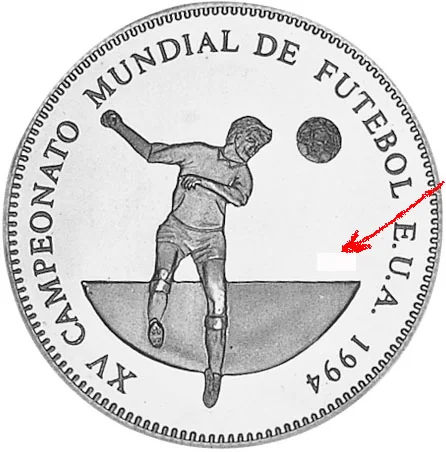
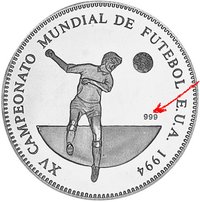
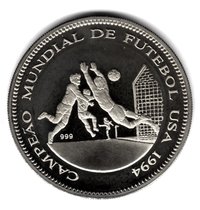
Commemoration: XV World Cup USA 1994
Mozambique
Context
Material
References
KM: #
Numista: #74643
Value
Exchange value: 10000 MZM
Bullion value: $45.82
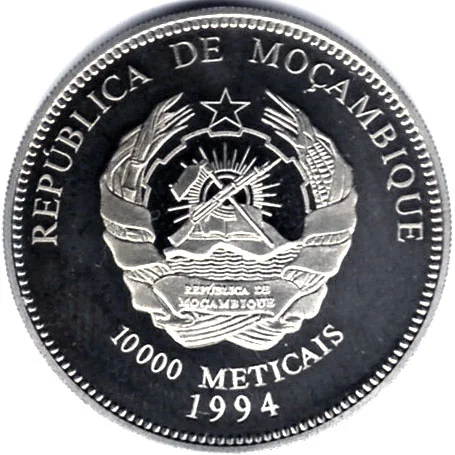
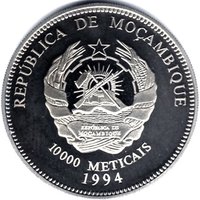
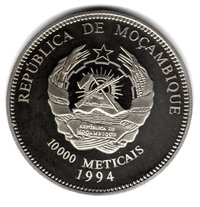
Obverse
Description:
National coat of arms.
Inscription:
REPÚBLICA DE MOÇAMBIQUE
10000 METICAIS
1994
10000 METICAIS
1994
Translation:
REPUBLIC OF MOZAMBIQUE
10000 METICAIS
1994
10000 METICAIS
1994
Script: Latin
Language: Portuguese
Reverse
Edge
Reeded
Mintings
| Year | Mint Mark | Mintage | Quality | Collection |
|---|---|---|---|---|
| 1994 | — | — |
Historical background
In 1994, Mozambique's currency situation was defined by the aftermath of a protracted civil war and the early stages of economic stabilization under the International Monetary Fund (IMF) and World Bank's Structural Adjustment Programme (SAP). The national currency, the metical (MZM), was experiencing high inflation and significant devaluation. This inflationary pressure was a direct legacy of war-financing through money printing, severe economic disruption, and a collapse in productive capacity. By 1994, the government was implementing painful reforms, including sharp cuts in public spending and the removal of subsidies, to curb hyperinflation, which had peaked at over 70% in the previous year.
The year was pivotal as it marked the country's first multi-party democratic elections in October, which were crucial for securing continued international aid and investment. Economically, the focus was on stabilizing the metical and rebuilding a functional financial system. A key monetary policy tool was the introduction of treasury bills in 1994 to help manage liquidity and provide a non-inflationary means of government borrowing. However, the currency remained weak and volatile, with its value largely determined by the black market, as formal exchange rates struggled to keep pace with reality.
Overall, the 1994 currency landscape was one of fragile transition. While the foundations for macroeconomic stability were being laid through liberalization and tight fiscal control, the benefits had not yet reached the majority of the population. The metical's instability reflected the broader challenges of rehabilitating a shattered economy, with the success of the currency reforms deeply intertwined with the political stability promised by the peaceful conclusion of the elections and the ongoing demobilization process.
The year was pivotal as it marked the country's first multi-party democratic elections in October, which were crucial for securing continued international aid and investment. Economically, the focus was on stabilizing the metical and rebuilding a functional financial system. A key monetary policy tool was the introduction of treasury bills in 1994 to help manage liquidity and provide a non-inflationary means of government borrowing. However, the currency remained weak and volatile, with its value largely determined by the black market, as formal exchange rates struggled to keep pace with reality.
Overall, the 1994 currency landscape was one of fragile transition. While the foundations for macroeconomic stability were being laid through liberalization and tight fiscal control, the benefits had not yet reached the majority of the population. The metical's instability reflected the broader challenges of rehabilitating a shattered economy, with the success of the currency reforms deeply intertwined with the political stability promised by the peaceful conclusion of the elections and the ongoing demobilization process.
✨ Legendary