

250 dirhams (Accession of King Mohammed VI) – Morocco
Add to wishlist
Non-circulating coins
Commemoration: 12th Anniversary of the Accession of King Mohammed VI
Morocco
Context
Material
References
KM: #
Numista: #74442
Value
Exchange value: 250 MAD
Bullion value: $63.98
Obverse
Description:
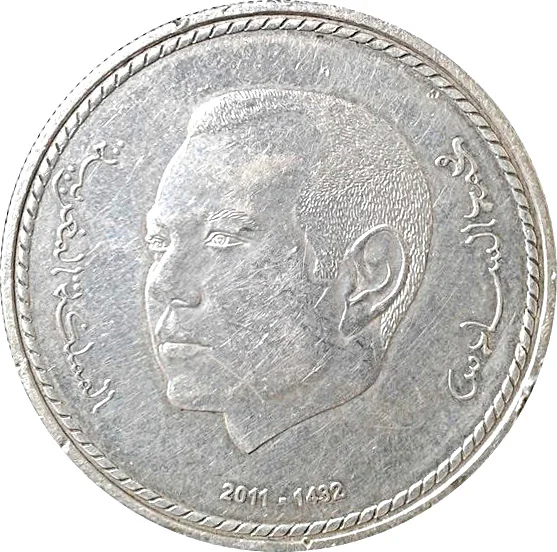
King Mohammed VI facing left, with dates below.
Inscription:
محمد السادس
المملكة المغربية
2011 - 1432
المملكة المغربية
2011 - 1432
Translation:
Mohammed VI
Kingdom of Morocco
2011 - 1432
Kingdom of Morocco
2011 - 1432
Language: Arabic
Reverse
Description:
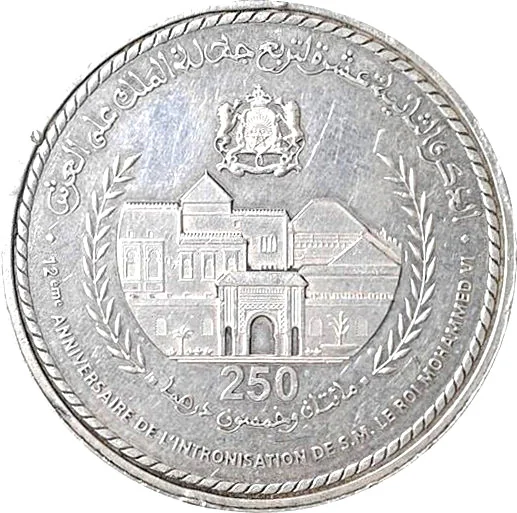
Moroccan coat of arms above Royal Palace, flanked by branches, with value below.
Inscription:
الذكرى الثانية عشرة لتربع جلالة الملك على العرش
250
♦ مائتان وخمسون درهما ♦
♦ 12ème ANNIVERSAIRE DE L'INTRONISATION DE S.M. LE ROI MOHAMMED VI ♦
250
♦ مائتان وخمسون درهما ♦
♦ 12ème ANNIVERSAIRE DE L'INTRONISATION DE S.M. LE ROI MOHAMMED VI ♦
Translation:
Twelfth Anniversary of His Majesty the King's Accession to the Throne
250
♦ Two Hundred and Fifty Dirhams ♦
♦ 12th Anniversary of the Enthronement of H.M. King Mohammed VI ♦
250
♦ Two Hundred and Fifty Dirhams ♦
♦ 12th Anniversary of the Enthronement of H.M. King Mohammed VI ♦
Edge
Mintings
| Year | Mint Mark | Mintage | Quality | Collection |
|---|---|---|---|---|
| 2011 | — | — | Proof |
Historical background
In 2011, Morocco's currency situation was characterized by a stable but carefully managed exchange rate regime, set against a backdrop of regional political upheaval and domestic economic pressures. The Moroccan dirham (MAD) operated under a fixed peg to a currency basket, weighted approximately 60% to the euro and 40% to the US dollar. This policy, administered by Bank Al-Maghrib (the central bank), provided stability for trade and investment but limited monetary policy autonomy. While the Arab Spring protests that year led to significant political reforms in Morocco, they did not trigger a currency crisis, largely due to the country's relative political stability, proactive social reforms by the monarchy, and robust foreign exchange reserves that cushioned against speculative pressures.
Economically, the year presented challenges that tested this stability. Soaring global prices for food and energy, which Morocco imports heavily, widened the trade and current account deficits. This increased demand for foreign currency put gradual depreciation pressure on the dirham. Furthermore, the economic downturn in the Eurozone—Morocco's primary trading partner and source of tourism revenue, foreign direct investment, and remittances—dampened crucial inflows of foreign exchange. Despite these pressures, Bank Al-Maghrib successfully maintained the peg, utilizing its reserves to intervene in the market and defend the agreed-upon exchange rate band.
Overall, 2011 was a year where Morocco's currency regime demonstrated resilience. The fixed peg was maintained without drastic devaluation, which helped control inflation and preserve economic confidence during a turbulent period. However, the underlying pressures highlighted the dirham's vulnerability to external shocks and set the stage for future policy debates. These discussions would eventually lead, years later, to a move towards a more flexible exchange rate system to better absorb such shocks and strengthen the competitiveness of the Moroccan economy.
Economically, the year presented challenges that tested this stability. Soaring global prices for food and energy, which Morocco imports heavily, widened the trade and current account deficits. This increased demand for foreign currency put gradual depreciation pressure on the dirham. Furthermore, the economic downturn in the Eurozone—Morocco's primary trading partner and source of tourism revenue, foreign direct investment, and remittances—dampened crucial inflows of foreign exchange. Despite these pressures, Bank Al-Maghrib successfully maintained the peg, utilizing its reserves to intervene in the market and defend the agreed-upon exchange rate band.
Overall, 2011 was a year where Morocco's currency regime demonstrated resilience. The fixed peg was maintained without drastic devaluation, which helped control inflation and preserve economic confidence during a turbulent period. However, the underlying pressures highlighted the dirham's vulnerability to external shocks and set the stage for future policy debates. These discussions would eventually lead, years later, to a move towards a more flexible exchange rate system to better absorb such shocks and strengthen the competitiveness of the Moroccan economy.
✨ Legendary