

½ Piastre – Lebanon
Lebanon
Context
Years: 1934–1936
Issuer: Lebanon 
Period:
(1926—1945)
Currency:
(1920—1939)
Demonetized: Yes
Total mintage: 1,400,000
Material
Diameter: 21 mm
Weight: 4 g
Thickness: 1.48 mm
Shape: Round
Composition: Copper-nickel
Technique: Milled
Alignment: Coin alignment
flip
References
KM: #Click to copy to clipboard9
Numista: #7443
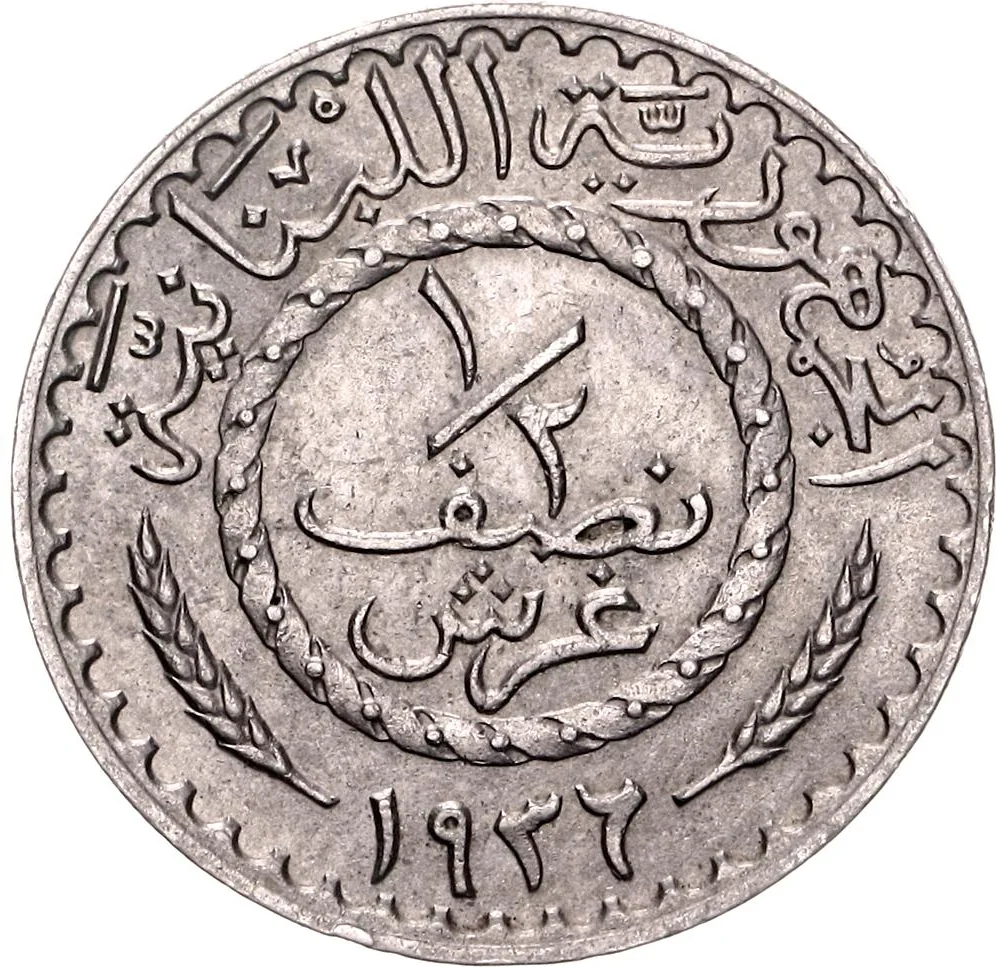
Obverse
Description:
Value in wreath, flanked by oats, above date.
Inscription:
الجمهورية اللبنانية
١/٢
نصف
غرش
١٩٣٦
١/٢
نصف
غرش
١٩٣٦
Translation:
Lebanese Republic
1/2
Half
Qirsh
1936
1/2
Half
Qirsh
1936
Language: Arabic
Engraver: Lucien Georges Bazor
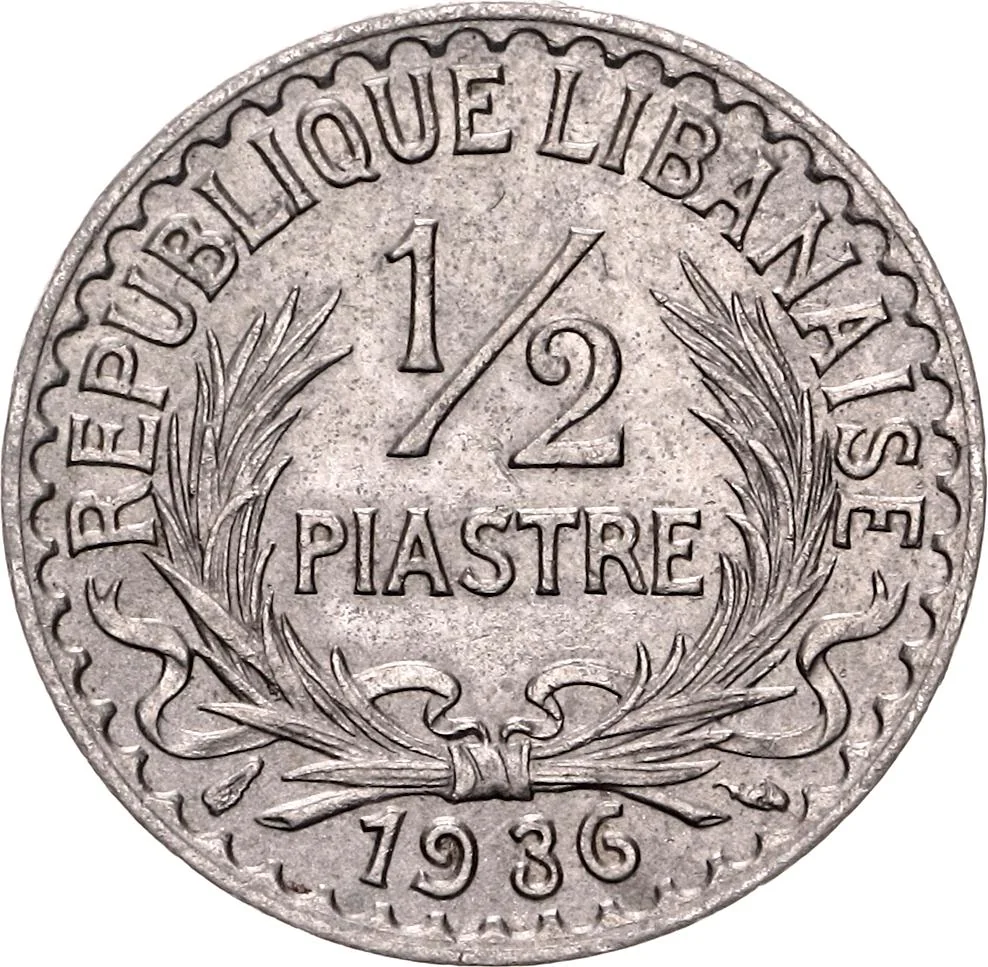
Reverse
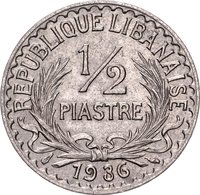
Description:
Sprig value above date.
Inscription:
REPUBLIQUE LIBANAISE
1/2
PIASTRE
1936
1/2
PIASTRE
1936
Translation:
LEBANESE REPUBLIC
1/2
PIASTER
1936
1/2
PIASTER
1936
Language: French
Engraver: Lucien Georges Bazor
Edge
Plain
Mints
| Name | Mark |
|---|---|
| Monnaie de Paris | — |
Mintings
| Year | Mint Mark | Mintage | Quality | Collection |
|---|---|---|---|---|
| 1934 | — | 200,000 | ||
| 1936 | — | 1,200,000 |
Historical background
In 1934, Lebanon's currency situation was defined by its position within the French Mandate for Syria and Lebanon, established after World War I. The official currency was the Syrian-Lebanese pound (livre), issued by the French-controlled Banque de Syrie et du Liban (BSL). This currency was not independent but was pegged at a fixed rate to the French franc (FF 20 = 1 Syrian-Lebanese pound), firmly anchoring Lebanon's monetary system to that of France. This arrangement facilitated trade and administrative stability but meant Lebanese monetary policy was entirely subordinate to French economic interests and decisions made in Paris.
The period was one of relative monetary stability compared to the turbulence that would follow later in the century. The BSL, operating under a concession granted by the French authorities, held a monopoly on note issuance, and the currency was fully convertible. Gold and silver coins also circulated alongside paper notes. This stability was crucial for the development of Lebanon's commercial and service-oriented economy, particularly in Beirut, which was emerging as a regional banking and trade hub. The fixed peg provided predictability for merchants and facilitated Lebanon's integration into the Franc Zone.
However, this system was inherently a colonial construct, designed to serve French imperial policy rather than Lebanese national sovereignty. There was no central bank or independent monetary authority for Lebanon itself. The stability of the 1934 currency was thus entirely dependent on the strength of the French franc and the political continuity of the Mandate. This lack of autonomy would become a significant point of contention as Lebanese nationalist movements grew stronger in the subsequent decade, eventually leading to the pursuit of an independent monetary system after gaining independence in 1943.
The period was one of relative monetary stability compared to the turbulence that would follow later in the century. The BSL, operating under a concession granted by the French authorities, held a monopoly on note issuance, and the currency was fully convertible. Gold and silver coins also circulated alongside paper notes. This stability was crucial for the development of Lebanon's commercial and service-oriented economy, particularly in Beirut, which was emerging as a regional banking and trade hub. The fixed peg provided predictability for merchants and facilitated Lebanon's integration into the Franc Zone.
However, this system was inherently a colonial construct, designed to serve French imperial policy rather than Lebanese national sovereignty. There was no central bank or independent monetary authority for Lebanon itself. The stability of the 1934 currency was thus entirely dependent on the strength of the French franc and the political continuity of the Mandate. This lack of autonomy would become a significant point of contention as Lebanese nationalist movements grew stronger in the subsequent decade, eventually leading to the pursuit of an independent monetary system after gaining independence in 1943.
🌱 Common