

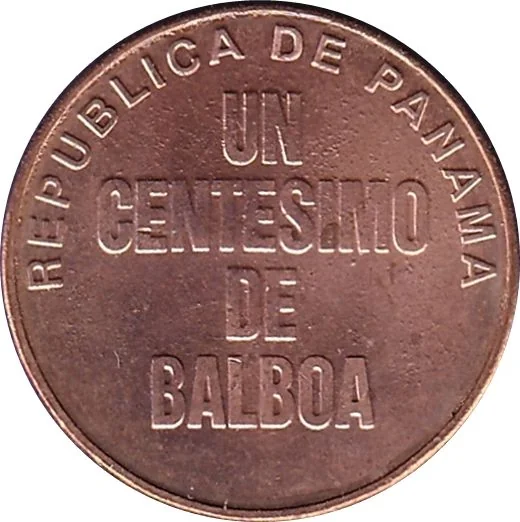
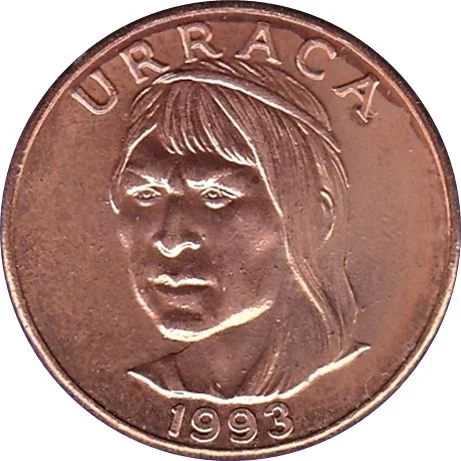
1 centesimo – Panama
Add to wishlist
Panama
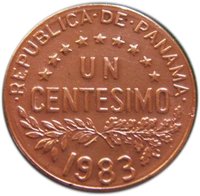
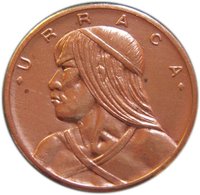
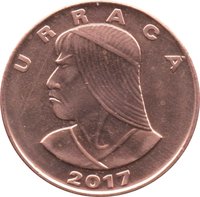
Obverse
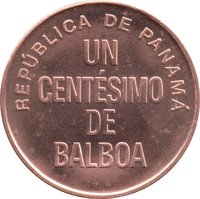
Reverse
Description:
Head of Urraca, 3/4 left. Name above, date below.
Inscription:
URRACA
1993
1993
Script: Latin
Edge
Plain
Categories
| Person> Military leader |
Mints
| Name | Mark |
|---|---|
| Royal Canadian Mint of Winnipeg | — |
Mintings
| Year | Mint Mark | Mintage | Quality | Collection |
|---|---|---|---|---|
| 1991 | — | — | ||
| 1993 | — | 30,000,000 |
Historical background
In 1991, Panama's currency situation was defined by a unique and stable system that had been formally established just two years prior. Following the political crisis and U.S. invasion of 1989, the new government of President Guillermo Endara reaffirmed Panama's official dollarization, which had been a de facto reality for decades. The 1904 monetary agreement with the United States was replaced by the Monetary Law of 1990, which made the U.S. dollar the sole legal tender, eliminating the Panamanian balboa as paper currency. The balboa survived only as coins, pegged at a strict 1:1 parity with the dollar.
This full dollarization provided immediate macroeconomic stability, controlling inflation and fostering confidence in the banking sector, which was crucial for recovery after the severe economic sanctions and instability of the late 1980s. However, it also meant Panama relinquished control over its monetary policy, unable to print money or set interest rates to manage economic cycles. The country's fiscal health and economic growth became entirely dependent on prudent fiscal policy, the competitiveness of its service-based economy (especially the Canal and banking), and the inflow of U.S. dollars through trade and finance.
Consequently, by 1991, Panama was navigating a post-crisis recovery within the constraints and benefits of its dollarized regime. The economy was rebounding from a deep recession, aided by the stability of using the U.S. dollar, which facilitated international trade and investment. The key challenge for policymakers was not exchange rate management, but rather fostering growth and managing public debt without the traditional tools of a central bank, making fiscal discipline the paramount concern for national economic management.
This full dollarization provided immediate macroeconomic stability, controlling inflation and fostering confidence in the banking sector, which was crucial for recovery after the severe economic sanctions and instability of the late 1980s. However, it also meant Panama relinquished control over its monetary policy, unable to print money or set interest rates to manage economic cycles. The country's fiscal health and economic growth became entirely dependent on prudent fiscal policy, the competitiveness of its service-based economy (especially the Canal and banking), and the inflow of U.S. dollars through trade and finance.
Consequently, by 1991, Panama was navigating a post-crisis recovery within the constraints and benefits of its dollarized regime. The economy was rebounding from a deep recession, aided by the stability of using the U.S. dollar, which facilitated international trade and investment. The key challenge for policymakers was not exchange rate management, but rather fostering growth and managing public debt without the traditional tools of a central bank, making fiscal discipline the paramount concern for national economic management.
🌱 Common