

5 Schilling – Austria
Austria

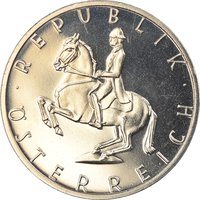
Obverse
Description:
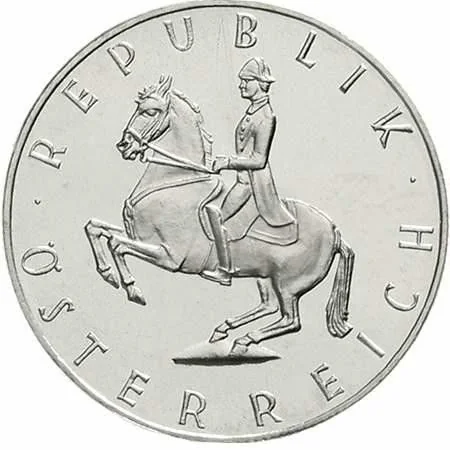
A Lipizzaner and rider from the Spanish Riding School.
Inscription:
· REPUBLIK ·
ÖSTERREICH
ÖSTERREICH
Translation:
· REPUBLIC ·
AUSTRIA
AUSTRIA
Script: Latin
Language: German
Engraver: Hans Köttenstorfer
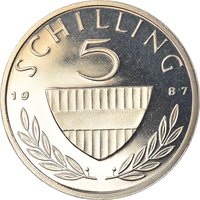
Reverse
Description:
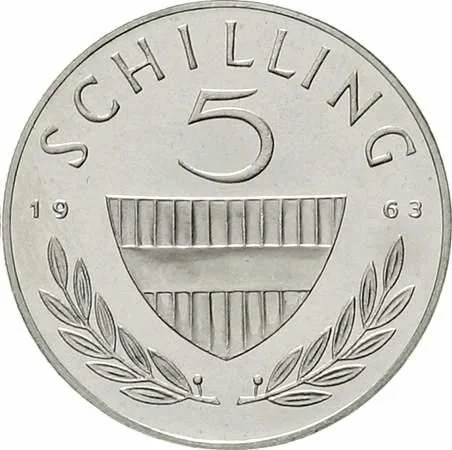
Austrian coat of arms, value, and laurel branches.
Inscription:
SCHILLING
5
19 63
5
19 63
Script: Latin
Engraver: Josef Köblinger
Edge
Reeded
Mints
| Name | Mark |
|---|---|
| Münze Österreich | — |
Mintings
| Year | Mint Mark | Mintage | Quality | Collection |
|---|---|---|---|---|
| 1960 | — | 12,618,000 | ||
| 1960 | — | 1,000 | Proof | |
| 1961 | — | 17,902,000 | ||
| 1961 | — | — | Proof | |
| 1962 | — | 6,771,000 | ||
| 1962 | — | — | Proof | |
| 1963 | — | 1,811,000 | ||
| 1963 | — | — | Proof | |
| 1964 | — | 4,030,000 | ||
| 1964 | — | — | Proof | |
| 1965 | — | 4,759,000 | ||
| 1965 | — | — | Proof | |
| 1966 | — | 4,481,000 | ||
| 1966 | — | — | Proof | |
| 1967 | — | 1,900,000 | ||
| 1967 | — | — | Proof | |
| 1968 | — | 4,792,300 | ||
| 1968 | — | 19,700 | Proof |
Historical background
In 1960, Austria's currency situation was defined by stability and successful post-war reconstruction, anchored by the Austrian Schilling (ÖS). The currency had been successfully reformed a decade earlier in 1947, when the "Second Schilling" replaced the heavily inflated wartime currency, wiping out much of the money supply to restore confidence. By 1960, the Schilling was a symbol of the country's "economic miracle" (Wirtschaftswunder), benefiting from conservative fiscal policies, significant Marshall Plan aid, and a growing industrial export sector. The Austrian National Bank (Oesterreichische Nationalbank), regaining its full autonomy in 1955, maintained a strict policy of price stability, and the Schilling was considered a hard, trustworthy currency within Europe.
This stability was further reinforced by Austria's participation in the Bretton Woods system of fixed exchange rates. The Schilling was pegged to the US Dollar at a rate of approximately 26 Schillings to 1 Dollar, which in turn was tied to gold. This peg provided a predictable framework for international trade and investment, crucial for Austria's open economy. The country was also an active member of the European Payments Union (EPU, 1950-1958), which had facilitated the return to convertibility for European currencies. By 1960, Austria had achieved full current account convertibility, allowing for the free flow of money for trade in goods and services.
However, this era of fixed parity required continual intervention to maintain. The Austrian National Bank had to hold substantial reserves of gold and foreign currency, primarily Dollars, to defend the Schilling's peg. While the economy was strong, the system's inherent rigidity meant that domestic monetary policy was largely subordinated to the goal of maintaining the exchange rate. This period of calm and predictability would last until the global pressures of the late 1960s began to strain the Bretton Woods system, eventually leading to its collapse and a new era of currency management for Austria in the following decade.
This stability was further reinforced by Austria's participation in the Bretton Woods system of fixed exchange rates. The Schilling was pegged to the US Dollar at a rate of approximately 26 Schillings to 1 Dollar, which in turn was tied to gold. This peg provided a predictable framework for international trade and investment, crucial for Austria's open economy. The country was also an active member of the European Payments Union (EPU, 1950-1958), which had facilitated the return to convertibility for European currencies. By 1960, Austria had achieved full current account convertibility, allowing for the free flow of money for trade in goods and services.
However, this era of fixed parity required continual intervention to maintain. The Austrian National Bank had to hold substantial reserves of gold and foreign currency, primarily Dollars, to defend the Schilling's peg. While the economy was strong, the system's inherent rigidity meant that domestic monetary policy was largely subordinated to the goal of maintaining the exchange rate. This period of calm and predictability would last until the global pressures of the late 1960s began to strain the Bretton Woods system, eventually leading to its collapse and a new era of currency management for Austria in the following decade.

🌱 Very Common