

100 Rubles – Russian Federation
Non-circulating coins
Commemoration: The 1st Kamchatka Expedition
Russia
Context
Year: 2003
Country: Russia 
Issuer: Russian Federation
Period:
(since 1991)
Currency:
(since 1998)
Total mintage: 1,500
Material
References
Value
Exchange value: 100 RUB
Bullion value: $2611.08
Inflation-adjusted value: 734.77 RUB
Obverse
Description:
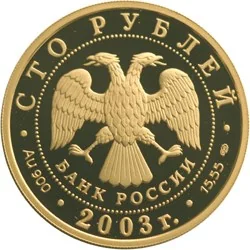
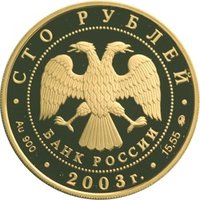
Center: Bank of Russia emblem (two-headed eagle, wings down, with "БАНК РОССИИ" below), within a dotted circle. Rim inscriptions: top - "СТО РУБЛЕЙ", bottom - year "2003". Left: metal/fineness mark. Right: fine metal content and mint mark.
Inscription:
СТО РУБЛЕЙ
БАНК РОССИИ
• Au 900 • 2003 г. • 15,55 СПМД •
БАНК РОССИИ
• Au 900 • 2003 г. • 15,55 СПМД •
Translation:
ONE HUNDRED RUBLES
BANK OF RUSSIA
• Au 900 • 2003 • 15.55 SPMD •
BANK OF RUSSIA
• Au 900 • 2003 • 15.55 SPMD •
Language: Russian
Designer and engraver: Alexander Vasilyevich Baklanov
Reverse
Description:
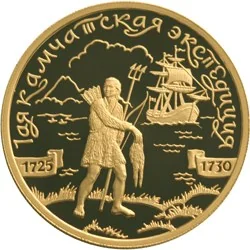
A Kamchatka native holds a leister, bow, quiver, and fish. Flanked by the dates 1725 and 1730, a sailing ship and mountain outlines are to the right. Rim inscription: "1ая КАМЧАТСКАЯ ЭКСПЕДИЦИЯ".
Inscription:
1ая КАМЧАТСКАЯ ЭКСПЕДИЦИЯ
1725 1730
1725 1730
Translation:
1st KAMCHATKA EXPEDITION
1725 1730
1725 1730
Script: Cyrillic
Language: Russian
Engraver: Andrey Sergevich Kunats
Designer: Alexander Vasilyevich Baklanov
Edge
240 corrugations
Categories
| Transportation> Watercraft |
| Object> Cold weapons |
Mints
| Name | Mark |
|---|---|
| Saint Petersburg | (СПМД) |
Mintings
| Year | Mint Mark | Mintage | Quality | Collection |
|---|---|---|---|---|
| 2003 | СПМД | 1,500 | Proof |
Historical background
In 2003, the Russian Federation's currency situation was characterized by a period of remarkable stability and strengthening, a stark contrast to the crises of the 1990s. The Russian ruble (RUB) was firmly under a managed float regime, where the Central Bank of Russia (CBR) intervened to smooth out excessive volatility while generally allowing market forces to determine the exchange rate. This stability was underpinned by a confluence of strong macroeconomic fundamentals: soaring global prices for oil and gas—Russia's key exports—fuelled a massive influx of petrodollars, leading to large trade and budget surpluses.
This economic windfall presented both an opportunity and a challenge for monetary authorities. The influx of foreign currency created significant upward pressure on the ruble's value. To prevent excessive appreciation, which could harm the competitiveness of non-oil exports, the CBR actively purchased foreign currency, building up its international reserves at an unprecedented rate. These reserves grew from about $48 billion at the start of the year to over $73 billion by year's end, providing a formidable buffer against external shocks. Concurrently, the government established a stabilization fund in 2004 to sterilize excess oil revenues, a direct policy response to the fiscal pressures of 2003.
Consequently, the year saw a steady nominal appreciation of the ruble against the US dollar, alongside low and declining inflation. This environment fostered growing public and business confidence in the national currency, encouraging de-dollarization as citizens and enterprises increasingly held savings and conducted transactions in rubles. Thus, 2003 stands as a foundational year of post-crisis consolidation, where Russia leveraged high commodity prices to achieve monetary stability, rebuild its reserves, and set the stage for a more assertive and sovereign financial policy in the years to follow.
This economic windfall presented both an opportunity and a challenge for monetary authorities. The influx of foreign currency created significant upward pressure on the ruble's value. To prevent excessive appreciation, which could harm the competitiveness of non-oil exports, the CBR actively purchased foreign currency, building up its international reserves at an unprecedented rate. These reserves grew from about $48 billion at the start of the year to over $73 billion by year's end, providing a formidable buffer against external shocks. Concurrently, the government established a stabilization fund in 2004 to sterilize excess oil revenues, a direct policy response to the fiscal pressures of 2003.
Consequently, the year saw a steady nominal appreciation of the ruble against the US dollar, alongside low and declining inflation. This environment fostered growing public and business confidence in the national currency, encouraging de-dollarization as citizens and enterprises increasingly held savings and conducted transactions in rubles. Thus, 2003 stands as a foundational year of post-crisis consolidation, where Russia leveraged high commodity prices to achieve monetary stability, rebuild its reserves, and set the stage for a more assertive and sovereign financial policy in the years to follow.
✨ Legendary