

20 euro – Lithuania
Add to wishlist
Non-circulating coins
Commemoration: Struve Geodetic Arc
Lithuania
Context
Material
References
KM: #
Numista: #74077
Value
Exchange value: 20 EUR
Bullion value: $66.59
Inflation-adjusted value: 30.60 EUR
Obverse
Description:
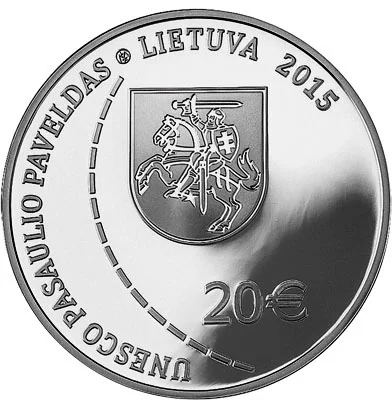
The obverse shows the Vytis at its center, encircled by a stylized meridian arc, with the inscriptions UNESCO PASAULIO PAVELDAS, LIETUVA, 2015, the €20 denomination, and the Lithuanian Mint mark.
Inscription:
UNESCO PASAULIO PAVELDAS LMK LIETUVA 2015
20 €
20 €
Translation:
UNESCO World Heritage LMK Lithuania 2015
20 €
20 €
Script: Latin
Language: Lithuanian
Engraver: Tadas Žebrauskas
Reverse
Description:
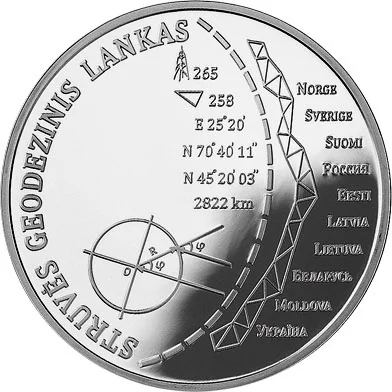
The reverse commemorates the Struve Geodetic Arc, a triangulation survey across ten nations. It honors scientist F.G.W. Struve, with the semicircular inscription STRUVĖS GEODEZINIS LANKAS.
Inscription:
STRUVĖS GEODEZINIS LANKAS
NORGE
SVERIGE
SUOMI
РОССНЯ
ESSTI
LATVIA
LIETUVA
БЕЛАРУСЬ
MOLDOVA
УКРAÏHA
265
E 25° 20'
N 70° 40' 11''
N 45° 20' 03''
2822km
NORGE
SVERIGE
SUOMI
РОССНЯ
ESSTI
LATVIA
LIETUVA
БЕЛАРУСЬ
MOLDOVA
УКРAÏHA
265
E 25° 20'
N 70° 40' 11''
N 45° 20' 03''
2822km
Translation:
Struve Geodetic Arc
Norway
Sweden
Finland
Russia
Estonia
Latvia
Lithuania
Belarus
Moldova
Ukraine
265
E 25° 20'
N 70° 40' 11''
N 45° 20' 03''
2822km
Norway
Sweden
Finland
Russia
Estonia
Latvia
Lithuania
Belarus
Moldova
Ukraine
265
E 25° 20'
N 70° 40' 11''
N 45° 20' 03''
2822km
Script: Latin
Languages: Latvian, Ukrainian, Swedish, Lithuanian, Lithuanian, Belarusian, Finnish, Estonian, Norwegian, Russian, Romanian/Moldovan
Engraver: Tadas Žebrauskas
Edge
Lettering
Legend:
GIREIŠIAI N55°54‘09‘‘ E25^26‘12‘‘ *MEŠKONYS N54^55‘51““ E25°19‘00‘‘
Translation:
Gireišiai N55°54'09" E25°26'12" * Meškonys N54°55'51" E25°19'00"
Language: Lithuanian
Categories
| Organization> UNESCO |
| Science |
| Symbols> Coat of Arms |
Mints
| Name | Mark |
|---|---|
| Lithuanian Mint | (LMK) |
Mintings
| Year | Mint Mark | Mintage | Quality | Collection |
|---|---|---|---|---|
| 2015 | LMK | 3,000 | Proof |
Historical background
In 2015, Lithuania completed a significant and historic monetary transition by adopting the euro on January 1st, becoming the 19th member of the Eurozone. This move marked the final step in its deep integration with Western economic and political structures, having joined the European Union and NATO a decade earlier. The changeover from the national litas (LTL), which had been pegged to the euro since 2002, was executed smoothly and with strong public support from institutions and businesses, though polls showed a lingering, cautious sentiment among the general population regarding potential price increases.
The decision to join the single currency was driven by strategic economic and security considerations. Following the 2008-09 financial crisis and the geopolitical tensions arising from Russia's actions in Ukraine in 2014, anchoring Lithuania firmly within the core of the European project was seen as a vital guarantee of stability and security. Economically, euro adoption aimed to eliminate currency risk, lower borrowing costs, and enhance trade and investment ties with major European partners, particularly Germany and the Nordic countries.
The year 2015 thus represented a period of post-transition adjustment. While the technical changeover was successful, the economy faced the broader challenges of the Eurozone, including the need for strict adherence to the EU's fiscal rules. Inflation briefly turned negative in 2015, partly due to falling global energy prices, but this was not a direct result of the currency change. Ultimately, 2015 solidified Lithuania's monetary framework within the European mainstream, providing a stable foundation for future growth while shifting the focus from currency policy to broader structural reforms within the Eurozone's constraints and opportunities.
The decision to join the single currency was driven by strategic economic and security considerations. Following the 2008-09 financial crisis and the geopolitical tensions arising from Russia's actions in Ukraine in 2014, anchoring Lithuania firmly within the core of the European project was seen as a vital guarantee of stability and security. Economically, euro adoption aimed to eliminate currency risk, lower borrowing costs, and enhance trade and investment ties with major European partners, particularly Germany and the Nordic countries.
The year 2015 thus represented a period of post-transition adjustment. While the technical changeover was successful, the economy faced the broader challenges of the Eurozone, including the need for strict adherence to the EU's fiscal rules. Inflation briefly turned negative in 2015, partly due to falling global energy prices, but this was not a direct result of the currency change. Ultimately, 2015 solidified Lithuania's monetary framework within the European mainstream, providing a stable foundation for future growth while shifting the focus from currency policy to broader structural reforms within the Eurozone's constraints and opportunities.
💎 Extremely Rare