

5 centimos – Costa Rica
Add to wishlist
Costa Rica
Context
Years: 1953–1967
Issuer: Costa Rica
Issuing organization: Central Bank of Costa Rica
Period:
(since 1948)
Currency:
(since 1896)
Demonetized: Yes
Total mintage: 39,880,000
Material
Diameter: 15 mm
Weight: 1 g
Thickness: 0.9 mm
Shape: Round
Composition: Stainless steel (17% Chrome)
Technique: Milled
Alignment: Coin alignment
flip
References
KM: #
Numista: #7403
Value
Exchange value: 0.05 CRC
Obverse
Description:
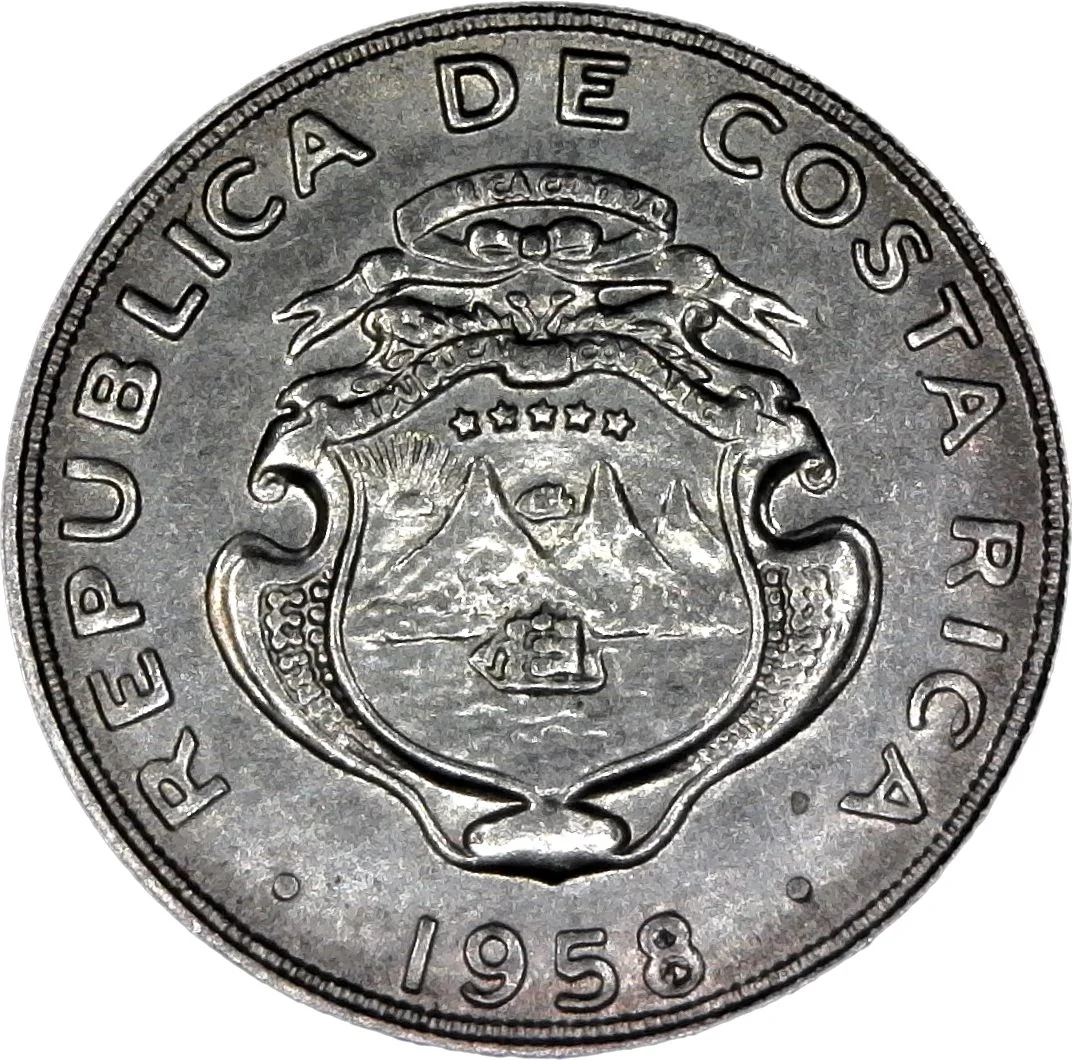
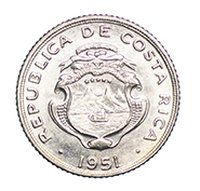
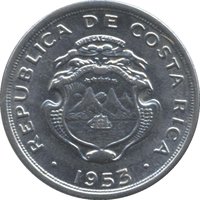
Costa Rica's coat of arms features five stars for its provinces, three volcanoes for its mountain ranges, two ships for its position between oceans, and a sunrise, with the date below.
Inscription:
REPUBLICA DE COSTA RICA
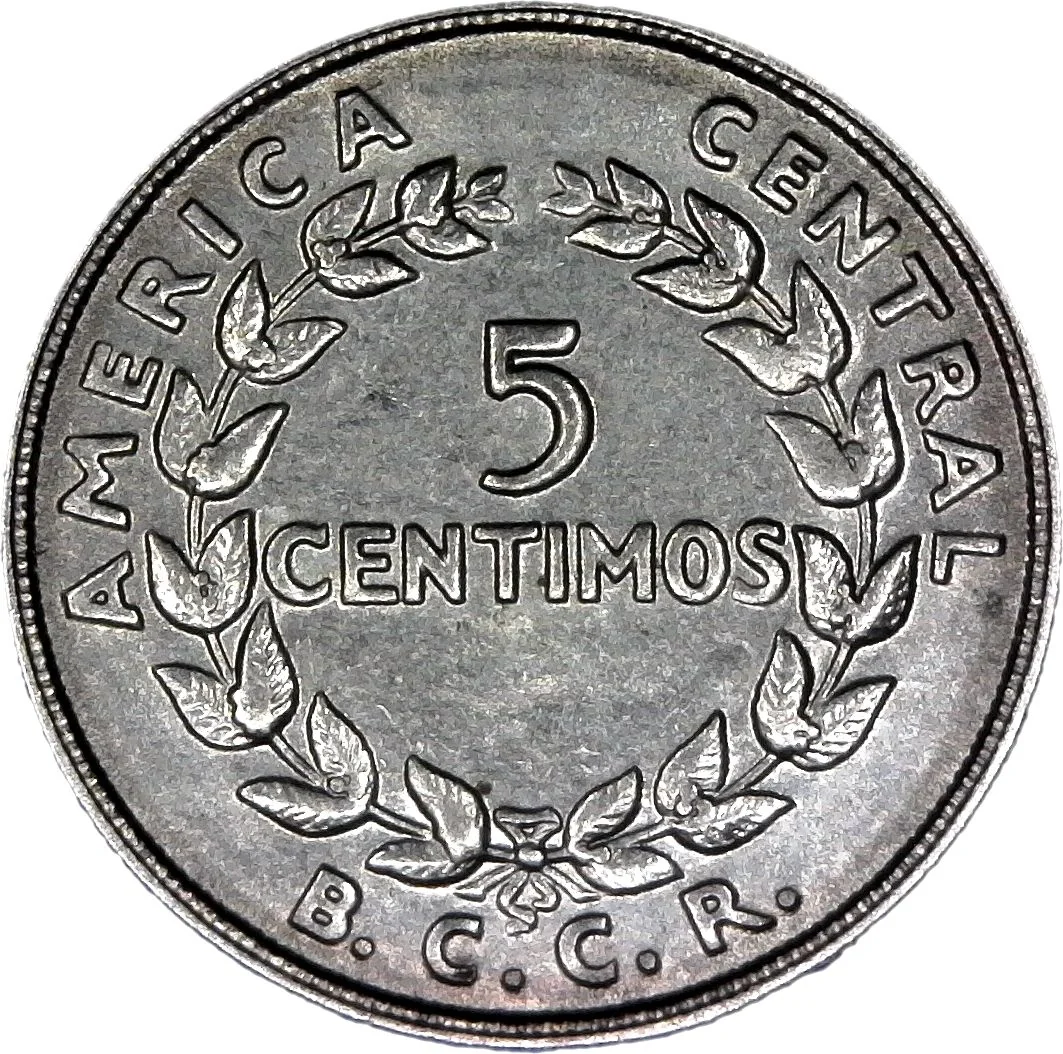
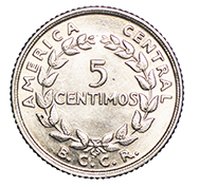
AMERICA CENTRAL
REPUBLICA DE COSTA RICA
1958
AMERICA CENTRAL
REPUBLICA DE COSTA RICA
1958
Translation:
REPUBLIC OF COSTA RICA
CENTRAL AMERICA
REPUBLIC OF COSTA RICA
1958
CENTRAL AMERICA
REPUBLIC OF COSTA RICA
1958
Script: Latin
Language: Spanish
Reverse
Edge
Milled
Categories
| Symbols> Coat of Arms |
| Symbol> Wreath |
Mintings
| Year | Mint Mark | Mintage | Quality | Collection |
|---|---|---|---|---|
| 1953 | — | 9,040,000 | ||
| 1958 | — | 19,940,000 | ||
| 1967 | — | 10,900,000 |
Historical background
In 1953, Costa Rica's currency situation was characterized by the dominance of the colón, which had been the national currency since 1896, replacing the Costa Rican peso. The colón was pegged to the United States dollar at a fixed rate of 5.60 colones per dollar, an exchange regime established in the 1930s. This peg provided a degree of monetary stability and predictability for a small, open economy heavily reliant on agricultural exports, primarily coffee and bananas. However, the system's rigidity also meant that Costa Rica's monetary policy was largely dictated by the need to maintain sufficient foreign exchange reserves to defend the fixed rate, limiting the central bank's ability to respond to domestic economic pressures.
The post-World War II period, including 1953, saw underlying strains on this system. The global coffee boom of the early 1950s provided a crucial inflow of dollars, bolstering reserves and supporting the peg. Yet, the economy remained vulnerable to commodity price swings, and the fixed exchange rate, combined with relatively high inflation compared to the U.S., began to lead to an overvaluation of the colón. This overvaluation made imports artificially cheap and exports less competitive over time, a structural weakness that would create significant problems in the coming years. Furthermore, the state-led development model pursued by the government, including significant public investment in banking, infrastructure, and social programs following the 1948 Civil War, required careful fiscal management to avoid destabilizing the currency.
Overall, 1953 represented a period of apparent surface stability for the Costa Rican colón, underpinned by favorable export earnings. However, it was a stability that masked growing imbalances. The fixed exchange rate regime was increasingly at odds with the goals of national economic development and expansionary fiscal policy. These tensions would culminate in a severe balance of payments crisis by the end of the decade, forcing Costa Rica to devalue the colón in 1961 and abandon the long-standing fixed peg, marking the end of an era in its monetary history.
The post-World War II period, including 1953, saw underlying strains on this system. The global coffee boom of the early 1950s provided a crucial inflow of dollars, bolstering reserves and supporting the peg. Yet, the economy remained vulnerable to commodity price swings, and the fixed exchange rate, combined with relatively high inflation compared to the U.S., began to lead to an overvaluation of the colón. This overvaluation made imports artificially cheap and exports less competitive over time, a structural weakness that would create significant problems in the coming years. Furthermore, the state-led development model pursued by the government, including significant public investment in banking, infrastructure, and social programs following the 1948 Civil War, required careful fiscal management to avoid destabilizing the currency.
Overall, 1953 represented a period of apparent surface stability for the Costa Rican colón, underpinned by favorable export earnings. However, it was a stability that masked growing imbalances. The fixed exchange rate regime was increasingly at odds with the goals of national economic development and expansionary fiscal policy. These tensions would culminate in a severe balance of payments crisis by the end of the decade, forcing Costa Rica to devalue the colón in 1961 and abandon the long-standing fixed peg, marking the end of an era in its monetary history.
🌱 Very Common