

20 Schilling (Georgenberger Handfeste) – Austria
Circulating commemorative coins
Commemoration: Steiermark - 800 Years of Georgenberger Handfeste
Austria

Obverse
Description:
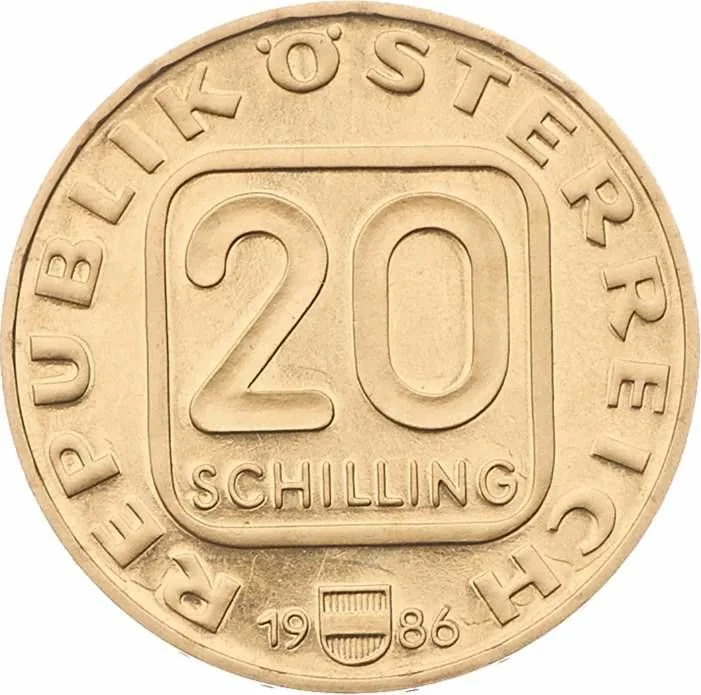
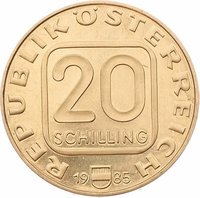
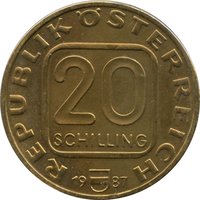
Austrian shield above date in rounded square frame.
Inscription:
REPUBLIK ÖSTERREICH
20
SCHILLING
19 86
20
SCHILLING
19 86
Translation:
REPUBLIC OF AUSTRIA
20
SCHILLING
19 86
20
SCHILLING
19 86
Script: Latin
Language: German
Engraver: Kurt Bodlak
Reverse
Description:
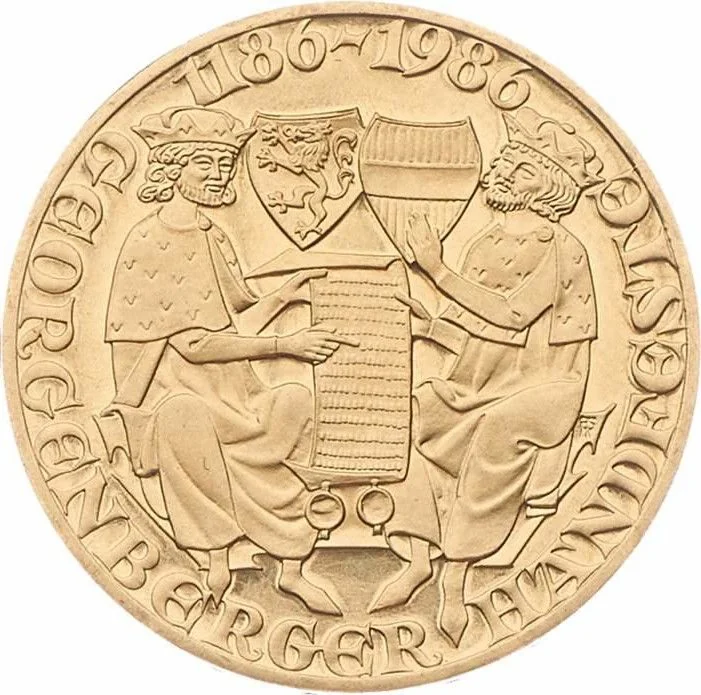
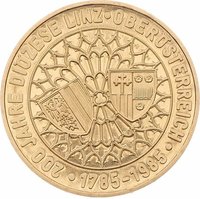
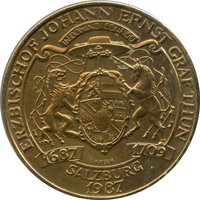
Left, Duke Leopold V.; right, Duke Ottokar IV. Between them, the sealed contract, topped by their coats of arms and encircled by a descriptive inscription.
Inscription:
1186-1986
GEORGENBERGER HANDFESTE
GEORGENBERGER HANDFESTE
Translation:
1186-1986
GEORGENBERGER CHARTER
GEORGENBERGER CHARTER
Script: Latin
Language: German
Engraver: Josef Kaiser
Designer: Thomas Pesendorfer
Edge
19 incuse dots in 9 groups of 2 or 3 (KM#2975.1), or smooth edge (KM#2975.2)
Legend:
••• •• •• •• •• •• •• •• ••
Categories
| Object> Hat |
| Symbols> Coat of Arms |
Mints
| Name | Mark |
|---|---|
| Münze Österreich | — |
Mintings
| Year | Mint Mark | Mintage | Quality | Collection |
|---|---|---|---|---|
| 1986 | — | 801,000 | ||
| 1986 | — | 42,000 | Proof | |
| 1991 | — | 140,000 | ||
| 1992 | — | 100,000 | ||
| 1993 | — | 180,000 |
Historical background
In 1986, Austria operated within a stable and conservative monetary framework, with the Austrian schilling (ATS) as its national currency. The country was not a member of the European Monetary System (EMS) but had, since the mid-1970s, maintained a de facto hard peg of the schilling to the Deutsche Mark (DM). This policy, known as the "hard currency policy," was a cornerstone of Austria's economic strategy, deliberately aligning its monetary policy with that of the Deutsche Bundesbank to import credibility and low inflation. Consequently, Austria enjoyed price stability and low interest rates, which were seen as critical for its export-oriented economy and for maintaining the social partnership model.
The year itself was not marked by a currency crisis or significant volatility. Instead, it was a period of consolidation for this successful policy. The schilling's stability was a point of national pride and a key factor in Austria's economic resilience. However, the broader European context was beginning to shift. Discussions on deeper European integration were advancing, and the Single European Act was signed in 1986, setting the stage for the eventual creation of a single market and, later, the Economic and Monetary Union (EMU). For Austria, this meant that long-term strategic questions about its monetary future were starting to emerge on the horizon.
Therefore, the 1986 currency situation was one of deliberate stability achieved through an unofficial anchor to the DM. This approach shielded Austria from the exchange rate turbulence experienced within the EMS during that period. The quiet success of the schilling, however, existed alongside the nascent European projects that would ultimately lead Austria to replace it with the euro in 1999, a logical culmination of its decades-long policy of aligning with German monetary stability.
The year itself was not marked by a currency crisis or significant volatility. Instead, it was a period of consolidation for this successful policy. The schilling's stability was a point of national pride and a key factor in Austria's economic resilience. However, the broader European context was beginning to shift. Discussions on deeper European integration were advancing, and the Single European Act was signed in 1986, setting the stage for the eventual creation of a single market and, later, the Economic and Monetary Union (EMU). For Austria, this meant that long-term strategic questions about its monetary future were starting to emerge on the horizon.
Therefore, the 1986 currency situation was one of deliberate stability achieved through an unofficial anchor to the DM. This approach shielded Austria from the exchange rate turbulence experienced within the EMS during that period. The quiet success of the schilling, however, existed alongside the nascent European projects that would ultimately lead Austria to replace it with the euro in 1999, a logical culmination of its decades-long policy of aligning with German monetary stability.
🌱 Common