

1 yuan – Szechuan Province
Add to wishlist
China
Context
Years: 1901–1908
Country: China
Issuer: Szechuan Province
Ruler: Guangxu
Currency:
(1897—1949)
Demonetized: Yes
Total mintage: 6,487,000
Material
References
Y: #
Numista: #7387
Value
Bullion value: $60.68
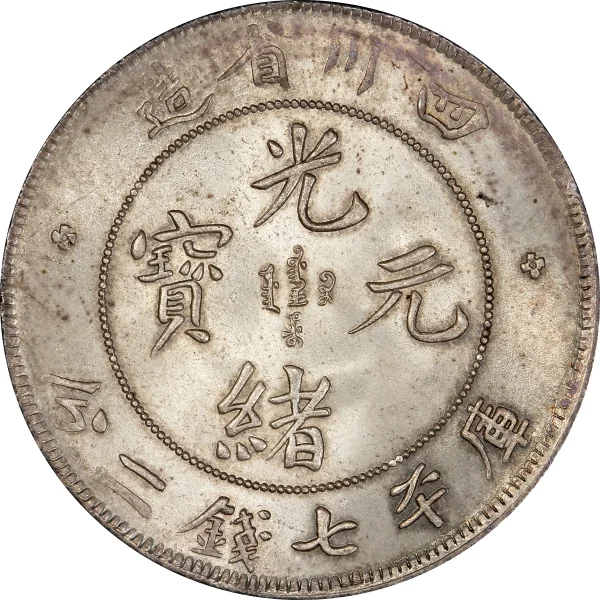
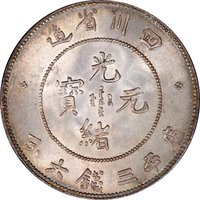
Obverse
Description:
Chinese ideograms read vertically, right to left, with Manchu text in the center, all encircled by more Chinese characters.
Inscription:
造省川四
光
ᠪᠠᡩᠠᡵᠠᠩᡤᠠ
寶 ᠶᡠᠸᠠᠨ ᠪᠣᠣ 元
ᡩᠣᡵᠣ
緒
分二錢七平库
光
ᠪᠠᡩᠠᡵᠠᠩᡤᠠ
寶 ᠶᡠᠸᠠᠨ ᠪᠣᠣ 元
ᡩᠣᡵᠣ
緒
分二錢七平库
Translation:
Made in Sichuan Province
Guangxu
[Reign Title]
Baoyuan
[Currency Bureau]
7 Mace 2 Candareens, Treasury Standard
Guangxu
[Reign Title]
Baoyuan
[Currency Bureau]
7 Mace 2 Candareens, Treasury Standard
Scripts: Chinese, Mongolian / Manchu
Languages: Manchu, Classical Chinese
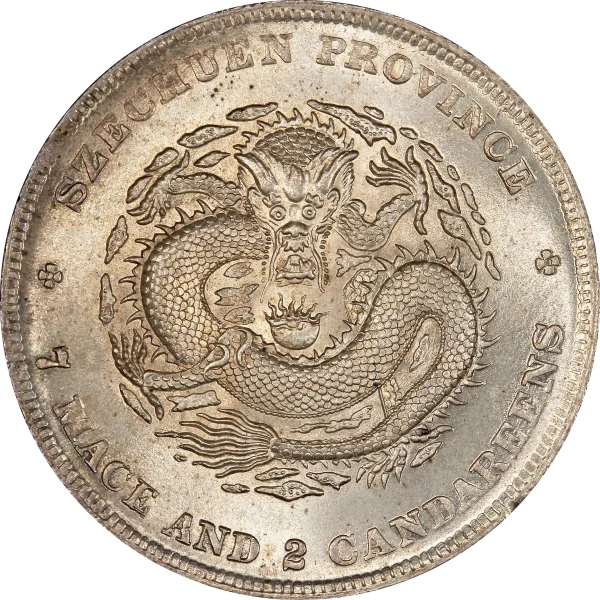
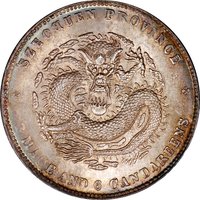
Reverse
Description:
Dragon encircling a pearl, surrounded by English text.
Inscription:
SZECHUEN PROVINCE
7 MACE AND 2 CANDAREENS
7 MACE AND 2 CANDAREENS
Script: Latin
Edge
Reeded.
Categories
| Mythology> Fantastic animal |
Mintings
| Year | Mint Mark | Mintage | Quality | Collection |
|---|---|---|---|---|
| — | — | 6,487,000 |
Historical background
In 1901, the currency situation in Sichuan Province was one of profound complexity and instability, characteristic of China's late Qing dynasty. The province operated under a chaotic multi-currency system, lacking a standardized medium of exchange. The primary forms included silver sycee (measured in taels), copper cash coins (wen), and a growing volume of privately issued paper notes from local banks, pawnshops, and even merchants. Crucially, there was no fixed exchange rate between silver and copper; the rate fluctuated wildly based on local supply, demand, and manipulation, creating significant hardship for peasants who earned in copper but often paid taxes in silver.
This instability was exacerbated by two major factors. First, a severe shortage of copper cash had plagued Sichuan for decades, driven by hoarding, counterfeiting of lightweight "bad cash," and the outflow of copper for other uses. Second, to fill the void, the circulation of unofficial paper money (qianpiao) had become ubiquitous and dangerously unregulated. These notes were promises to pay in copper cash, but issuing institutions frequently failed to maintain adequate reserves, leading to frequent bank runs and note devaluations. The provincial government's attempts to manage the system were largely ineffective.
The currency chaos had deep social and economic consequences. It facilitated corruption, hindered intra-provincial trade, and increased the tax burden on the common people, as magistrates applied unfavorable exchange rates. This monetary disorder contributed to the underlying social unrest that would continue to simmer in Sichuan. While the imperial court recognized the need for monetary reform, substantive nationwide change would not begin until the last years of the dynasty, leaving Sichuan's 1901 currency landscape fragmented and fraught with risk for ordinary transactions.
This instability was exacerbated by two major factors. First, a severe shortage of copper cash had plagued Sichuan for decades, driven by hoarding, counterfeiting of lightweight "bad cash," and the outflow of copper for other uses. Second, to fill the void, the circulation of unofficial paper money (qianpiao) had become ubiquitous and dangerously unregulated. These notes were promises to pay in copper cash, but issuing institutions frequently failed to maintain adequate reserves, leading to frequent bank runs and note devaluations. The provincial government's attempts to manage the system were largely ineffective.
The currency chaos had deep social and economic consequences. It facilitated corruption, hindered intra-provincial trade, and increased the tax burden on the common people, as magistrates applied unfavorable exchange rates. This monetary disorder contributed to the underlying social unrest that would continue to simmer in Sichuan. While the imperial court recognized the need for monetary reform, substantive nationwide change would not begin until the last years of the dynasty, leaving Sichuan's 1901 currency landscape fragmented and fraught with risk for ordinary transactions.
⭐ Rare