

25 Euro – Grand Duchy of Luxembourg
Non-circulating coins
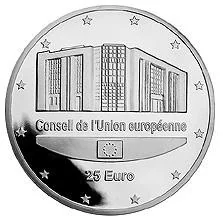
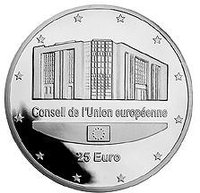
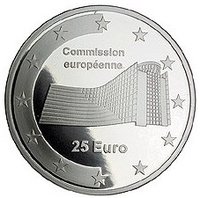
Commemoration: European Union presidency of Luxembourg
Luxembourg
Context
Year: 2005
Country: Luxembourg 
Issuer: Grand Duchy of Luxembourg
Ruler: Henry
Currency:
(since 2002)
Total mintage: 5,000
Material
References
KM: #Click to copy to clipboard98
Numista: #73670
Value
Exchange value: 25 EUR = $29.54
Bullion value: $59.79
Inflation-adjusted value: 39.34 EUR
Obverse
Description:
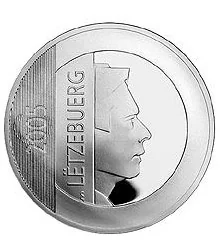
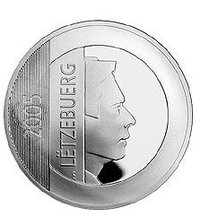
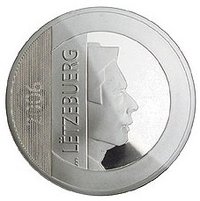
Grand Duke Henri of Luxembourg, right profile.
Inscription:
2005
LËTZEBUERG
CG
LËTZEBUERG
CG
Translation:
Luxembourg
2005
2005
Script: Latin
Languages: French, Luxembourgish
Engraver: Yvette Gastauer-Claire
Reverse
Edge
Mintings
| Year | Mint Mark | Mintage | Quality | Collection |
|---|---|---|---|---|
| 2005 | — | 5,000 | Proof |
Historical background
In 2005, the Grand Duchy of Luxembourg was a fully integrated member of the Eurozone, having adopted the euro as its sole legal tender on 1 January 2002, alongside eleven other founding members. The national currency, the Luxembourg franc, had been permanently fixed at a rate of 40.3399 francs to one euro and was in the final stages of being phased out of circulation. While banks still exchanged francs for euros, and some older price tags in shops might still display the dual pricing, daily economic life was conducted entirely in euros. This seamless transition cemented Luxembourg's position at the heart of European financial and economic integration.
The currency situation was fundamentally stable, underpinned by the shared monetary policy of the European Central Bank (ECB), to which Luxembourg's central bank, the Banque Centrale du Luxembourg (BCL), was a contributing member. Luxembourg's economy, heavily reliant on its large financial sector, cross-border workers, and stable political environment, benefited greatly from the elimination of exchange rate risk with its key trading partners, notably Belgium, France, and Germany. The euro facilitated the country's role as a major investment fund hub and private banking centre, as it simplified transactions and enhanced financial transparency for international clients and institutions operating within its borders.
However, 2005 also fell within a period of broader Eurozone adjustment and scrutiny. The year saw debates over the stability and growth pact, following its suspension for major economies like France and Germany in 2003. For a fiscally conservative and prosperous nation like Luxembourg, which consistently maintained budget surpluses and low debt, there was a concern about the potential for fiscal laxity in other member states to undermine the euro's stability and inflation prospects. Thus, while the domestic currency situation was settled and highly advantageous, Luxembourg's policymakers were actively engaged in Frankfurt and Brussels, advocating for strict fiscal discipline to ensure the long-term credibility of the single currency they had fully embraced.
The currency situation was fundamentally stable, underpinned by the shared monetary policy of the European Central Bank (ECB), to which Luxembourg's central bank, the Banque Centrale du Luxembourg (BCL), was a contributing member. Luxembourg's economy, heavily reliant on its large financial sector, cross-border workers, and stable political environment, benefited greatly from the elimination of exchange rate risk with its key trading partners, notably Belgium, France, and Germany. The euro facilitated the country's role as a major investment fund hub and private banking centre, as it simplified transactions and enhanced financial transparency for international clients and institutions operating within its borders.
However, 2005 also fell within a period of broader Eurozone adjustment and scrutiny. The year saw debates over the stability and growth pact, following its suspension for major economies like France and Germany in 2003. For a fiscally conservative and prosperous nation like Luxembourg, which consistently maintained budget surpluses and low debt, there was a concern about the potential for fiscal laxity in other member states to undermine the euro's stability and inflation prospects. Thus, while the domestic currency situation was settled and highly advantageous, Luxembourg's policymakers were actively engaged in Frankfurt and Brussels, advocating for strict fiscal discipline to ensure the long-term credibility of the single currency they had fully embraced.
💎 Extremely Rare