

1 Dollar – Australia
Non-circulating coins
Commemoration: Year of the Outback
Australia
Context

Material
References
KM: #Click to copy to clipboard600.2
Numista: #73408
Value
Exchange value: 1 AUD = $0.71
Inflation-adjusted value: 1.86 AUD
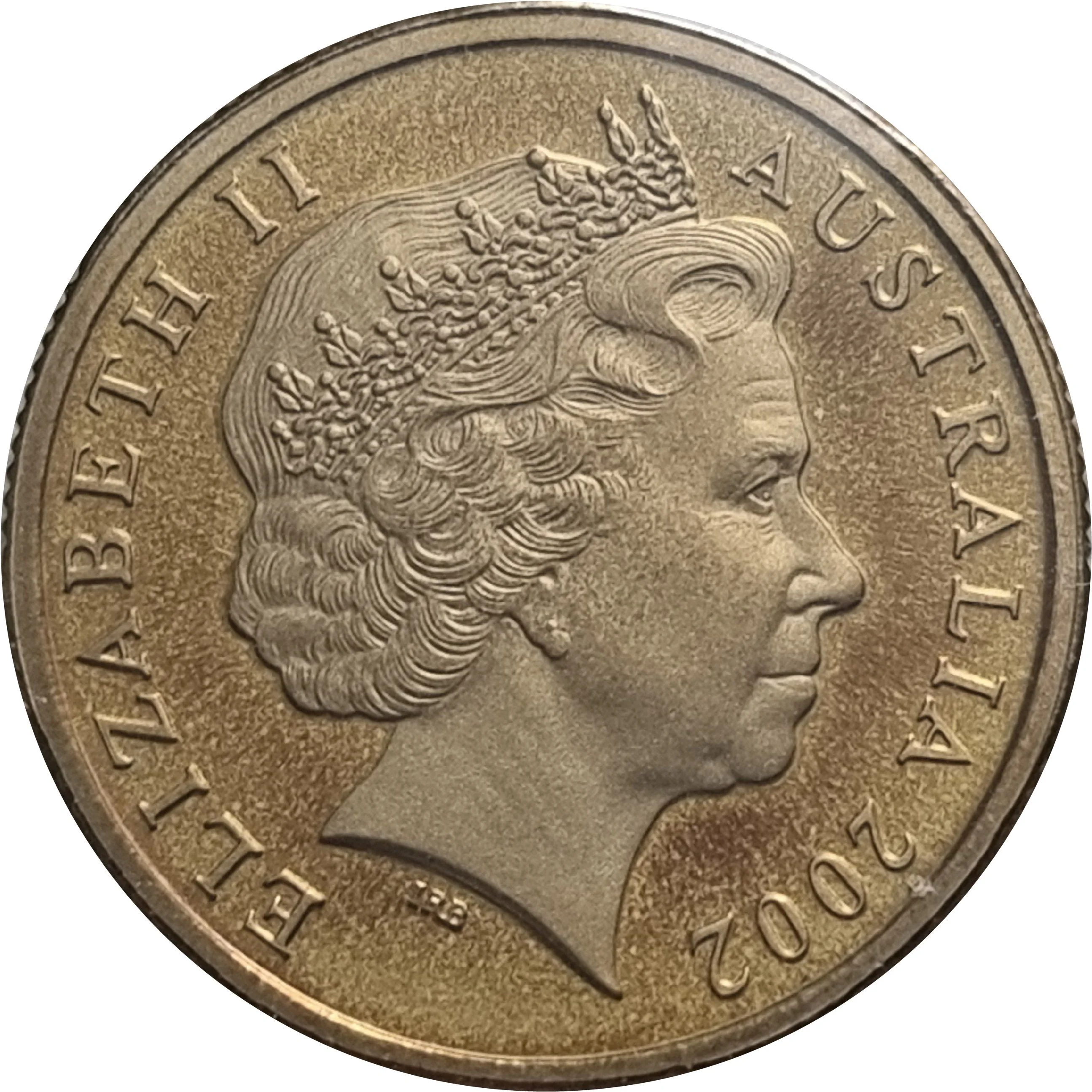
Obverse
Description:
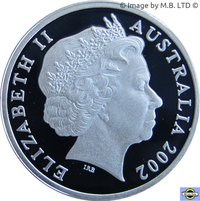
Queen Elizabeth IV, facing right, wearing the Girls of Great Britain and Ireland Tiara.
Inscription:
ELIZABETH II
AUSTRALIA 2002
IRB
AUSTRALIA 2002
IRB
Script: Latin
Designer: Ian Rank-Broadley
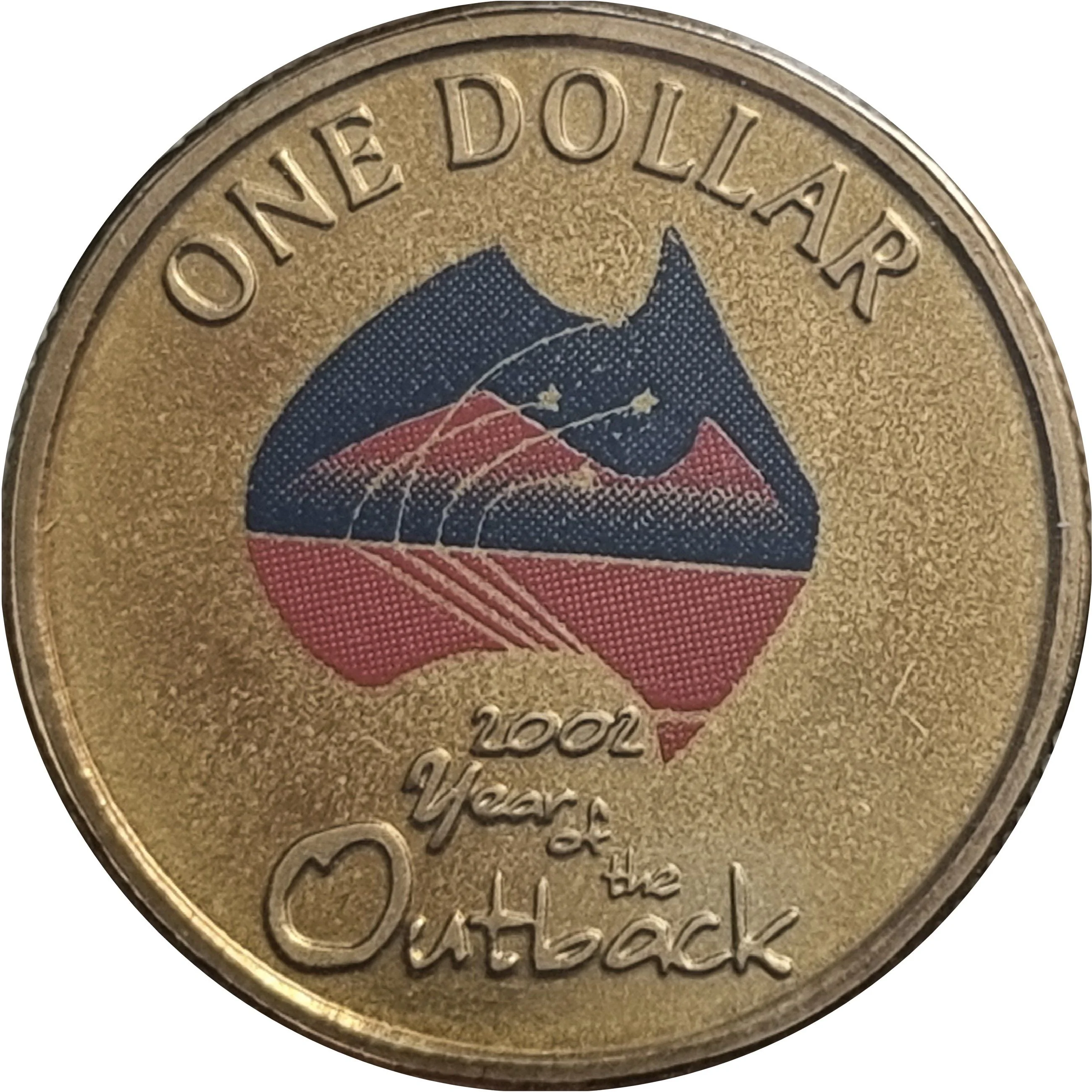
Reverse
Description:
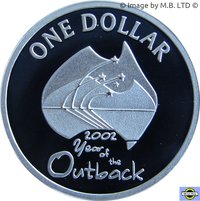
Red and blue stylised Australia with the Southern Cross.
Inscription:
ONE DOLLAR
2002
Year of the Outback
2002
Year of the Outback
Script: Latin
Designer: Wojciech Pietranik
Edge
7 shorter smooth segments between 7 reeded segments (11 grooves each)
Categories
| Map |
Mints
| Name | Mark |
|---|---|
| Royal Australian Mint | — |
Mintings
| Year | Mint Mark | Mintage | Quality | Collection |
|---|---|---|---|---|
| 2002 | — | 13,996 | Proof |
Historical background
In 2002, Australia's currency situation was defined by the robust performance of the Australian dollar (AUD), which had emerged from a period of historic weakness. The AUD had hit an all-time low of 47.75 US cents in April 2001, a slump driven by factors including the dot-com bust, global economic uncertainty, and perceptions of the currency as a commodity-linked risk asset. However, a dramatic reversal began in late 2001 and accelerated throughout 2002. The currency appreciated strongly, rising over 20% against the US dollar during the year, to trade in a range roughly between 54 and 58 US cents by year's end.
This sharp appreciation was primarily fueled by two interconnected factors. First, Australia's economy remained resilient, avoiding the recession that affected many major economies post-9/11, thanks in part to strong domestic consumption and a housing boom. Second, and crucially, a global commodities "super-cycle" was beginning, with soaring demand from China for Australia's mineral and energy exports. This fundamentally improved the nation's terms of trade and attracted significant foreign investment, boosting demand for the AUD. The Reserve Bank of Australia (RBA) responded to the domestic strength by raising interest rates twice in 2002 (May and June), making Australian assets even more attractive to international investors seeking yield.
Consequently, the policy focus shifted from concerns about a weak currency to managing the impacts of a strengthening one. The rising AUD helped contain imported inflation, giving the RBA flexibility in its monetary policy. However, it also applied pressure on the export-oriented manufacturing, tourism, and education sectors, which found their goods and services more expensive on the global market. By the close of 2002, the narrative had firmly changed from one of vulnerability to one of a commodity-driven currency riding a wave of global macroeconomic change, setting the stage for its continued ascent in the following years.
This sharp appreciation was primarily fueled by two interconnected factors. First, Australia's economy remained resilient, avoiding the recession that affected many major economies post-9/11, thanks in part to strong domestic consumption and a housing boom. Second, and crucially, a global commodities "super-cycle" was beginning, with soaring demand from China for Australia's mineral and energy exports. This fundamentally improved the nation's terms of trade and attracted significant foreign investment, boosting demand for the AUD. The Reserve Bank of Australia (RBA) responded to the domestic strength by raising interest rates twice in 2002 (May and June), making Australian assets even more attractive to international investors seeking yield.
Consequently, the policy focus shifted from concerns about a weak currency to managing the impacts of a strengthening one. The rising AUD helped contain imported inflation, giving the RBA flexibility in its monetary policy. However, it also applied pressure on the export-oriented manufacturing, tourism, and education sectors, which found their goods and services more expensive on the global market. By the close of 2002, the narrative had firmly changed from one of vulnerability to one of a commodity-driven currency riding a wave of global macroeconomic change, setting the stage for its continued ascent in the following years.
💎 Very Rare