

100 francs – New Hebrides
Add to wishlist
Vanuatu
Context
Year: 1966
Country: Vanuatu
Issuer: New Hebrides
Period:
(1906—1980)
Currency:
(1921—1982)
Demonetized: Yes
Total mintage: 200,000
Material
References
KM: #
Numista: #10363
Value
Bullion value: $52.40
Obverse
Description:
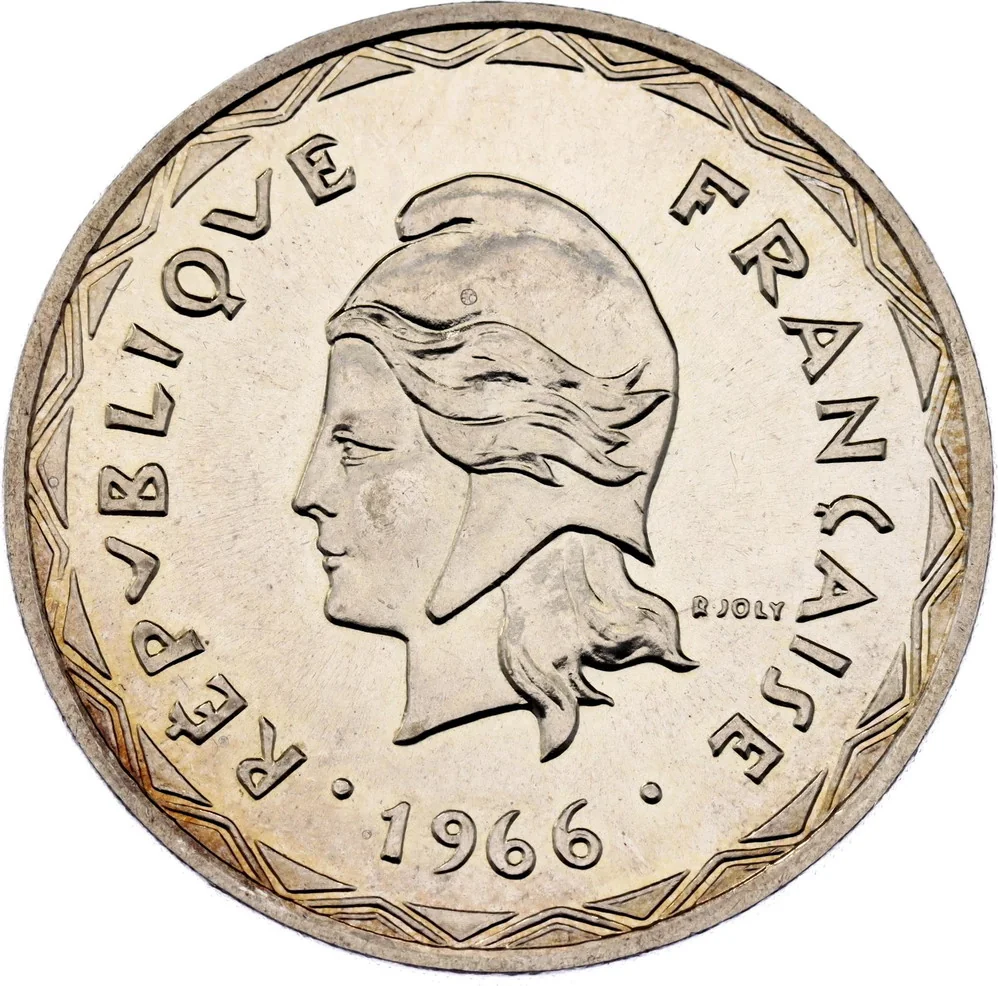
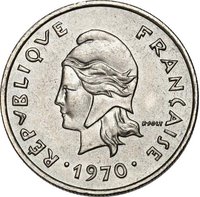
Marianne, the personification of Liberty, faces left wearing a Phrygian cap.
Inscription:
RÉPVBLIQVE FRANÇAISE
R·JOLY
1966
R·JOLY
1966
Translation:
FRENCH REPUBLIC
R·JOLY
1966
R·JOLY
1966
Script: Latin
Language: French
Engraver: Raymond Joly
Reverse
Description:
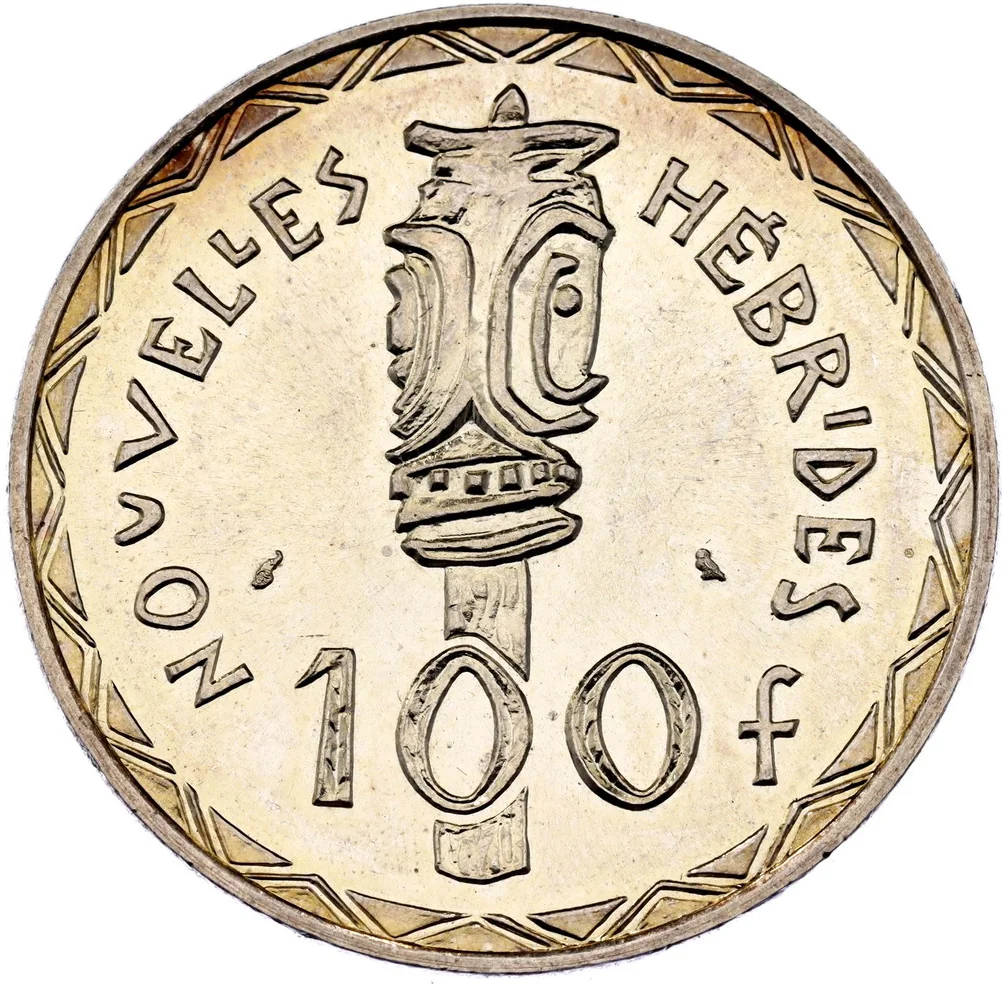
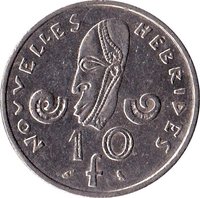
A bisj or totem pole is a ritual wooden artifact carved with human or animal faces.
Inscription:
NOUVELLES HÉBRIDES
100f
100f
Translation:
New Hebrides
100 Francs
100 Francs
Script: Latin
Language: French
Engraver: Raymond Joly
Edge
Reeded
Mints
| Name | Mark |
|---|---|
| Monnaie de Paris | — |
Mintings
| Year | Mint Mark | Mintage | Quality | Collection |
|---|---|---|---|---|
| 1966 | — | 200,000 |
Historical background
In 1966, the currency situation in the New Hebrides condominium was a unique and tangible reflection of the territory’s unusual Anglo-French joint administration. The archipelago did not issue its own independent currency. Instead, two separate official currencies circulated simultaneously and were legal tender: the Australian pound (A£) and the French Pacific franc (CFP franc). This dual-currency system was a direct consequence of the Condominium's "Pandemonium" structure, where two separate governmental systems operated in parallel, each with its own language, education, and economic linkages.
Practically, this meant businesses and individuals had to navigate daily transactions using either or both currencies, with exchange rates fluctuating based on supply and demand between the two European powers' monetary zones. The Australian pound was tied to the British sterling system and was dominant in the sectors and islands influenced by British missionaries and Australian trade. The CFP franc, pegged to the French franc, was prevalent in areas under stronger French commercial and administrative influence. This often led to complexity and inconvenience, requiring a working knowledge of two monetary systems.
This arrangement underscored the lack of a unified national economy and was symptomatic of the broader political fragmentation. It would remain in place until 1973, when, in a step toward simplification ahead of independence, the dual currencies were replaced by a single common currency of account, the New Hebrides franc, which was itself pegged to both the Australian dollar and the French franc. The 1966 system, therefore, stands as a notable historical example of a functioning, if cumbersome, bi-monetary economy under a shared sovereignty.
Practically, this meant businesses and individuals had to navigate daily transactions using either or both currencies, with exchange rates fluctuating based on supply and demand between the two European powers' monetary zones. The Australian pound was tied to the British sterling system and was dominant in the sectors and islands influenced by British missionaries and Australian trade. The CFP franc, pegged to the French franc, was prevalent in areas under stronger French commercial and administrative influence. This often led to complexity and inconvenience, requiring a working knowledge of two monetary systems.
This arrangement underscored the lack of a unified national economy and was symptomatic of the broader political fragmentation. It would remain in place until 1973, when, in a step toward simplification ahead of independence, the dual currencies were replaced by a single common currency of account, the New Hebrides franc, which was itself pegged to both the Australian dollar and the French franc. The 1966 system, therefore, stands as a notable historical example of a functioning, if cumbersome, bi-monetary economy under a shared sovereignty.
🌱 Common