

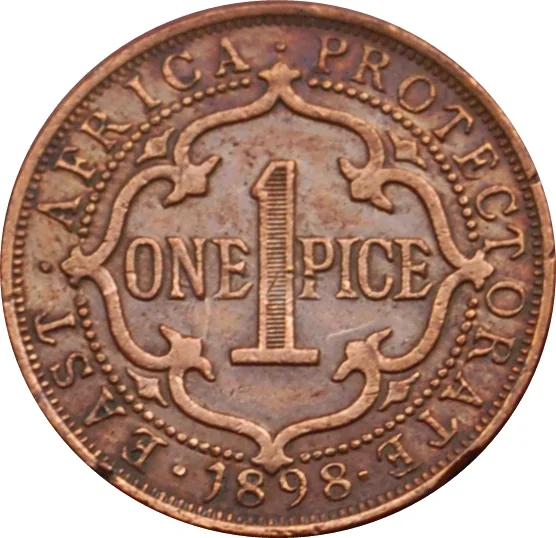
1 paisa – East Africa
Add to wishlist
Context
Years: 1897–1899
Issuer: East Africa
Ruler: Victoria
Currency:
(1895—1905)
Demonetized: Yes
Total mintage: 10,240,000
Material
References
KM: #
Numista: #7273
Obverse
Description:
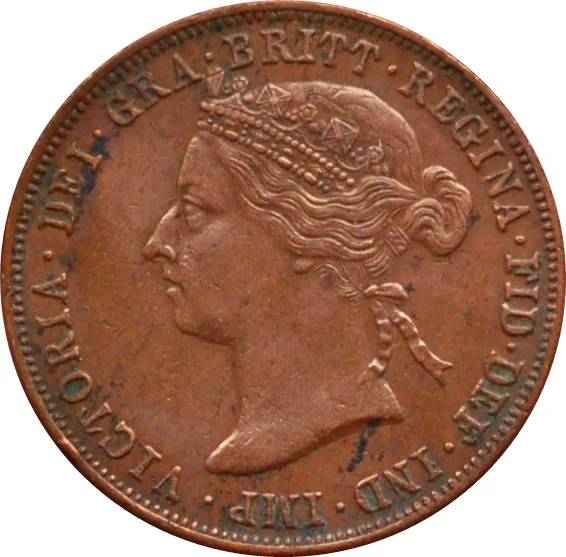
Portrait of Queen Victoria.
Inscription:
VICTORIA·DEI·GRA·BRITT·REGINA·FID·DEF·IND·IMP
Script: Latin
Engraver: Leonard Charles Wyon
Designer: William Theed
Reverse
Edge
Plain
Mints
| Name | Mark |
|---|---|
| Mumbai / Bombay | — |
Mintings
| Year | Mint Mark | Mintage | Quality | Collection |
|---|---|---|---|---|
| 1897 | — | 640,000 | ||
| 1897 | — | — | Proof | |
| 1898 | — | 6,400,000 | ||
| 1898 | — | — | Proof | |
| 1899 | — | — | Proof | |
| 1899 | — | 3,200,000 |
Historical background
In 1897, the currency landscape of East Africa was a complex mosaic of indigenous, regional, and imperial systems, reflecting the area's transition from pre-colonial trade networks to formal colonial economies. The dominant local mediums were the Maria Theresa thaler (a silver coin minted in Austria) along the coast and caravan routes, and cowrie shells in many interior markets. These coexisted with a variety of cloth currencies, copper wires, and barter goods like salt and ivory. Meanwhile, the Indian rupee, backed by British authority, was making significant inroads, particularly in the British East Africa Protectorate (modern Kenya) and the Uganda Protectorate, where it was used for government transactions and trade with the Indian merchant community.
This monetary plurality was a direct result of competing colonial spheres of influence. The German East Africa Company administered Tanganyika (mainland Tanzania), where the German rupee was the official currency, though the Maria Theresa thaler remained stubbornly popular. In British territories, the Imperial British East Africa Company had initially issued its own copper and silver coins (the Pice, Anna, and Rupee) in the early 1890s, but by 1897 the British government was asserting direct control and standardizing the Indian rupee as the sole legal tender. This created a fractured zone where borders were often meaningless to currency flows, complicating regional trade.
The situation was inherently unstable, marked by chronic shortages of official coinage, fluctuating exchange rates between the various silver coins, and widespread counterfeiting. Colonial administrations viewed this monetary chaos as an obstacle to efficient taxation, labour payment, and the creation of cash-crop economies. Consequently, 1897 fell within a period of intense monetary reform, as both British and German authorities worked to demonetize traditional currencies and enforce their own uniform systems, a process that was as much about political control and economic extraction as it was about financial modernization.
This monetary plurality was a direct result of competing colonial spheres of influence. The German East Africa Company administered Tanganyika (mainland Tanzania), where the German rupee was the official currency, though the Maria Theresa thaler remained stubbornly popular. In British territories, the Imperial British East Africa Company had initially issued its own copper and silver coins (the Pice, Anna, and Rupee) in the early 1890s, but by 1897 the British government was asserting direct control and standardizing the Indian rupee as the sole legal tender. This created a fractured zone where borders were often meaningless to currency flows, complicating regional trade.
The situation was inherently unstable, marked by chronic shortages of official coinage, fluctuating exchange rates between the various silver coins, and widespread counterfeiting. Colonial administrations viewed this monetary chaos as an obstacle to efficient taxation, labour payment, and the creation of cash-crop economies. Consequently, 1897 fell within a period of intense monetary reform, as both British and German authorities worked to demonetize traditional currencies and enforce their own uniform systems, a process that was as much about political control and economic extraction as it was about financial modernization.
🌱 Fairly Common