

10 centesimi – Italy
Add to wishlist
Italy
Context
Years: 1862–1867
Issuer: Italy
Ruler: Vittorio Emanuele II
Currency:
(1861—2001)
Demonetized: Yes
Total mintage: 402,000,000
Material
References
KM: #
Numista: #726
Value
Exchange value: 0.10 ITL
Obverse
Description:
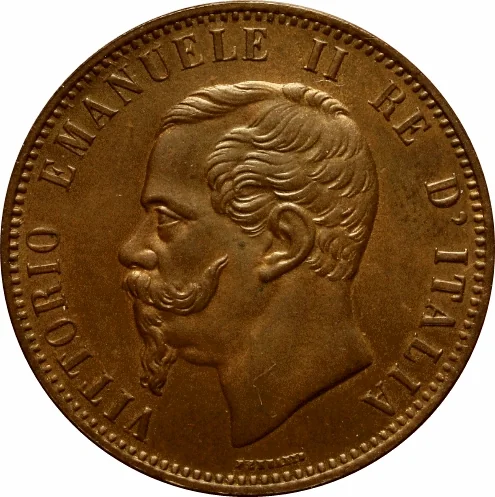
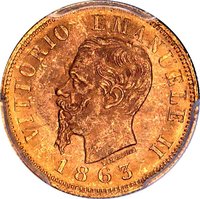
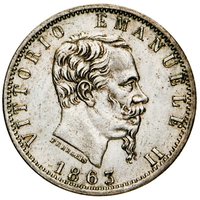
Head of King Vittorio Emanuele II left; engraver's name below neck.
Inscription:
VITTORIO EMANUELE II RE D'ITALIA
FERRARIS
FERRARIS
Translation:
Victor Emmanuel II King of Italy
Ferraris
Ferraris
Script: Latin
Language: Italian
Engraver: Giuseppe Ferraris
Reverse
Description:
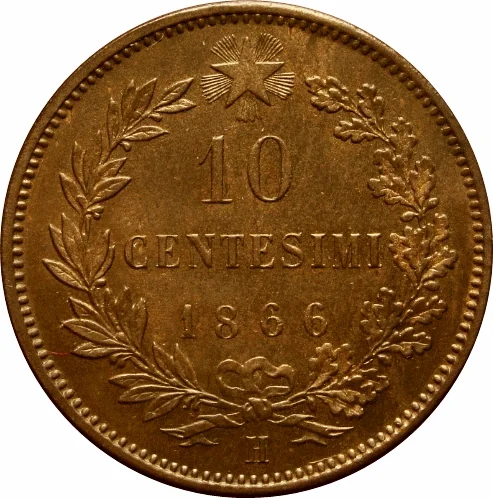
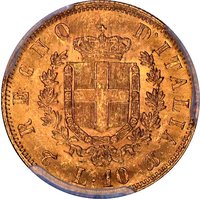
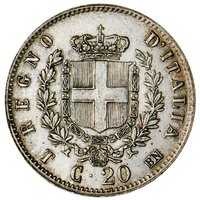
Value and date within laurel and oak branches, with Italy's star above and mint mark below.
Inscription:
10
CENTESIMI
1866
H
CENTESIMI
1866
H
Script: Latin
Engraver: Giuseppe Ferraris
Edge
Plain
Mints
| Name | Mark |
|---|---|
| Monnaie de Paris | — |
| Strasbourg | .OM |
| Royal Mint of Belgium | .OM. |
| Heaton and Sons / The Mint Birmingham | H |
| Milan | M |
| Naples | N |
| Monnaie de Paris | OM |
| Turin | T |
Mintings
Historical background
In 1862, Italy was grappling with the profound monetary complexities of unification. The peninsula, newly unified under the Kingdom of Italy in 1861, inherited a patchwork of at least eight different currency systems from its predecessor states. These included the Piedmontese lira, the Tuscan fiorino, the Papal scudo, and the Neapolitan ducat, each with varying metallic compositions and exchange rates. This fragmentation severely hindered domestic trade, economic planning, and the very idea of a unified national market, creating an urgent administrative and symbolic need for a single, national currency.
The government, led by Prime Minister Urbano Rattazzi and Finance Minister Quintino Sella, took decisive action. On August 24, 1862, the Legge sul corso forzoso (Law on Inconvertible Paper Money) was passed. This pivotal legislation established the lira as the sole legal tender of the Kingdom, based on a bimetallic standard of gold and silver. Crucially, it also authorized the issuance of inconvertible paper money, meaning banknotes could not be directly exchanged for precious metal on demand. This move was a practical necessity to finance the state's substantial debts from the wars of unification and to fund ongoing development, but it immediately placed the new lira on a shaky, fiduciary foundation.
Consequently, the Italian economy in 1862 operated under a dual system: an official bimetallic lira and a growing circulation of paper money that was legally mandated but not backed by specie. While this successfully began the process of monetary unification, it also sowed the seeds for future instability, including inflation and a divergence between the face value of paper currency and its real metallic worth. Thus, the year represents a critical juncture—the birth of a national currency, but one born from financial necessity and immediately burdened with the challenges of managing a forced circulation.
The government, led by Prime Minister Urbano Rattazzi and Finance Minister Quintino Sella, took decisive action. On August 24, 1862, the Legge sul corso forzoso (Law on Inconvertible Paper Money) was passed. This pivotal legislation established the lira as the sole legal tender of the Kingdom, based on a bimetallic standard of gold and silver. Crucially, it also authorized the issuance of inconvertible paper money, meaning banknotes could not be directly exchanged for precious metal on demand. This move was a practical necessity to finance the state's substantial debts from the wars of unification and to fund ongoing development, but it immediately placed the new lira on a shaky, fiduciary foundation.
Consequently, the Italian economy in 1862 operated under a dual system: an official bimetallic lira and a growing circulation of paper money that was legally mandated but not backed by specie. While this successfully began the process of monetary unification, it also sowed the seeds for future instability, including inflation and a divergence between the face value of paper currency and its real metallic worth. Thus, the year represents a critical juncture—the birth of a national currency, but one born from financial necessity and immediately burdened with the challenges of managing a forced circulation.
🌱 Very Common